semi合集-English.pdf - 第3496页
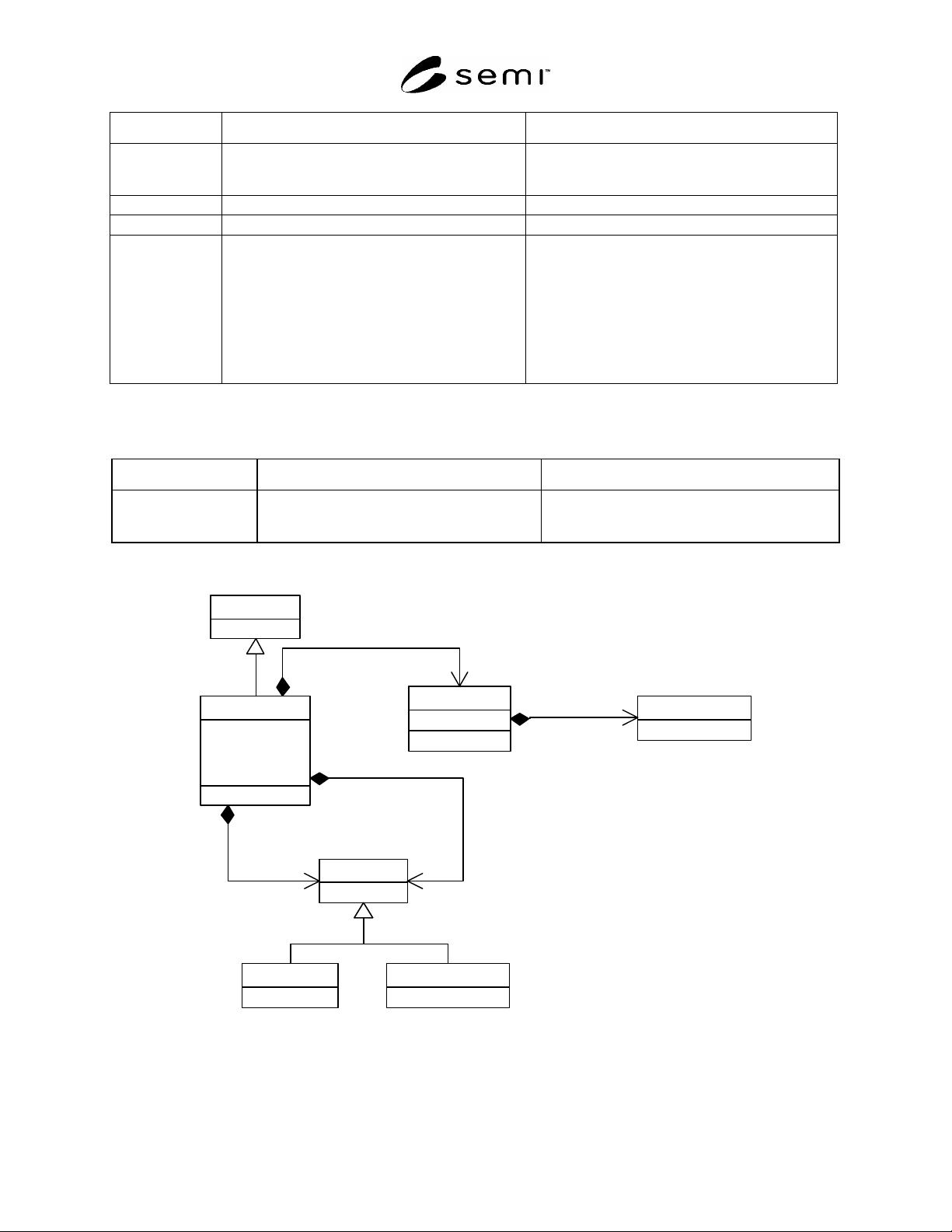
SEMI E134-0305 © SEMI 2004, 2005 49 14.1.5.1 Figure 27 shows how to represent a trace report. A si ngle trace report can include one or more collected results, and each result includes the va lues of a set of param eters…
SEMI E134-0305 © SEMI 2004, 2005 48
Attribute Name Definition Form
exceptionId The identifier of the exception. Text, formatted according to the convention used for
identifying an exception (see Limitations, Section
3.1.1).
exceptionTime The time at which the exception was detected. Text, formatted according to Section 14.5.
severity The severity of the exception. Text. Allowable values are supplier-defined.
state The state of the exception, if applicable. Text. For exceptions corresponding to E30 alarms,
valid values are:
“urn:semi-org:E30:alarmSet”
“urn:semi-org:E30:alarmClear”
If the exception has no associated state, this field shall
be empty.
14.1.4.2 ExceptionReport Association Definition Table
Table 60 ExceptionReport Association Definition
Association Role Name Definition Comments
parameterValues The parameters requested for this exception. Ordered list of zero or more parameter values (see
Section 14.2). Parameters are positioned in an
order specified by the supplier.
14.1.5 Trace Reports
traceId
startTriggerTime
stopTriggerTime
reportTime
TraceReport
collectionTime
CollectedData
ParameterValue
1
traceRes ults1..*
1
parameterValues
1..*
Report
Trigger
EventTrigger ExceptionTrigger
startTrigger
1
0..1
1
stopTrigger
0..1
{ordered}
{ordered}
Figure 27
Trace Reports
SEMI E134-0305 © SEMI 2004, 2005 49
14.1.5.1 Figure 27 shows how to represent a trace report. A single trace report can include one or more collected
results, and each result includes the values of a set of parameters, appearing in the order specified in the DCP’s
TraceRequest.
14.1.5.1.1 More than one result is included in a trace report if and only if the DCP has specified that the equipment
should buffer collected data for the trace before reporting (that is, the ‘groupSize’ attribute of the TraceRequest class
is > 1).
14.1.5.1.2 If the trace request included start- and/or stop-triggers, the TraceReport includes the trigger that
started/stopped the trace, and the time at which the trigger was detected. These are only required to be provided in
the first TraceReport immediately following the detection of a start or stop trigger.
14.1.5.1.3 TraceReport — Represents an individual trace report that has obtained one or more collection results. A
trace report has a unique identifier within the scope of the DCP, and may have been started and stopped by specific
triggers, if requested in the DCP. Each of these identifiers, triggers, and associated timestamps is included in the
trace report.
14.1.5.1.4 TraceReport Attribute Definition Table
Table 61 TraceReport Attribute Definition
Attribute Name Definition Form
traceId The unique id of this trace report, as specified in
the DCP.
Integer.
startTriggerTime The time at which the trace start trigger was
detected.
Text, formatted according to Section 14.5.
stopTriggerTime The time at which the trace stop trigger was
detected.
Text, formatted according to Section 14.5.
reportTime The time at which the report creation was
completed.
Text, formatted according to Section 14.5.
14.1.5.2 TraceReport Association Definition Table
Table 62 TraceReport Association Definition
Association Role Name Definition Comments
traceResults A list of data collected for this trace
report.
Ordered list of one or more elements of type CollectedData,
appearing in the order of each result’s start time (see Section
14.1.5.2.1). Must contain no more than ‘groupSize’ entries if
‘groupSize’ is > 1.
startTrigger The trigger that initiated the trace Zero or one element of any type derived from Trigger (see
Section 11.1.6). Only required to be provided with the first
TraceReport to be sent after the trigger was detected.
stopTrigger The trigger that stopped the trace Zero or one element of any type derived from Trigger (see
Section 11.1.6). Only required to be provided with the first
TraceReport to be sent after the trigger was detected.
14.1.5.2.1 CollectedData — Represents the results of the collection of the values of one or more parameters. A
data collection result has a collection time corresponding to when the equipment began collecting the associated data
values.
14.1.5.2.2 CollectedData Attribute Definition Table
Table 63 CollectedData Attribute Definition
Attribute Name Definition Form
collectionTime The time at which the DCP began collecting the
values of the parameters requested for this trace.
Text, formatted according to Section 14.5.
SEMI E134-0305 © SEMI 2004, 2005 50
14.1.5.3 CollectedData Association Definition Table
Table 64 CollectedData Association Definition
Association Role Name Definition Comments
parameterValues The parameters requested for this
trace.
Ordered list of elements of type ParameterValue, described in
Section 14.2. ParameterValues appear in the order specified in
the original TraceRequest in the corresponding DCP.
14.2 Parameter Values
IntegerValue RealValue BooleanValue String Valu e
BinaryValue
EnumeratedIntegerValue
EnumeratedStringValue
ArrayValue
StructureValue
ParameterValue Ab stractValue
1
value
1
reasonCode
desc ript ion
NoValue
ValueNotAvailable
NoSuc hSource
NoSuc hParameter
«enumeration»
NoValu eReasonEnum
Figure 28
Parameter Values
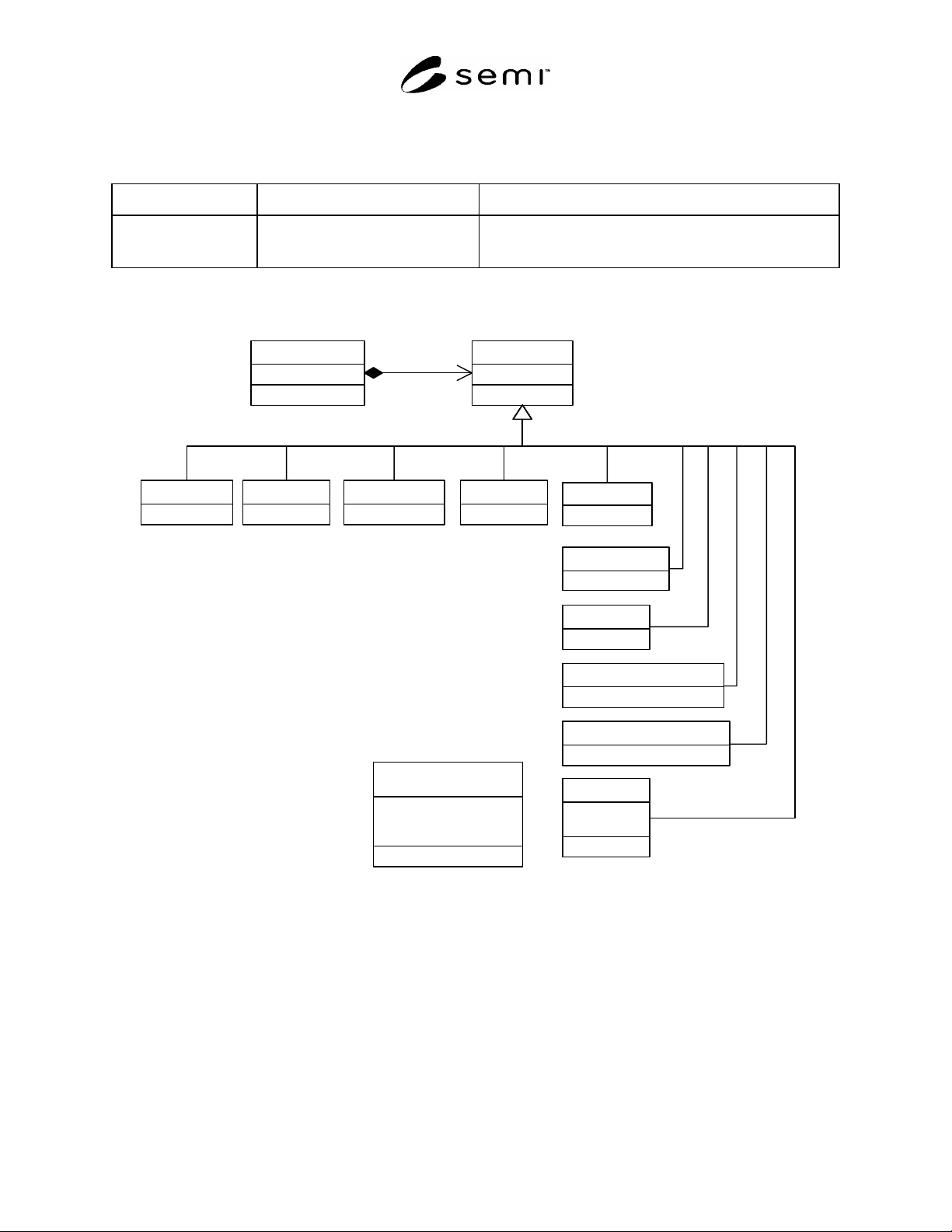
14.2.1 Figure 28 shows how to represent a given data value corresponding to the specific parameters requested for
an event or trace report in a DCP, or as a response to the GetParameterValues operation described in Section 9.1.2.9.
14.2.1.1 ParameterValue — Represents a data value originating from a specific source. For example, the
temperature from a specific processing chamber, a measurement or test result variable, the value of an E39-based
object attribute, etc.