semi合集-English.pdf - 第6721页
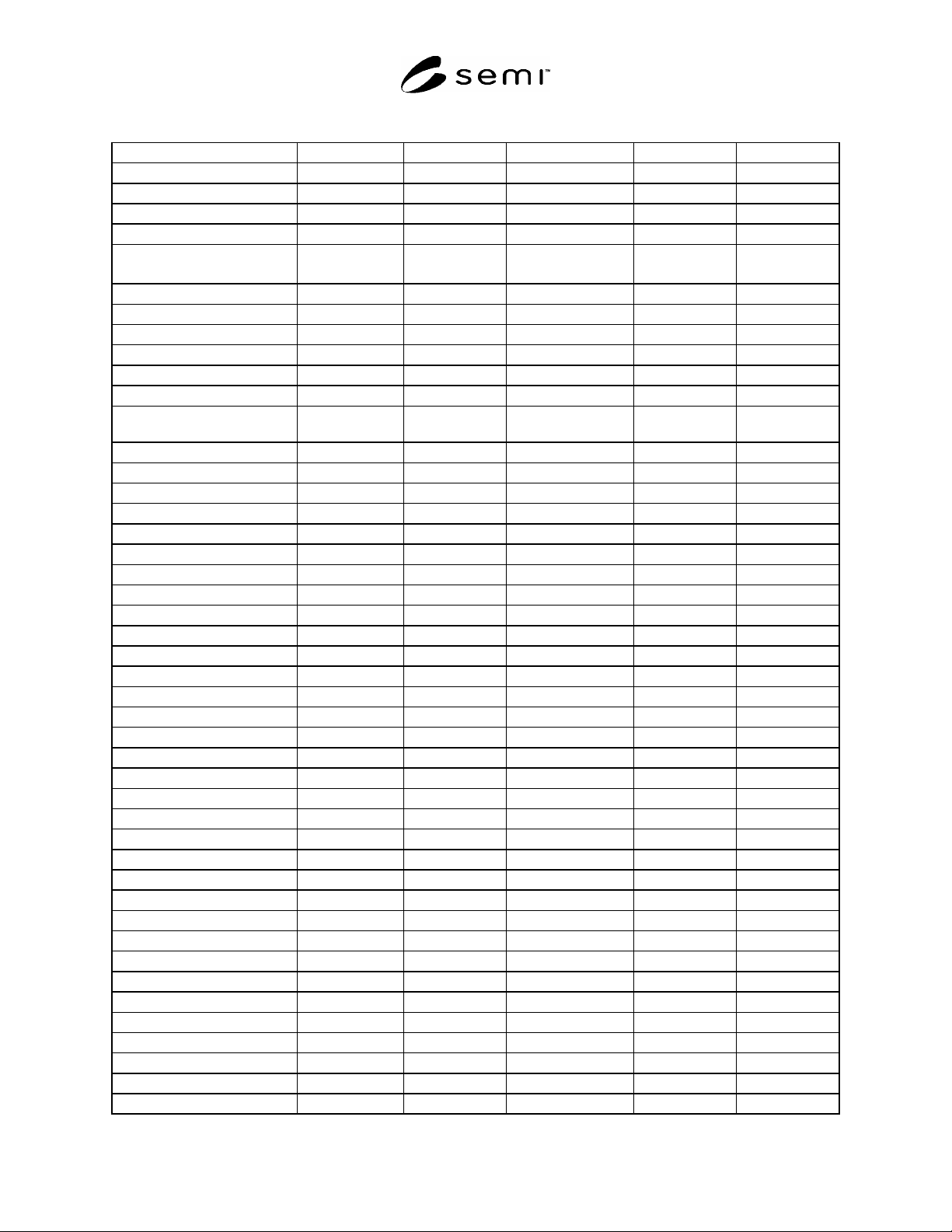
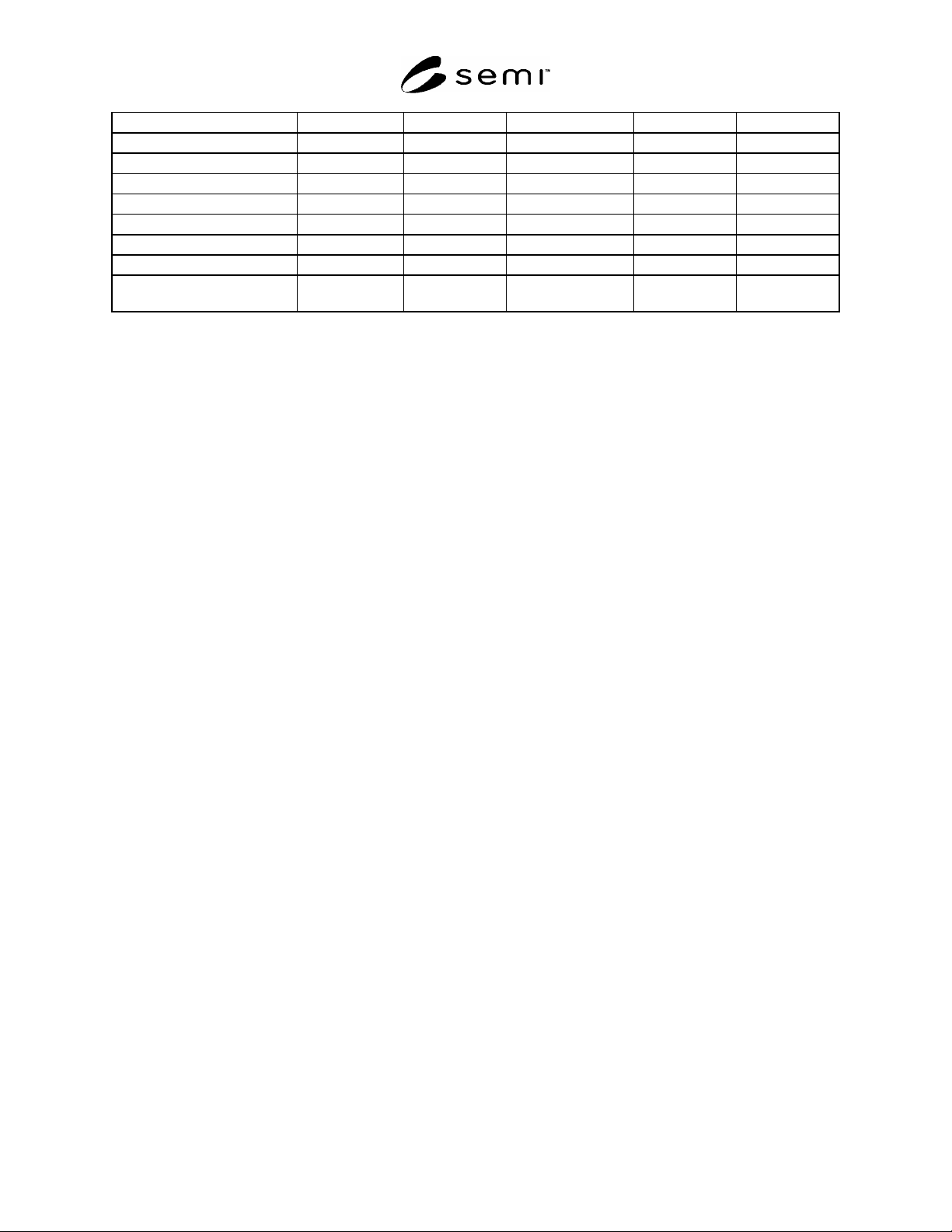
SEMI C41-0705 © SEMI 1978, 2005 8 Strontium (Sr) - 10 ppb max 0.01 ppm max - - Tantalum (Ta) - 10 ppb max - - - Thallium (Tl) - 10 ppb max 0.01 ppm max - - Tin (Sn) 0.1 ppm max 10 ppb max 0.02 ppm max 1 ppb max 100 ppt m…
SEMI C41-0705 © SEMI 1978, 2005 7
Table 1 Impurity Limits and Other Requirements for 2-Propanol
Previous SEMI Reference # C1.15-96 C7.7-93 C11.7-0698 C8.7-92 -
Grade 1 Grade 2 VLSI Grade Grade 3 Grade 4
(Specification) (Specification) (Guideline) (Specification) (Specification)
Assay (CH
3
CHOHCH
3
) 99.5% min 99.8% min 99.7% min 99.8% min 99.8% min
Color (APHA) 10 max 10 max 10 max 10 max 10 max
Residue after Evaporation 5 ppm max 5 ppm max
5 ppm max 5 ppm max
5 ppm max
Resistivity - - 15 MegOhm cm min - -
Solubility in Water To pass test - - - -
Chloride (Cl) 0.2 ppm max 200 ppb max 0.2 ppm max 50 ppb max 50 ppb max
Nitrate (NO
3
) - - - 50 ppb max 50 ppb max
Phosphate (PO
4
) 0.5 ppm max 500 ppb max 0.5 ppm max 50 ppb max 50 ppb max
Sulfate (SO
4
) - - 1 ppm max 50 ppb max 50 ppb max
Aldehydes and Ketones (as
CH
3
COCH
3
)
- - 100 ppm max - -
Water (H
2
O) 0.05% max 0.05% max 0.05% max 0.05% max 0.05% max
Acidity 0.2 µeq/g max - 0.2 µeq/g max - -
Alkalinity 0.1 µeq/g max - 0.1 µeq/g max - -
Aluminum (Al) 0.1 ppm max 10 ppb max 0.05 ppm max 1 ppb max 100 ppt max
Antimony (Sb) - - 0.01 ppm max 1 ppb max 100 ppt max
Arsenic (As) - - 0.01 ppm max 1 ppb max 100 ppt max
Arsenic and Antimony (as As) 0.01 ppm max 10 ppb max - - -
Barium (Ba) - 10 ppb max 0.02 ppm max 1 ppb max 100 ppt max
Beryllium (Be) - 10 ppb max 0.01 ppm max - -
Bismuth (Bi) - 10 ppb max 0.02 ppm max - -
Boron (B) 0.01 ppm max 10 ppb max 0.01 ppm max 1 ppb max 100 ppt max
Cadmium (Cd) - 10 ppb max 0.01 ppm max 1 ppb max 100 ppt max
Calcium (Ca) 0.1 ppm max 10 ppb max 0.01 ppm max 1 ppb max 100 ppt max
Chromium (Cr) 0.1 ppm max 10 ppb max 0.01 ppm max 1 ppb max 100 ppt max
Cobalt (Co) - 10 ppb max 0.01 ppm max - -
Copper (Cu) 0.1 ppm max 10 ppb max 0.01 ppm max 1 ppb max 100 ppt max
Gallium (Ga) - 10 ppb max 0.01 ppm max - -
Germanium (Ge) - 10 ppb max - - -
Gold (Au) 0.1 ppm max 5 ppb max 0.02 ppm max - -
Indium (In) - - 0.01 ppm max - -
Iron (Fe) 0.1 ppm max 5 ppb max 0.01 ppm max 1 ppb max 100 ppt max
Lead (Pb) 0.1 ppm max 10 ppb max 0.01 ppm max 1 ppb max 100 ppt max
Lithium (Li) - 10 ppb max 0.01 ppm max 1 ppb max 100 ppt max
Magnesium (Mg) 0.1 ppm max 10 ppb max 0.01 ppm max 1 ppb max 100 ppt max
Manganese (Mn) 0.1 ppm max 10 ppb max 0.01 ppm max 1 ppb max 100 ppt max
Molybdenum (Mo) - 10 ppb max 0.01 ppm max - -
Nickel (Ni) 0.1 ppm max 10 ppb max 0.01 ppm max 1 ppb max 100 ppt max
Niobium (Nb) - 10 ppb max - - -
Platinum (Pt) - - 0.02 ppm max - -
Potassium (K) 0.1 ppm max 10 ppb max 0.01 ppm max 1 ppb max 100 ppt max
Silicon (Si) - - - - -
Silver (Ag) - 5 ppb max 0.01 ppm max - -
Sodium (Na) 0.1 ppm max 10 ppb max 0.1 ppm max 1 ppb max 100 ppt max
SEMI C41-0705 © SEMI 1978, 2005 8
Strontium (Sr) - 10 ppb max 0.01 ppm max - -
Tantalum (Ta) - 10 ppb max - - -
Thallium (Tl) - 10 ppb max 0.01 ppm max - -
Tin (Sn) 0.1 ppm max 10 ppb max 0.02 ppm max 1 ppb max 100 ppt max
Titanium (Ti) 0.1 ppm max 10 ppb max 0.01 ppm max 1 ppb max 100 ppt max
Vanadium (V) - 10 ppb max 0.01 ppm max 1 ppb max 100 ppt max
Zinc (Zn) 0.1 ppm max 10 ppb max 0.01 ppm max 1 ppb max 100 ppt max
Zirconium (Zr) - 10 ppb max 0.01 ppm max - -
Particles in bottles (size,
#/mL)
#1 #1 #1 #1 #1
#1
Due to the limitations of current particle counters, particle size and number are to be agreed upon between supplier and user. See SEMI C1,
‘Calibration and Measurement Method for Particles in Liquids’.
#2
Residue after Evaporation - since no new analytical data is available at this time the specification level remains at Grade 2 level.
#3
Water (H
2
O) - since no new analytical data is available at this time the specification level remains at Grade 2 level.
NOTICE: SEMI makes no warranties or representations as to the suitability of the standards set forth herein for any
particular application. The determination of the suitability of the standard is solely the responsibility of the user.
Users are cautioned to refer to manufacturer's instructions, product labels, product data sheets, and other relevant
literature, respecting any materials or equipment mentioned herein. These standards are subject to change without
notice.
By publication of this standard, Semiconductor Equipment and Materials International (SEMI) takes no position
respecting the validity of any patent rights or copyrights asserted in connection with any items mentioned in this
standard. Users of this standard are expressly advised that determination of any such patent rights or copyrights, and
the risk of infringement of such rights are entirely their own responsibility.
Copyright by SEMI® (Semiconductor Equipment and Materials
International), 3081 Zanker Road, San Jose, CA 95134. Reproduction of
the contents in whole or in part is forbidden without express written
consent of SEMI.
SODIUM HYDROXIDE PELLETS SEMI C42-0699 © SEMI 1978, 19991
SEMI C42-0699
SPECIFICATION FOR SODIUM HYDROXIDE PELLETS
This specification was technically approved by the Global Process Chemicals Committee and is the direct
responsibility of the North American Process Chemicals Committee. Current edition approved by the North
American Regional Standards Committee on April 23, 1999. Initially available on SEMI OnLine May 1999;
to be published June 1999. This document replaces SEMI C1.22 in its entirety. Originally published in
1978.
1 Purpose
1.1 The purpose of this document is to standardize
requirements for sodium hydroxide pellets used in the
semiconductor industry and testing procedures to
support those standards. Test methods have been shown
to give statistically valid results. This document also
provides guidelines for grades of sodium hydroxide
pellets for which a need has been identified. In the case
of the guidelines, the test methods may not have been
statistically validated yet.
2 Scope
2.1 The scope of this document is all grades of sodium
hydroxide pellets used in the semiconductor industry.
3 Limitations
3.1 None.
4 Referenced Documents
SEMI C1 — Specifications for Reagents
5 Terminology
5.1 None.
6 Physical Property (for information only)
6.1 Not applicable.
7 Requirements
7.1 The requirements for sodium hydroxide pellets for
Grade 1 are listed in Table 1.
8 Grade 1 Procedures
8.1 Assay — Weigh accurately 35 to 40 g of sample in
a closed weighing bottle. Transfer to a 500 mL
volumetric flask, dissolve with carbon dioxide-free
water, cool to 25°C, dilute to the mark with carbon
dioxide-free water, and mix thoroughly. Transfer 25
mL of this solution to a 500 mL glass-stoppered flask,
dilute with 175 mL of carbon dioxide-free water, add 5
mL of barium chloride reagent solution, shake, and
allow to stand for five minutes. Add 0.15 mL of
phenolphthalein indicator solution and titrate with 1 N
hydrochloric acid. (Save this solution for the sodium
carbonate test.)
%Assay
=
mL
×
N
of HCl
×
80.0
0
Weight of sample g
(
)
8.2 Sodium Carbonate (Na
2
CO
3
) — To the above
titrated solution, add 0.15 mL of methyl orange
indicator and continue the titration with 1 N
hydrochloric acid, making sure that no insoluble
carbonate remains. The additional hydrochloric acid is
equivalent to that consumed by the sodium carbonate.
% Na
2
CO
3
=
mL
×
N
of HCl
×
106.00
Weight of sample g
(
)
8.3 Ammonium Hydroxide Precipitate — Weigh 10 g
of sample and dissolve in about 100 mL of water.
Cautiously add 15 mL of sulfuric acid to 15 mL of
water, cool; then cautiously add the mixture to the
solution of the sample, and evaporate to dense fumes.
Cool, dissolve the residue in 130 mL of hot water, and
add ammonium hydroxide until the solution is just basic
to methyl red. Heat to boiling, filter, wash with hot
water, and ignite. The weight of the residue should not
exceed 2 mg.
8.4 Insoluble Matter — Dissolve 50 g of sample in
250 mL of carbon dioxide-free water in a 500 mL
stoppered flask and cool to 25° C. The solution should
be clear and colorless. Filter through a tared, medium-
porosity filtering crucible and wash thoroughly with hot
water. Dry at 105° C for 1 hour, cool, and weigh the
residue. The result of the residue should not exceed 2.5
mg.
8.5 Stock Solution for 8.6-8.11, 8.13-8.14 — Dissolve
50 g of sample in 250 mL of carbon dioxide-free water
and dilute with such water to 500 mL. One mL contains
0.10 g of sample. Store in a plastic container.
8.6 Nitrogen Compounds (as N) — Dilute 20 mL of
the Stock Solution with 50 mL of water in a flask
connected through a spray trap to a condenser, the end
of which dips beneath the surface of 10 mL of 0.1 N
hydrochloric acid. For the standard, take 50 mL of
water in a similar flask, and add 10 mL of the Stock
Solution and 1 mL of the nitrogen standard solution. To
each flask add 0.5 g of aluminum wire in small pieces,
allow to stand for 1 hour, and slowly distill about 35