semi合集-English.pdf - 第2055页
SEMI E54.9-0303 © SEMI 2000, 2003 16 NOTICE: SEMI makes no warranties or representations as to the suitability o f the standard set forth herei n for any pa rticular application. The determination of the suitability o f …
SEMI E54.9-0303 © SEMI 2000, 2003 15
9.4.3 Sensor-BI-TH-EP The presentation of the
Sensor, Binary Input, Threshold type, Endpoint object
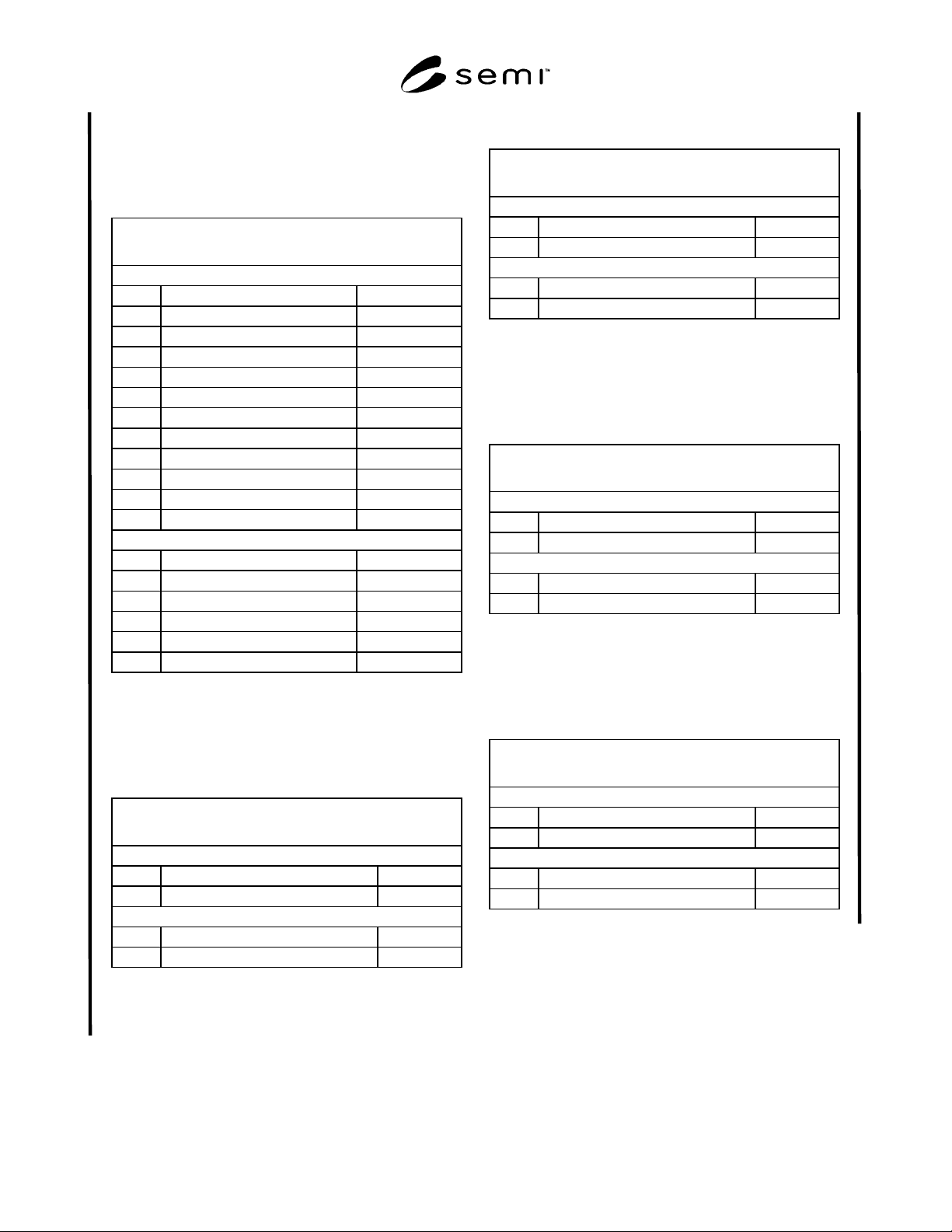
attributes and services is specified in Table 44.
Table 44 Sensor-BI-TH-EP Object Instance
Attributes and Services
Sensor-BI-TH-EP
Class ID = 0150, Instance ID = 0001 - 1024
Attributes
ID Attribute Name SDM Tag
129 Value SbithepA16
130 Reading Valid SbithA64
131 State SbithA65
132 Status SbithA66
133 Minimum Time EpA1
134 Maximum Time EpA2
135 Target Time EpA3
136 Elapsed Time EpA4
137 Time Stamp EpA5
138 Recipe Identifier EpA6
139 Step Identifier EpA7
Services
ID Service Name SDM Tag
129 Endpoint On S1
130 Endpoint Off S2
131 Endpoint Start S3
132 Endpoint Suspend S4
133 Endpoint Resume S5
9.4.4 Assembly-EPD#1 The presentation of the
Assembly #1 Endpoint Device object attributes and
services is specified in Table 45.
Table 45 Assembly-EPD#1 Object Instance
Attributes and Services
Assembly-EPD#1
Class ID = 0151, Instance ID = 0001
Attributes
ID Attribute Name SDM Tag
-- No additional attributes defined --
Services
ID Service Name SDM Tag
-- No additional services defined --
9.4.5 Assembly-EPD#2 The presentation of the
Assembly #2 Endpoint Device object attributes and
services is specified in Table 46.
Table 46 Assembly-EPD#2 Object Instance
Attributes and Services
Assembly-EPD#2
Class ID = 0152, Instance ID = 0001
Attributes
ID Attribute Name SDM Tag
-- No additional attributes defined --
Services
ID Service Name SDM Tag
-- No additional services defined --
9.4.6 Assembly-EPD#3 The presentation of the
Assembly #3 Endpoint Device object attributes and
services is specified in Table 47.
Table 47 Assembly-EPD#3 Object Instance
Attributes and Services
Assembly-EPD#3
Class ID = 0153, Instance ID = 0001
Attributes
ID Attribute Name SDM Tag
-- No additional attributes defined --
Services
ID Service Name SDM Tag
-- No additional services defined --
9.4.7 Assembly-EPD#4 The presentation of the
Assembly #4 Endpoint Device object attributes and
services is specified in Table 48.
Table 48 Assembly-EPD#4 Object Instance
Attributes and Services
Assembly-EPD#4
Class ID = 0154, Instance ID = 0001
Attributes
ID Attribute Name SDM Tag
-- No additional attributes defined --
Services
ID Service Name SDM Tag
-- No additional services defined --

SEMI E54.9-0303 © SEMI 2000, 2003 16
NOTICE: SEMI makes no warranties or
representations as to the suitability of the standard set
forth herein for any particular application. The
determination of the suitability of the standard is solely
the responsibility of the user. Users are cautioned to
refer to manufacturer’s instructions, product labels,
product data sheets, and other relevant literature
respecting any materials mentioned herein. These
standards are subject to change without notice.
The user’s attention is called to the possibility that
compliance with this standard may require use of copy-
righted material or of an invention covered by patent
rights. By publication of this standard, SEMI takes no
position respecting the validity of any patent rights or
copyrights asserted in connection with any item
mentioned in this standard. Users of this standard are
expressly advised that determination of any such patent
rights or copyrights, and the risk of infringement of
such rights, are entirely their own responsibility.
Copyright by SEMI® (Semiconductor Equipment and Materials
International), 3081 Zanker Road, San Jose, CA 95134. Reproduction o
f
the contents in whole or in part is forbidden without express written
consent of SEMI.

SEMI E54.10-0600 © SEMI 20001
SEMI E54.10-0600
SPECIFICATION FOR SENSOR/ACTUATOR NETWORK SPECIFIC
DEVICE MODEL FOR AN IN-SITU PARTICLE MONITOR DEVICE
This specification was technically approved by the Global Information & Control Committee and is the direct
responsibility of the North American Information & Control Committee. Current edition approved by the
North American Regional Standards Committee on March 2, 2000. Initially available at www.semi.org May
2000; to be published June 2000.
1 Purpose
1.1 This specification is part of a suite of standards
that specify the implementation of SEMI standards for
the Sensor/Actuator Network. The specific purpose of
this specification is to describe a network independent
application model comprised of device objects that are
common to all In-Situ Particle Monitor Devices on a
semiconductor equipment Sensor/Actuator communica-
tions network.
2 Scope
2.1 An In-Situ Particle Monitor (ISPM) is a device
that measures and counts particles. These devices clas-
sify by size and count, particles in the environment
(gaseous, liquid, or vacuum) utilizing a technique such
as detecting light from a sample region of the environ-
ment’s space. These counts are accumulated in bins and
then reported. The number of bins varies by vendor and
model.
2.2 This specification specifically addresses the
minimum attributes, services, and behavior an In-Situ
Particle Monitor (ISPM) device must support to be
interoperable on the Sensor/Actuator Network.
2.3 This specification is intended to ensure a high-
degree of device interoperability on the Sensor/Actuator
Network, while still allowing flexibility for product
differentiation and technology evolution.
2.4 The model specified in this specification is used in
conjunction with SEMI E54.1 (Standard for Sensor/
Actuator Network Common Device Model (CDM)) to
completely describe the ISPM as it appears from the
network interface.
2.5 This specification, together with SEMI E54, SEMI
E54.1, and one of the Sensor/Actuator Network
Communication Specifications, form a complete
interoperability specification for the ISPM.
2.6 To comply with this specification, a device must
implement and support, at a minimum, the required
attributes, services, and behavior identified in these
documents. Support for optional attributes, services,
and behavior is not required to be compliant to this
specification. Optional attributes, services, and behavior
are specified in these documents to promote further
device interoperability as features evolve and are
adopted by more manufacturers. If optional attributes,
services, and behavior are implemented for this device
they must be implemented as identified in this
document.
2.7 This specification does not purport to address
safety issues, if any, associated with its use. It is the
responsibility of the users of this specification to estab-
lish appropriate safety and health practices and deter-
mine the applicability of regulatory limitations prior to
use.
3 Limitations
3.1 This specification is a companion to a suite of spe-
cifications that together make up the Sensor/Actuator
Network Communication standard. Therefore, using
portions of this specification that relate to network
communications necessarily requires an understanding
of the associated network specification.
3.2 As this document is a specification for the In-Situ
Particle Monitor Device Model, it does not contain any
definition of objects, attributes, services, or behavioral
descriptions that are already defined in SEMI E54.1.
Additional attributes, attribute assignments, services,
and/or service parameters that are ISPM Device speci-
fic and/or implementation specific are contained in this
specification.
3.3 While this specification is sufficient to completely
describe the ISPM as it appears from the network, it
does not fully describe behavior of the ISPM which is
not visible from the network. This allows flexibility in
implementation techniques and product differentiation
between manufacturers. Manufacturer specific objects
may be defined by the manufacturer but are, by
definition, outside the scope of this standard.
3.4 This specification is compatible, but not compliant
with SEMI E39. This means that although this
specification does not require compliance with SEMI
E39, it is extensible such that implementations may be
developed that are fully compliant with both standards.
Note that the concepts and terminology of this
specification are compatible with those of SEMI E39.
However, SEMI E39 has specific requirements that are