semi合集-English.pdf - 第6589页
SEMI C1-0705 © SEMI 1978, 2005 15 and, using gloves, pressing it around the base of an 800 mL beaker. The balance is a semi-micro type, and t h e static electricity el iminator ma y be obtained from suppl y houses. Figur…

SEMI C1-0705 © SEMI 1978, 2005 14
reagent. The efficient mass transfer associated with wide bore capillary columns may necessitate initial column
temperatures to be more than 20°C below the boiling point of the reagent of interest. Temperature programming
may be used to improve the shape of eluting peaks and to shorten analysis times. The remaining two heated zones
(injector and detector) should be maintained at as low a temperature as possible to lessen thermal decomposition
effects. Typically, for the injector this is 50°C above the boiling point of the material of interest; the detector is held
25°C above the highest temperature reached by the column, but never less than 100°C. The split or splitless mode
of injection can be used depending on the chromatographic equipment available. The use of a wide bore capillary
column simplifies conversion of a packed column to a capillary instrument.
7.2.5 Detector — Use of a thermal conductivity detector minimizes the need to correct for detector response to
differences in liquid chemical composition and is usually sufficient for determining reagent assay. To qualify trace
impurities, the more sensitive flame ionization detector is recommended. The detector output, after amplification, is
used to produce the chromatogram, a plot of component quantity versus elution time. Modern systems digitize the
analog output, allowing direct printout of peak areas and retention times.
7.2.6 Calculation of Results — Results from a chromatogram, used to determine the assay of a reagent, are
expressed in area percent normalized to 100%. A response factor correction for each component is required for the
most accurate results, especially when the sample components differ markedly in their detector response. An
internal standard reduces error due to variations in injection quantities, column, and detector conditions. The use of
control charts, to aid the analyst in visualizing chromatographic variability, is suggested. To verify that assay results
are valid, use of a system suitability test is recommended.
7.3 Color
7.3.1 Color (APHA) — For the rapid assessment of “colorless” liquids for contamination by colored materials,
visual comparison with platinum-cobalt solution standards is appropriate, following the methodology of the
American Public Health Association (APHA)
7
established for the evaluation of the color of water.
7.3.2 Preparation of Platinum-Cobalt Stock Solution (APHA No. 500) — Dissolve 1.246 g of reagent grade
potassium chloroplatinate, K
2
PtCl
6
, and 1.000 g of cobalt chloride hexahydrate, CoCl
2
• 6H
2
0, in water. Add 100 mL
of reagent grade hydrochloric acid (~37%) and dilute with water to exactly 1,000 mL. Store in a tightly closed
bottle.
7.3.3 General Procedure for “Color (APHA)” Test — For the working standard, dilute one or more suitable
aliquots of the Platinum-Cobalt Stock Solution (APHA No. 500) with water to 100 mL. In 100 mL Nessler tubes,
compare the working standard with an equal volume of the liquid under assessment. View each tube vertically over
a white background. The color of the liquid should not exceed the maximum APHA standard value allowed by the
specification for that liquid. On the dilution to 100 mL, aliquots of the stock standard of 1, 2, 3 . . . mL correspond
to APHA 5, 10, 15, etc.
7.4 Determination of Residue after Evaporation
7.4.1 Introduction — The residue after evaporation is defined as the relative amount of residue remaining after
evaporation of a sample of solvent followed by heating of the residue at 105°C for 30 minutes. Drying to constant
weight is not utilized since protracted heating may lead to slow volatilization of high-boiling matter.
7.4.2 For the determination of the residue after evaporation at the level of 5 parts per million (µg/g) or below,
determinate errors must be kept extremely small and random errors should be minimized. In the procedure given
below, the positive error due to exposure to airborne particulate matter is reduced by the use of the closed system
afforded by the Thiers assembly. Possible negative errors associated with losses caused by transfer of a
concentrated sample or the residue is avoided by effecting the evaporation and weighing in a single dish. The
determinate and random errors associated with the weighing operations are reduced by using an aluminum dish for
most solvents, weighing on a semi-microbalance, eliminating any static electricity, and conducting all heating and
cooling steps in a reproducible manner.
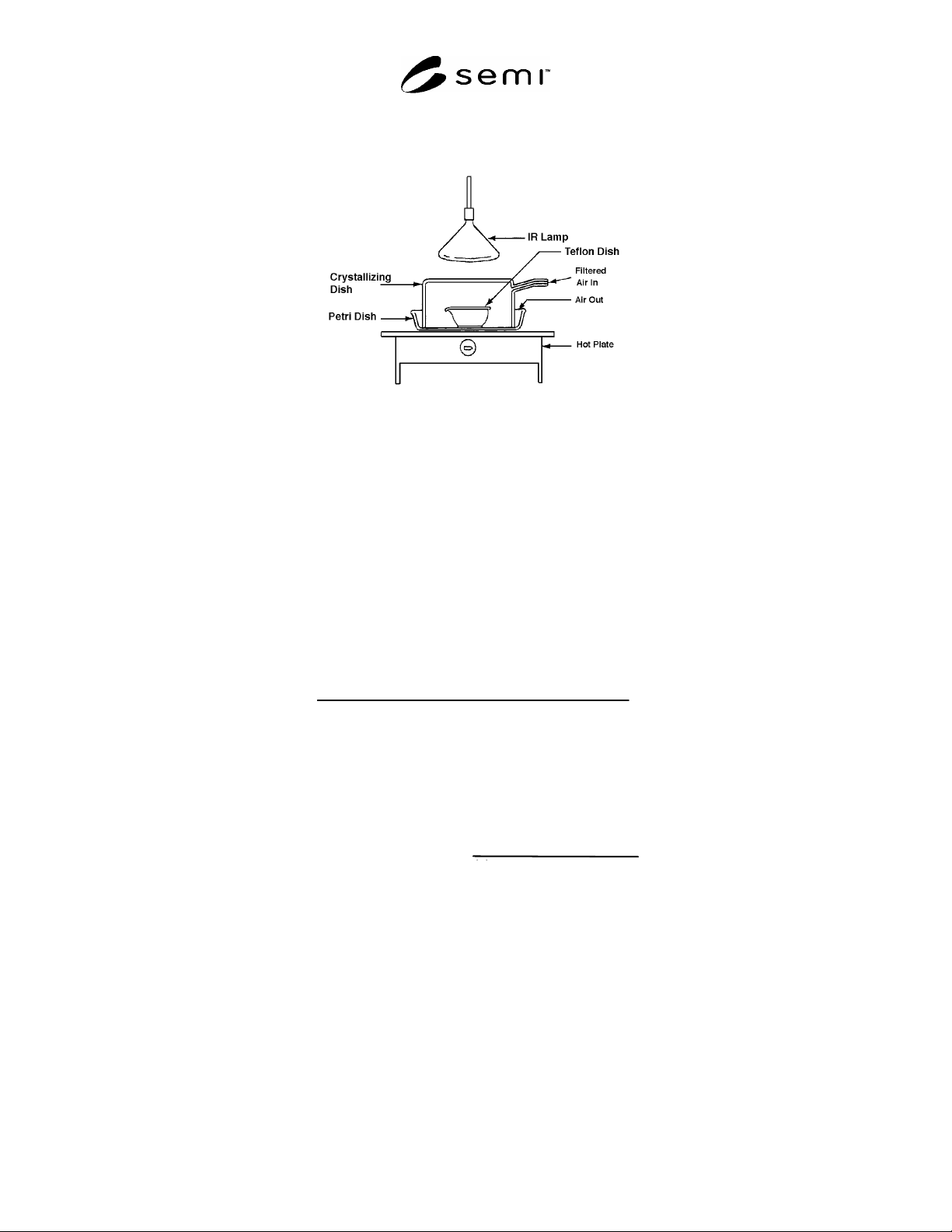
7.4.3 Equipment — The Thiers assembly is fashioned from a crystallizing dish. (See Figure 2.) The aluminum
dishes of 250 mL capacity are prepared by cutting out a 30 cm circle of aluminum foil, rinsing it with the solvent,
7 American Public Health Association, 800 I Street, NW, Washington, DC 20001, Phone: (202) 777-2742, Fax: (202) 777-2534, Website:
http://www.apha.org
SEMI C1-0705 © SEMI 1978, 2005 15
and, using gloves, pressing it around the base of an 800 mL beaker. The balance is a semi-micro type, and the static
electricity eliminator may be obtained from supply houses.
Figure 3
Thiers Assembly
7.4.4 Procedure
7.4.4.1 Rinse the 250 mL aluminum dish (or platinum dish in the case of halogenated solvents) with a portion of the
sample. Heat the dish at 105°C in an oven for 30 min and cool for 30 min (1 hr for platinum) in a desiccator
charged with calcium chloride and placed near the balance. Discharge static electricity using the eliminator and
weigh the dish on a semi-microbalance to the nearest 0.01 mg.
7.4.4.2 Start the flow of filtered nitrogen gas through the side arm of the Thiers assembly and place the dish inside.
Raise the cover briefly to add the specified amount of solvent from a clean, graduated cylinder. Adjust the nitrogen
stream so that the surface of the solvent is barely rippled. Also, adjust the heat lamp and hot plate so that the
evaporation rate does not exceed 8 mL/min and that no sample condenses on the top inner surface of the assembly.
7.4.4.3 When all of the sample has evaporated, heat the dish for 30 min in an oven at 105°C. Cool as given above,
discharge the static electricity, and reweigh. Calculate the residue as mg/mL.
[wt of dish plus residue (g)
-
wt of dish (g)]
10
6
sample wt (g)
For best results, room temperature should be kept constant to ± 5°C.
7.5 Residue after Ignition — A “residue after ignition” test serves to assess the amount of nonvolatile inorganic
matter present in a sample. Unless otherwise stated, the ignition shall be performed at 800° ± 25°C for 15 minutes.
Where the addition of sulfuric acid is specified, the result corresponds to what is often termed “sulfated ash.” The
calculation of the result, expressed in parts per million (µg/g), takes the form:
ppm Residue after Ignition
=
Net weight of residue
()
10
Weight of sample
6
7.6 Trace Arsenic (and Antimony) Determination
7.6.1 Introduction — This photometric procedure is based upon the color reaction of silver diethyldithiocarbamate
with arsine (and stibine). It provides for measurement of the absorbance of the sample and standards with
subsequent calculation of the arsenic and antimony content of the sample, expressed as arsenic. The procedure
given below differs from conventional ones by the omission of potassium iodide and stannous chloride. By this
omission, antimony is evolved as stibine and reacts with the silver diethyldithiocarbamate solution. The color
development is consequently due to both arsenic and antimony. The test sensitivity for arsenic is greater than for
antimony.
SEMI C1-0705 © SEMI 1978, 2005 16
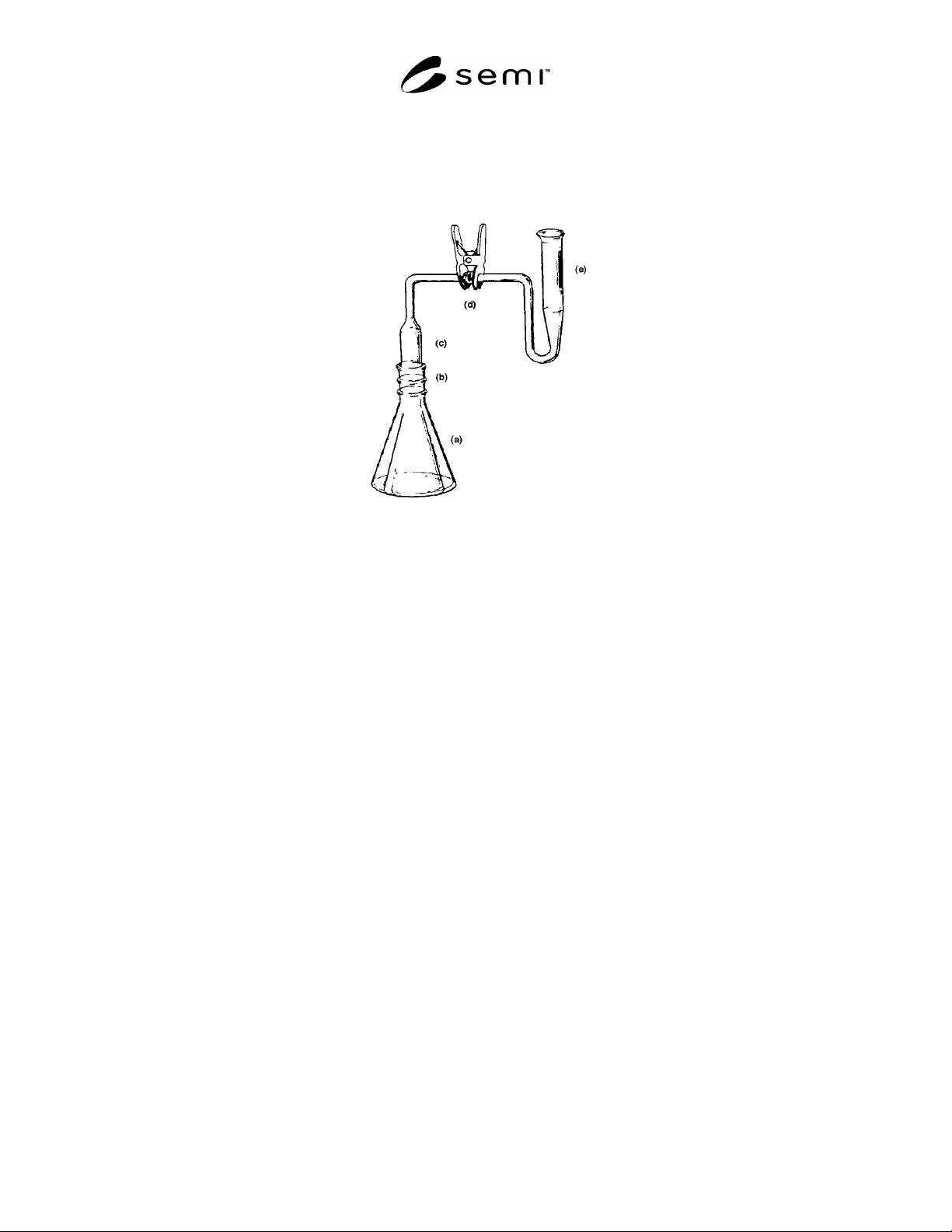
7.6.2 Apparatus — The apparatus (see Figure 3) consists of a 125 mL arsine generator (a) fitted with a scrubber
unit (c) and an absorber tube (e), with a 24/40 standard-taper joint (b) and a ground glass ball-and-socket joint (d),
secured with a No. 12 clamp, connecting the units. In order to insure a more uniform rate of flow of gas into the
absorbing solution, various modifications may be employed, such as the use of a fritted-glass disk sealed into the
tapered end of the absorption tube.
Figure 4
Arsenic Test Apparatus
7.6.3 Reagents
7.6.3.1 Arsenic Stock Solution — (1.00 mg/mL of arsenic) — Transfer 0.66 g of arsenic trioxide to a 500 mL
volumetric flask and dissolve with 5 mL of 50% sodium hydroxide solution. Neutralize with 5 N sulfuric acid, add
an excess of 5 mL, dilute to the mark with water, and mix thoroughly.
7.6.3.2 Arsenic Working Solution — (1.0 µg/mL of arsenic) — Transfer exactly 0.5 mL of the arsenic stock solution
to a 500 mL volumetric flask, and 5 mL of 5 N sulfuric acid, dilute to the mark with water, and mix thoroughly.
Prepare immediately before use.
7.6.3.3 Lead Acetate Solution — Dissolve 10 g of lead acetate trihydrate in 100 mL of water.
7.6.3.4 Silver Diethyldithiocarbamate Solution — Dissolve 1 g of diethyldithiocarbamic acid, silver salt, in 200 mL
of pyridine and filter the solution. (The pyridine is best purified by passage through an alumina column.) Store this
solution in a light-resistant container and use within 1 month. Silver diethyldithiocarbamate as a dry solid is yellow
in color. Discard material that is markedly off color or develops a strong odor; alternatively, recrystallize from 1:1
pyridine-water and dry in vacuo at room temperature.
7.6.4 Sample Solution Preparation — Prepare the sample solution as specified in the procedures for the individual
liquid chemical.
7.6.5 Procedure
7.6.5.1 Treat the sample as described in the procedure for the individual chemical and transfer the resulting solution
to the generator flask. Swirl the flask, add 5 mL of 20% sulfuric acid, and allow to stand at room temperature for 15
minutes.
7.6.5.2 Pack the scrubber tube (c) with two pledgets of lead acetate-impregnated glass wool previously moistened
with lead acetate solution freed from excess solution by squeezing and dried in a vacuum. Allow a small space
between the two pledgets. Place 3.0 mL of silver diethyldithiocarbamate solution in the absorber tube (e), add 3 g of
zinc (granular) to the generator flask (a), and immediately connect the scrubber-absorber assembly to the flask.