semi合集-English.pdf - 第1116页
SEMI E5-1104 © SEMI 1982, 2004 58 10 Message Detail 10.1 Intent — Thi s section defines a num ber of specific funct ions in diffe rent streams which can be used as a basis for communi cation between host and equipm ent. …
SEMI E5-1104 © SEMI 1982, 2004 57
9.8.2 attribute name — A reserved text string, of at most 40 characters, that is unique for that object.
9.8.3 description — A description of the attribute.
9.8.4 access — Indicates whether the attribute may be set through messages. Access is either read-only (RO) or
read-write (RW).
9.8.5 format — Indicates the type of data (format code).
9.8.6 timestamp format — Text form indicating date and time in the format “YYYYMMDDhhmmsscc”.
9.8.7 related data items — Indicates an explicit relationship with a corresponding data item.
9.8.8 value — Specifies any restrictions on the possible values. Examples of restrictions include exclusion of zero
for format 5(), a maximum length for text, a format imposed on text, an order imposed on a list, or an enumerated
set of valid values.
9.8.9 Requirements
The attributes “ObjType” and “ObjID” are required for all object definitions and shall use format 20.
The attribute “ObjType” shall be assigned a fixed value for each object.
The value of “ObjID” may not be changed by using SetAttr (S14F3).
9.8.10 The value of “ObJType” may be used for messages using the data item OBJTYPE. The value of the attribute
“ObjID” may be used for messages using the data item OBJID.
9.8.11 The name of a public attribute may be used for messages using the data item ATTRID. The value of a public
attribute may be used for messages using the data item ATTRDATA.
9.8.12 Variable data items defined in Section 9.7 may be regarded as attributes of the object type “Equipment”,
where SVs and DVVALs are RO and ECVs are RW.
9.9 With the use of Harel
4
state diagrams to describe the behavior of objects, an object’s state must be describable
as a combination of a set of sub-states and concurrent states. The rules for describing the state of an object are: (1)
use the comma (‘,’) to deliminate concurrent states, (2) use the foreslash (‘/’) to delimit a super-state and sub-state,
(3) to deliver the set of lowest level concurrent states, and (4) optionally omit super-state names when there are no
ambiguities in the names of the lowest level states.
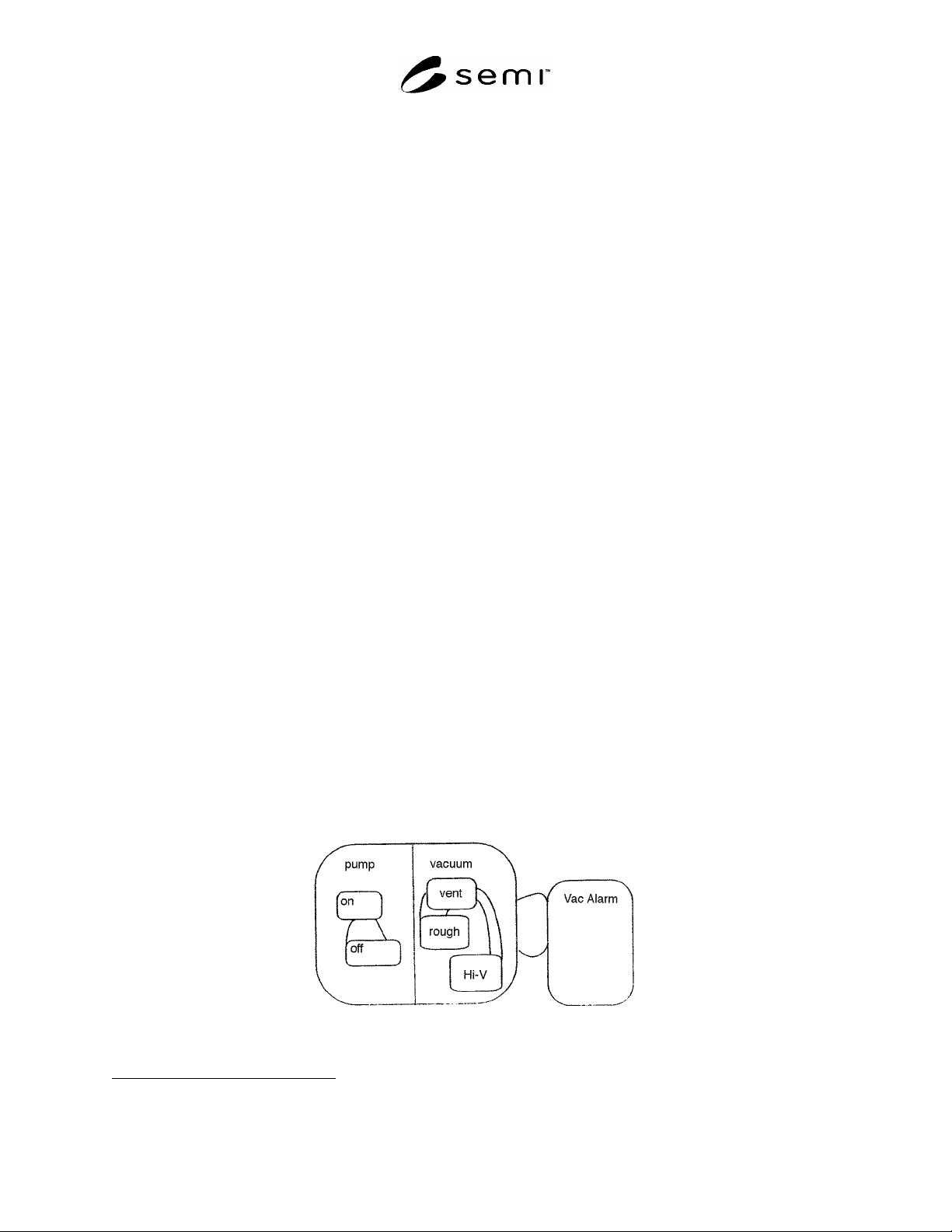
9.9.1 Please refer to Figure 3 in order to follow the discussions for the notations. In Harel notation, ‘pump’ and
‘vacuum’ are concurrent states. The text to specify this relation in a response to a request for state is ‘pump,
vacuum’. The comma can be read as meaning ‘and’. ‘on’ and ‘off’ are sub-states of ‘pump’. ‘vent’, ‘rough’, and
‘Hi-V’ are sub-states of ‘vacuum’. The sub-state syntax is ‘state/sub-state’ where the ‘/’ can be read as ‘is in sub-
state’. So using the example in Figure 3, if the pump is off and the vacuum is vented, then the text message which
conveys this is ‘pump/off, vacuum/vent’. This message can be shortened to ‘off,vent’ because there is no ambiguity
in doing so.
Figure 3
State Chart Example
4 Harel D. “Statecharts: A Visual Formalism for Complex Systems”, Science of Computer Programming, 8, 1987, pp. 231-274. Elsevier Science,
P.O. Box 945, New York, NY 10159-0945, http://www.elvesier.nl/homepage/browse.htt
SEMI E5-1104 © SEMI 1982, 2004 58
10 Message Detail
10.1 Intent — This section defines a number of specific functions in different streams which can be used as a basis
for communication between host and equipment. The functions are defined in the form of transaction message pairs
according to the transaction level requirements specified in Section 8.
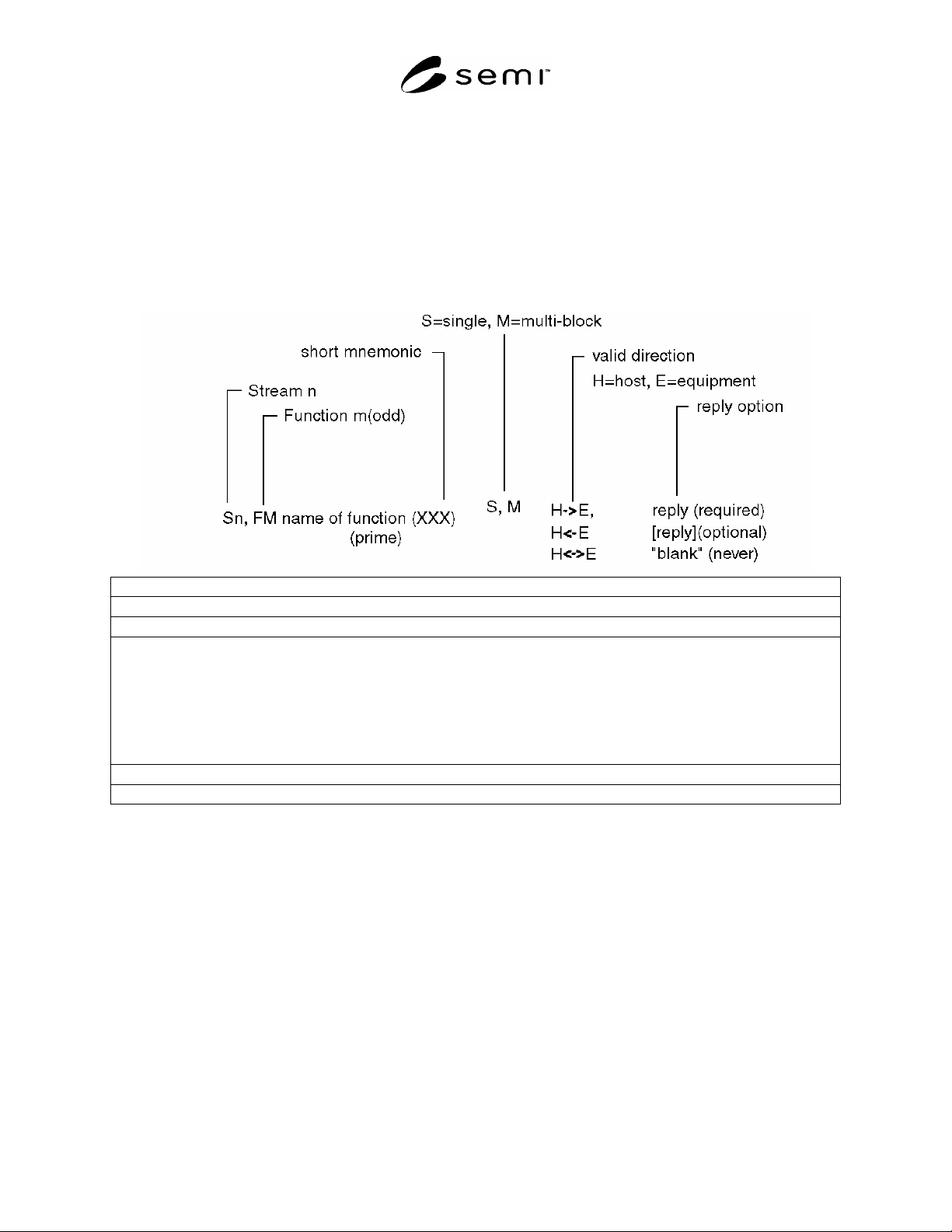
10.2 The functions are described in a standard form which involves specification of the number, name, single or
multiple block, direction of communication, nature of reply required, description, variable definition, and the
detailed structure of the message in terms of lists and items. Double lines separate streams, and single lines separate
transactions to aid readability.
10.2.1 The abbreviations used in each transaction are as follows:
Description
A description of the action generated by the function.
Structure
Detailed structure showing lists and defined items. Lists are denoted by a capital L
followed by the length separated by a comma. The individual elements in the list are
numbered on separate lines. Nested lists are indented to emphasize the structure.
The detailed form of the items is given in the define section at the beginning of the
transaction. The symbols "<" and ">" are used to enclose each item in the structure
data and imply that there is an item header. A detailed description of each data item
as well as a list of the allowable data formats can be found in the Data Item
Dictionary.
Exception
Special cases in the structure that have a different meaning.
Sn,Fm+1 Name of function (same structure as above
(secondary) except never with reply)
10.3 Message Usage — This section discusses message features and where they may be used.
10.3.1 Zero Length Items and Lists — Certain message definitions may use zero length data items and zero length
lists as a technique to convey specific information to the receiver of the message. For commands (i.e., “Do
Something”) and requests (i.e., “Return Some Data”), it may be used to mean “Use default values for the data
item(s) which were not included”. The default may be a specific value or a value chosen by the equipment.
10.3.1.1 For messages reporting data (either responses to requests or asynchronous reports), the technique may be
used to indicate that the desired information is not available or not applicable. In some cases, the fact that data is
unavailable may indicate success or failure of a command.
10.3.1.2 Certain message definitions may define a zero length data item or a zero length list to mean “the
information is not supplied.” The receiving party should react to this lack of information as it deems appropriate.
10.3.2 Compliance to Message Definitions — Any given standard SECS-II message shall comply to the format
shown in the Message Definition for that Stream and Function. Specifically:

SEMI E5-1104 © SEMI 1982, 2004 59
1. The message shall contain all Lists and Data Items shown as required in the Message Definition.
2. The message shall not contain any Lists or Data Items not shown in the Message Definition, unless the Message
Definition specifically allows this.
3. The message shall not contain any List Item or Data Item with zero length unless the Message Definition
specifically defines a meaning for such a zero length item.
10.4 Stream 0 and Function 0 — Stream 0 is always defined as not used since a 0 is the most likely error. No
functions are defined in stream 0.
10.4.1 Function 0 exists in all streams and has the same special meaning in each stream. A function 0 message
closes a transaction, so that the originator will not have to wait for a transaction timeout to proceed. Function 0 is
sent in lieu of the expected secondary message when the interpreter cannot, because of a transmission error or some
other reason, respond with the expected reply. It is not a requirement that the interpreter send function 0 to close a
transaction.
10.5 Stream 1 Equipment Status — This stream provides a means for exchanging information about the status of the
equipment, including its current mode, depletion of various consumable items, and the status of transfer operations.
Stream,Function Name (Mnemonic) Direction
S1,F0 Abort Transaction (S1F0) S,H<->E
Description
Used in lieu of an expected reply to abort a transaction. Function 0 is defined in every stream and has the same meaning in every
stream.
Structure
Header only
Exception
None
Stream,Function Name (Mnemonic) Direction
S1,F1 Are You There Request (R) S,H<->E,reply
Description
Establishes if the equipment is on-line. A function 0 response to this message means the communication is inoperative. In the
equipment, a function 0 is equivalent to a timeout on the receive timer after issuing S1,F1 to the host.
Structure
Header only
Exception
None
Stream,Function Name (Mnemonic) Direction
S1,F2 On Line Data (D) S,H<->E
Description
Data signifying that the equipment is alive.
Structure
L,2
1. <MDLN>
2. <SOFTREV>
Exception
The host sends a zero-length list to the equipment.