semi合集-English.pdf - 第1340页
SEMI E30-1103 © SEMI 1992, 2003 14 to operate the equipment through the full process cycle in an automat ed manner. The equipm ent does not restrict any hos t capabilities when REMOTE is active. The degree of control exe…
SEMI E30-1103 © SEMI 1992, 2003
13
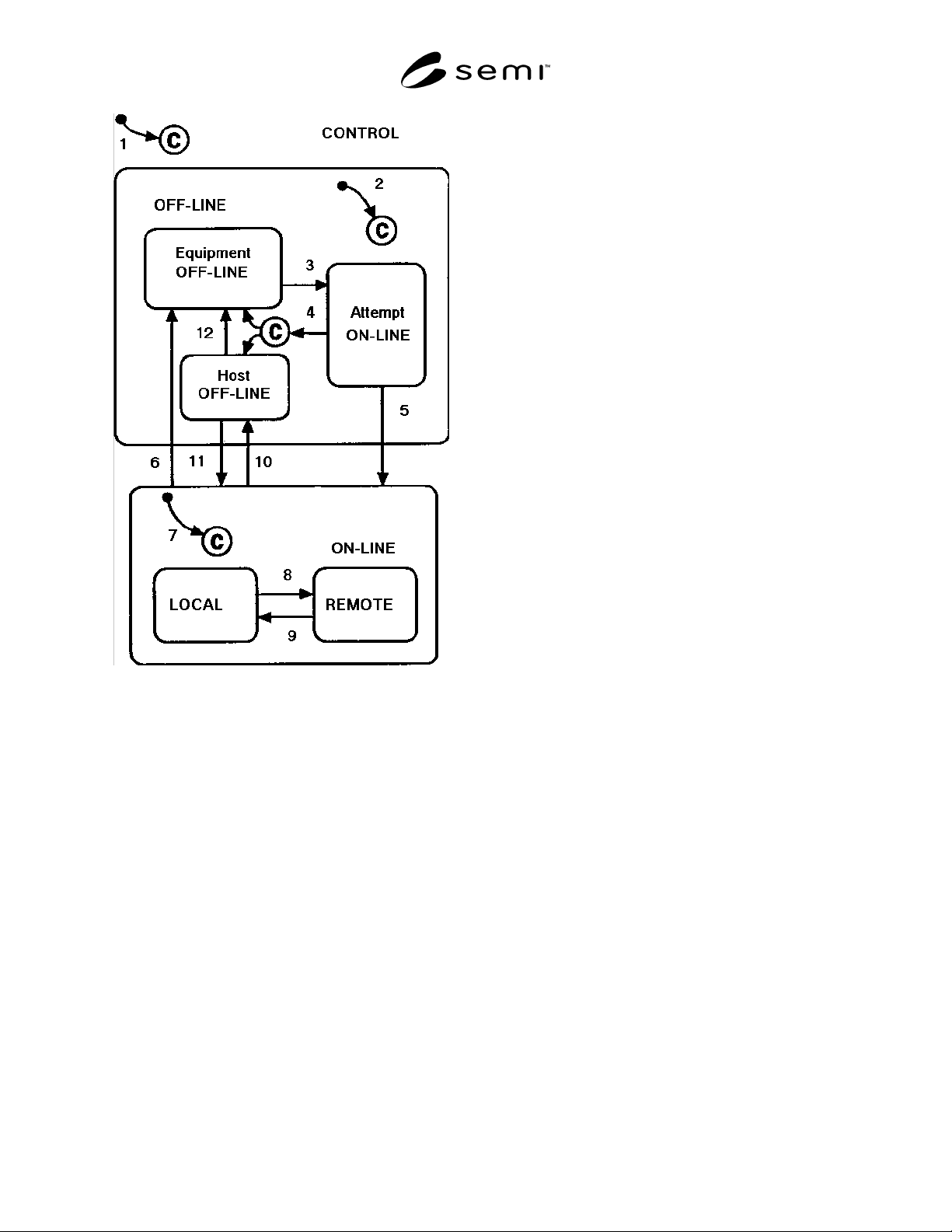
Figure 3.3
CONTROL State Model
OFF-LINE/HOST OFF-LINE
While the HOST OFF-LINE state is active, the
operator’s intent is that the equipment be ON-LINE.
However, the host has not agreed. Entry to this state
may be due to a failed attempt to go ON-LINE or to the
host’s request that the equipment go OFF-LINE from
ON-LINE (see the transition table for more detail).
While this state is active, the equipment shall positively
respond to any host’s request to go ON-LINE (S1,F17).
Such a request shall be denied when the HOST OFF-
LINE state is not active.
ON-LINE
While the ON-LINE state is active, SECS-II messages
may be exchanged and acted upon. Capabilities that
may be available to the host should be similar to those
available from the operator console wherever practical.
The use of Sx,F0 messages is not required while the
ON-LINE state is active. Their use is discouraged in
this case. The only allowed use is to close open
transactions in conjunction with message faults.
ON-LINE/LOCAL
Operation of the equipment is implemented by direct
action of an operator. All operation commands shall be
available for input at the local operator console of the
equipment.
The host shall have the following capabilities and
restrictions when the LOCAL state is active:
— The host shall be prohibited from the use of remote
commands that cause physical movement or which
initiate processing. During processing, the host
shall be prohibited from the use of any remote
command that affects that process.
— During processing, the host shall be prohibited
from modifying any equipment constants that
affect that process. Other equipment constants shall
be changeable during processing. The host shall be
able to modify all available equipment constants
when no processing is in progress.
— The host shall be capable of initiating the upload
and download of recipes to/from the recipe storage
area on the equipment. The host shall be capable of
selecting recipes for execution so long as this
action does not affect any currently executing
recipe.
— The host shall be able to configure automatic data
reporting capabilities including alarms, event
reporting, and trace data reporting. The host shall
receive all such reports at the appropriate times.
— The host shall be able to inquire for data from the
equipment, including status data, equipment
constants, event reports, process program
directories, and alarms.
— The equipment shall be able to perform Terminal
Services as defined in GEM.
The host shall be allowed any other capabilities that
were not specifically restricted in the above items as
long as the LOCAL state is active.
NOTE 2: Capabilities mentioned above which are not
implemented on a specific equipment may be ignored in this
context.
ON-LINE/REMOTE
For equipment which supports the GEM capability of
remote control (see Section 4.4), while the REMOTE
state is active, the host shall have access, through the
communications interface, to the necessary commands

SEMI E30-1103 © SEMI 1992, 2003
14
to operate the equipment through the full process cycle
in an automated manner. The equipment does not
restrict any host capabilities when REMOTE is active.
The degree of control executed by the host may vary
from factory to factory. In some cases, the operator
maybe required to interact during remotely controlled
processes. This interaction may involve set-up
operations, operator assist situations, and others. This
state is intended to be flexible enough to accommodate
these different situations.
To support the different factory automation policies and
procedures, it shall be possible to configure the
equipment to restrict the operator in specific non-
emergency procedures. These restrictions shall be
configurable so that the equipment may be set up to
allow the operator to perform necessary functions
without contention with the host. The categories for
configuration shall include (but are not limited to):
— change equipment constants (process-related),
— change equipment constants (non-process-related),
— initiate process program download,
— select process program,
— start process program,
— pause/resume process program,
— operator assist,
— material movement to/from equipment,
— equipment-specific commands (on a command-by-
command basis if needed).
NOTE 3: Capabilities mentioned above which are not
implemented on a specific equipment may be ignored in this
context.
No capabilities that are available to the operator when
the LOCAL state is active should be unconditionally
restricted when the REMOTE state is active. The
supplier may provide for configurable restriction of
operator capabilities not included in the list above if
desired. No configurability is necessary for any
operator functions not available to the host.
The control functions must be shared to some degree
between the host and the local operator. At the very
least, the operator must have the capability to change
the CONTROL state, actuate an Emergency Stop, and
interrupt processing (e.g., STOP, ABORT, or PAUSE).
All of these capabilities except Emergency Stop may be
access-limited.
13
The host software should be designed to be compatible
with the capabilities allotted to the operator.
13 Definition of the method of limiting operator access (password,
key, etc.) to a capability is not within the scope of this document.

SEMI E30-1103 © SEMI 1992, 2003
15
Table 3.3 CONTROL State Transition Table
# Current State Trigger New State Action Comments
1 (Undefined) Entry into
CONTROL state
(system
initialization).
CONTROL
(Substate
conditional on
configuration).
None Equipment may be configured to
default to ON-LINE or OFF-LINE .
(See NOTE 1.)
2 (Undefined) Entry into OFF-
LINE state.
OFF-LINE
(Substate
conditional on
configuration.)
None Equipment may be configured to
default to any substate of OFF-LINE.
3 EQUIPMENT
OFF-LINE
Operator actuates
ON-LINE switch.
ATTEMPT ON-
LINE
None Note that an S1,F1 is sent whenever
ATTEMPT ON-LINE is activated.
4 ATTEMPT ON-
LINE
S1,F0. New state
conditional on
configuration.
None This may be due to a communication
failure (See NOTE 2), reply timeout, or
receipt of S1,F0. Configuration may be
set to EQUIPMENT OFF-LINE or
HOST OFF-LINE.
5 ATTEMPT ON-
LINE
Equipment
receives expected
S1,F2 message
from the host.
ON-LINE None Host is notified of transition to ON-
LINE at transition 7.
6 ON-LINE Operator actuates
OFF-LINE switch.
EQUIPMENT
OFF-LINE
None “Equipment OFF-LINE” event occurs.
(See NOTE 3.) Event reply will be
discarded while OFF-LINE is active.
7 (Undefined) Entry to ON-LINE
state.
ON-LINE
(Substate
conditional on
REMOTE/LOCAL
switch setting.)
None “Control State LOCAL” or “Control
State REMOTE” event occurs. Event
reported based on actual ON-LINE
substate activated.
8 LOCAL Operator sets front
panel switch to
REMOTE.
REMOTE None “Control State REMOTE” event
occurs.
9 REMOTE Operator sets front
panel switch to
LOCAL.
LOCAL None “Control State LOCAL” event occurs.
10 ON-LINE Equipment accepts
“Set OFF-LINE”
message from host
(S1,F15).
HOST OFF-LINE None “Equipment OFF-LINE” event occurs.
11 HOST OFF-LINE Equipment accepts
host request to go
ON-LINE
(S1,F17).
ON-LINE None Host is notified to transition to ON-
LINE at transition 7.
12 HOST OFF-LINE Operator actuates
OFF-LINE switch.
EQUIPMENT
OFF-LINE
None “Equipment OFF-LINE” event occurs.
NOTE 1: The configuration mentioned for transitions 1 and 2 should be a single setting. This would provide the user with a choice of entering the
EQUIPMENT OFF-LINE, ATTEMPT ON-LINE, HOST OFF-LINE, or ON-LINE states.
NOTE 2: Communication failures are protocol specific. Refer to the appropriate protocol standard (e.g., SEMI E4 or SEMI E37) for a protocol-
specific definition of communication failure.
NOTE 3: Any host initiated transaction open at the equipment must be completed. This may happen either by sending the appropriate reply to the
host prior to sending the event message or by sending an Sx,F0 message following the event message (i.e., after the transaction).