semi合集-English.pdf - 第1886页
SEMI E54-0705 © SEMI 1997, 2005 2 4.1.4 IDL — Interface Definition Language. A programm ing language-indepe ndent notation for specifying interfaces. 4.1.5 ISO — International Organ ization for Standardization. 4.1.6 NCS…

SEMI E54-0705 © SEMI 1997, 2005 1
SEMI E54-0705
SENSOR/ACTUATOR NETWORK STANDARD
This standard was technically reapproved by the Global Information and Control Committee and is the direct
responsibility of the North American Information and Control Committee. Current edition approved by the
North American Regional Standards Committee on March 14, 2004. Initially available at www.semi.org
May 2004; to be published July 2004. Originally published in 1997; previously published March 2003.
NOTICE: The designation of SEMI E54 was updated during the 0705 publishing cycle to reflect the creation of
SEMI E54.16 and SEMI E54.17.
NOTICE: The document that was previously designated as SEMI E54 (Standard for Sensor/Actuator Network
Common Device Model) has been redesignated as SEMI E54.1. Because the Sensor/Actuator Network Standard is
the parent document, it has been designated as SEMI E54.
1 Purpose
1.1 This specification provides the structure of SEMI’s Sensor/Actuator Network (SAN) standard. It provides the
definition for interoperability with respect to SEMI SAN standard-compliant Sensor/Actuator devices.
2 Scope
2.1 This standard specifies how devices interoperate on a network as part of the control system for equipment.
2.2 This specification, which is the root of the SAN standard, defines the relationships of each of the other
specifications that are components of the SEMI SAN standard.
NOTICE: This standard does not purport to address safety issues, if any, associated with its use. It is the
responsibility of the users of this standard to establish appropriate safety and health practices and determine the
applicability of regulatory or other limitations prior to use.
3 Referenced Standards
3.1 SEMI Standards
SEMI E30 — Generic Model for Communications and Control of SEMI Equipment (GEM)
SEMI E39 — Object Services Standard: Concepts, Behavior, and Services
SEMI E54.1 — Standard for Sensor/Actuator Network Common Device Model
3.2 Other Documents
ISO 7498
1
— Basic Reference Model for Open Systems Interconnection (OSI)
James Rumbaugh, Michael Blaha, William Premerlani, Frederic Eddy, William Lorensen, Object-Oriented
Modeling and Design, Englewood Cliffs, New Jersey: Prentice-Hall, 1991.
NOTICE: Unless otherwise indicated, all documents cited shall be the latest published versions.
4 Terminology
4.1 Abbreviations & Acronyms
4.1.1 API — Applications Programming Interface
4.1.2 CDM — Common Device Model. The root object application model for devices on the sensor bus.
4.1.3 DM — DeviceManager. An object specified in SEMI E54.1 (Standard for Sensor/Actuator Network Common
Device Model).
1 International Organization for Standardization, ISO Central Secretariat, 1, rue de Varembé, Case postale 56, CH-1211 Geneva 20, Switzerland.
Telephone: 41.22.749.01.11; Fax: 41.22.733.34.30
Website: www.iso.ch

SEMI E54-0705 © SEMI 1997, 2005 2
4.1.4 IDL — Interface Definition Language. A programming language-independent notation for specifying
interfaces.
4.1.5 ISO — International Organization for Standardization.
4.1.6 NCS — Network Communication Standard. Provides the specification for mapping the CDM and SDM to
specific network technologies. These standards will be incorporated as parts of the SEMI SAN standard.
4.1.7 OEM — Original Equipment Manufacturer. They are usually the control system developer, but in any case
they are almost always responsible for the control system.
4.1.8 OMT — Object Modeling Technique. A methodology developed by James Rumbaugh, et al. for using objects
to model systems.
4.1.9 OSI — Open System Interconnection. A seven-layer model for communications developed by ISO.
4.1.10 OSS — Object Services Standard. SEMI E39.
4.1.11 SAN — Sensor/Actuator Network. It is frequently used to reference this standard.
4.1.12 SDM — Specific Device Model. This is an application model for a specific type of sensor, actuator, or entity.
4.2 Definitions
4.2.1 application — for software, this is a working series of computer instructions that provide end user services.
4.2.2 applications model — a formal description of the software elements and interactions that perform an end user
task.
4.2.3 entity — in software engineering, this is something that is recognizable as distinct and particular from the
other things that make up a software system or program.
4.2.4 interface — in information modeling, it is the boundary between two entities from which information will
flow.
4.2.5 user layer — in communications, this is a set software function connected to the communication protocol's
top layer, usually called the applications layer, from the user’s application environment. It typically allows the user
application to be protocol-independent.
5 Overview
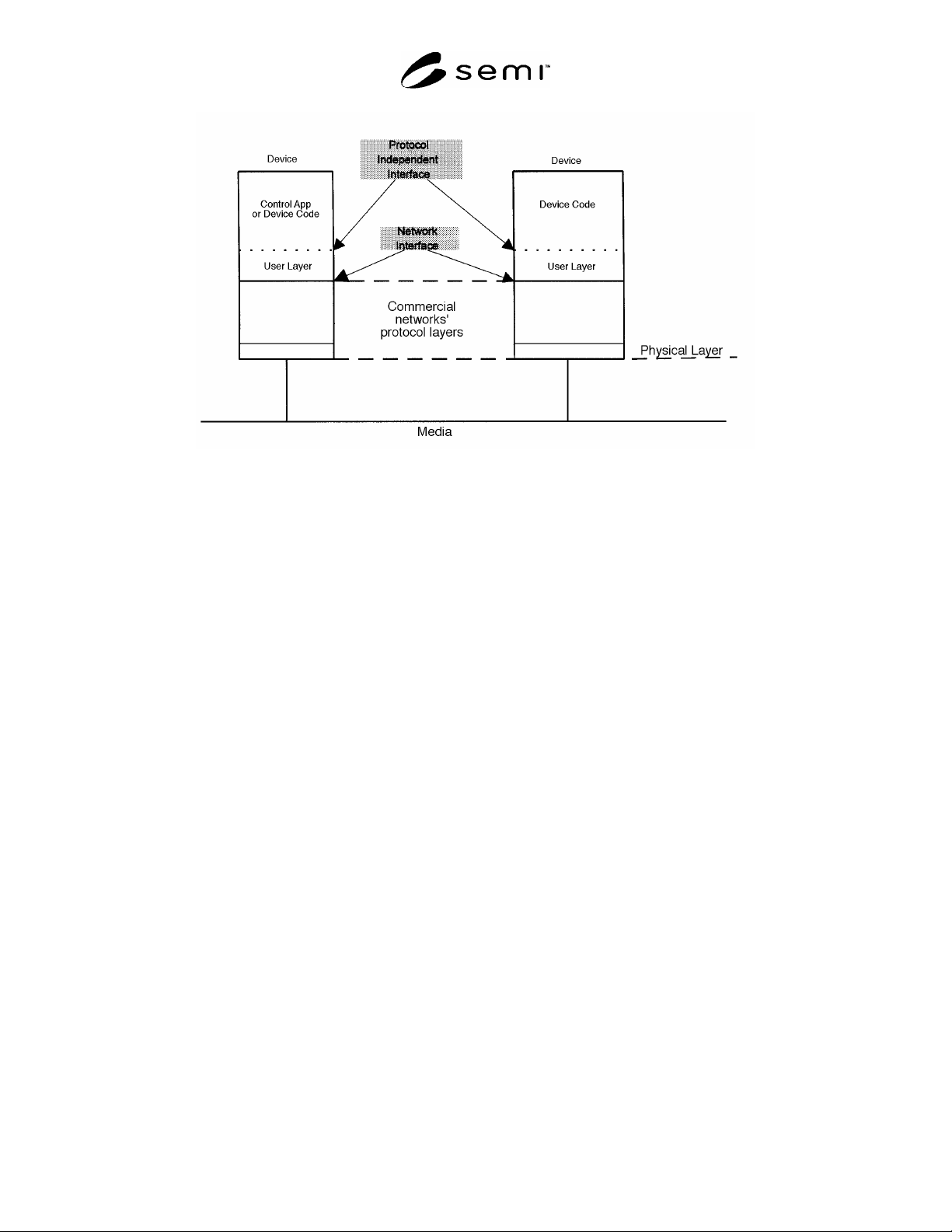
5.1 Referring to Figure 1, the SAN standards specify a complete communications solution covering all the layers of
the OSI reference model. The CDM and SDM together specify a protocol-independent set of application services,
attributes, and behavior for a device that must be supported by the user layer as shown in Figure 1. An NCS
completes the specification of the user layer by specifying a mapping to a network technology’s interface. The NCS
must specify its capabilities referenced against the ISO OSI Reference Model. An NCS may utilize an open or
commercial solution. In any case, the NCS will provide references to those solution’s specifications.
SEMI E54-0705 © SEMI 1997, 2005 3
Figure 1
SEMI SAN Protocol Layers
5.2 Generally, the functionality of a software layer is embodied by the definition of the services it provides. Its
services are the set of messages it generates and to which it responds, and its subsequent behavior upon receipt of
any particular message. The CDM and an SDM provide a complete user layer specification in a platform and
language-neutral form (dotted line in Figure 1). The goal being to provide device interoperability at the applications
level. The NCS will guarantee interoperability at the network level (i.e., across a single type of network). The SAN
standard does not require implementation of the top interface to the user layer, as specified by the CDM and an
SDM. The CDM and an SDM provide the information needed to develop an NCS, which defines the interface
requirement between the user layer and a specific network technologies communication layer (the solid line labeled
as Network Interface). This means that the SAN standard allows user applications, whether from the device or the
controller side implementation viewpoint, to interact directly with a network technologies interface.
5.3 Network Technology Supplier View of the SAN Standard
5.3.1 The CDM and an SDM together specify the messages, behavior, and attributes of a device type that will be
visible over the network. In Figure 1, this is the area above the line that indicates the protocol-independent interface.
Network suppliers will map this information to the top layer of their protocol. They do this by helping to develop
and extend their NCS.
5.3.2 Most network suppliers have an application layer already defined for their protocol. In that case, the user layer
as specified in a SEMI SAN NCS is quite thin. In fact, it is just a simple mapping of SDM interface to messages and
data (attributes) provided by the network. Thus, an NCS (one for each supported network) specifies a user layer that
sits on top of the network supplier’s protocol.
5.4 Device Supplier View of the SAN Standard
5.4.1 Device suppliers are not required to implement designs illustrated in the specific device model (SDM)
specifications. The designs are presented using an object-modeling notation as a means to clearly specify the devices
interface. An SDM provides a model of a device, it is not a design for the device. Device suppliers are not expected
to provide an object-oriented implementation. However, in order to ensure that a device interface responds as
expected, it is necessary for the device supplier to not only provide the support for the services and attributes
specified, but to ensure that the code that is implemented on the device behaves as specified by the applications
model for a specific device type.
5.5 Equipment Supplier View of the SAN Standard
5.5.1 The OEM’s have the largest task in adopting the SAN standard. They have to implement applications that use
the interfaces defined for the many devices that make up the typical equipment control system. They have to be