semi合集-English.pdf - 第2402页
SEMI E86-0200 © SEMI 1999 , 2000 2 Specification for CIM Framework Domain Architecture. 2.4 Thi s stan dard does not purport t o address safety issues, if any, associated with its use. It is the responsibility of t he us…

SEMI E86-0200 © SEMI 1999, 20001
SEMI E86-0200
PROVISIONAL SPECIFICATION FOR CIM FRAMEWORK FACTORY
LABOR COMPONENT
This specification was technically approved by the Global Information & Control Committee and is the direct
responsibility of the North American Information & Control Committee. Current edition approved by the
North American Regional Standards Committee on October 21, 1999. Initially available at www.semi.org
January 2000; to be published February 2000. Originally published September 1999.
1 Purpose
1.1 The Factory Labor Component provides the
capability to support the qualification and management
of available, qualified human resources for manufact-
uring operations.
1.2 The technical content of this ballot addresses the
portion of the CIM Framework domain specified in
SEMI E81, Provisional Specification for CIM
Framework Domain Architecture, concerned with
management of the availability of qualified factory
personnel. This specification provides the interfaces
required by Manufacturing Execution Systems to:
• Configure the Person resource model.
− Each Person’s name (or appropriate alias),
identification, department, role, etc. There
may be cases where identifying information
should not be used to associate a person with
the required factory labor records.
− Each Person’s initial skills and authorization to
perform jobs and access data.
− Each Person’s initial assignment to other
factory resources (such as specific machines or
factory areas).
− Each Person’s medical qualifications.
• Define skill maintenance tasks and what triggers
them.
• Track and report the Person’s skills, authorization,
and assignments and record these in the Person’s
histories.
• Support assignment of Persons to factory jobs and
monitor and record job progress (from the
perspective of the Person’s role).
• Monitor skill maintenance triggers (such as expired
skill certification) and recommend skill mainten-
ance jobs.
• Execute triggered skill maintenance jobs.
− Change Person capabilities (before and after
training).
− Execute and monitor skill maintenance jobs
(training, certification testing) and report job
progress.
− Record skill maintenance triggers and job
results in Person’s skill maintenance histories.
• Collect and report Person and skill performance
(utilization and effectiveness).
• Maintain relationships between Persons and system
security for identity authentication and
authorization.
2 Scope
2.1 Specifically, this component provides the services
to:
• Manage the assignment of qualified and available
labor resources for factory operations.
• Manage the training and medical requirements for
factory operations.
• Support the maintenance of personnel information
(full name, employee number, department, shift
assignment, machines qualified to operate, course
and medical examination records).
• Support the maintenance of personnel skill qual-
ification histories (courses and medical examina-
tions successfully completed) of factory personnel.
2.2 The Factory Labor Component is divided into two
subcomponents:
• Person Management, which tracks, logs, and main-
tains availability and task assignment for factory
operations personnel within the manufacturing
facility. Also provides support for the management
of personnel information, training, and medical
qualifications.
• Skill Management, which provides support for the
management of training and medical requirements
for factory operations.
2.3 Figure 1 depicts the relationships between these
two components and their interaction with other CIM
Framework components defined in the Section 7.2
Functional Partitioning of SEMI E81, Provisional
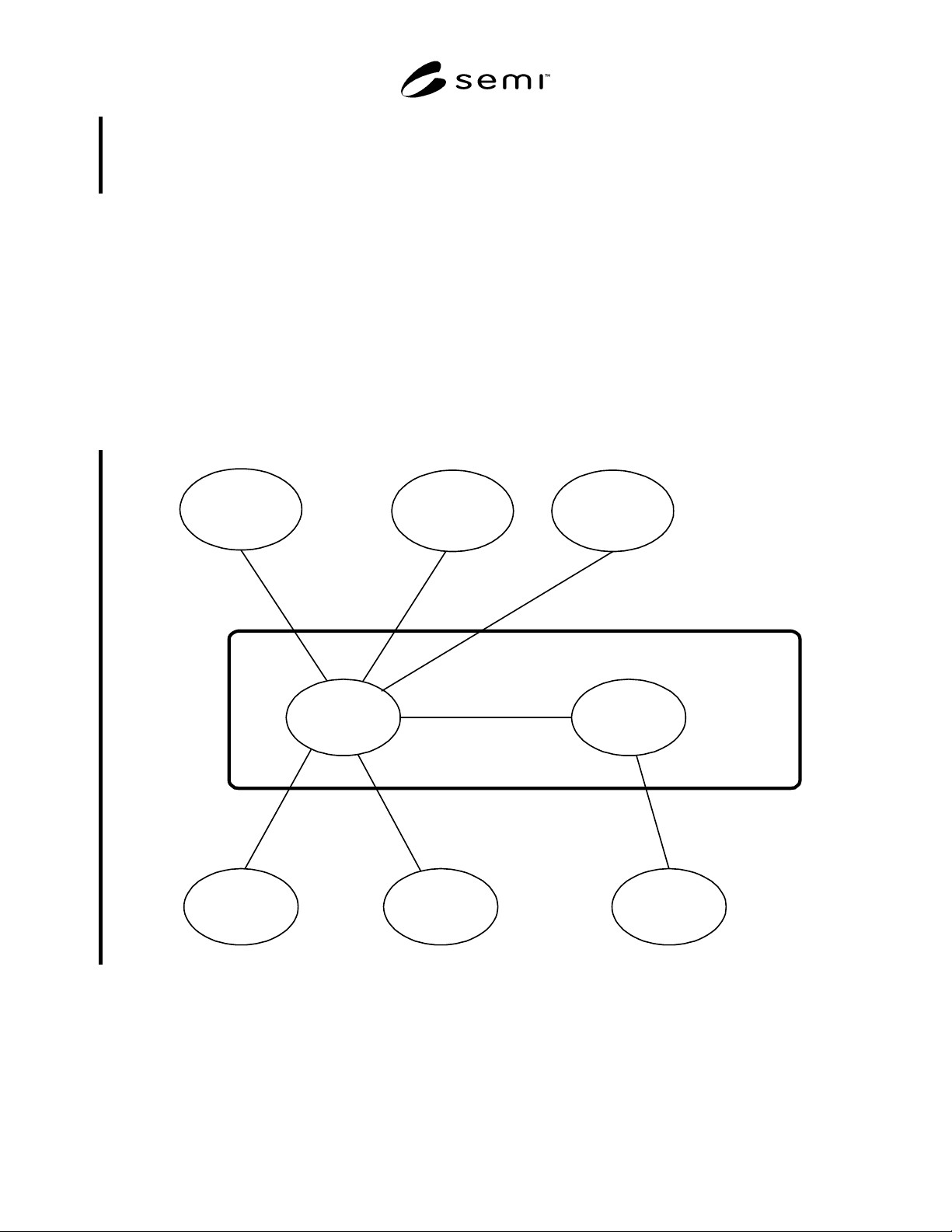
SEMI E86-0200 © SEMI 1999, 2000 2
Specification for CIM Framework Domain
Architecture.
2.4 This standard does not purport to address safety
issues, if any, associated with its use. It is the
responsibility of the users of this standard to establish
appropriate safety and health practices and determine
the applicability of regulatory limitations prior to use.
3 Limitations
3.1 This specification is designated as provisional due
to known areas that need to be completed. The
following items summarize the deficiencies of the
provisional specification to be addressed before a
subsequent ballot to upgrade it to full standard status.
3.2 Provisional Status
3.2.1 The following items need to be completed before
conducting a subsequent ballot to upgrade the Factory
Labor Component to full standard status.
• Define skill maintenance tasks and what triggers
them.
• Monitor skill maintenance triggers (such as expired
skill certification) and recommend skill
maintenance jobs.
• Maintain relationships between persons and system
security for identity authentication and
authorization.
3.2.2 It is anticipated that a future document defining
the Resource Abstract Interface will satisfy the first two
items.
FACTORY LABOR
identify/assign qualified/
available person to
perform a job
assign person to
shift(s) / area(s) /
machine(s)
request job to be
performed
request personnel to
perform PMs for support
resources
define skills
needed for
a process
capability
Skill
Management
request manual
material movement
compare personnel
medical / training history
with skill requirements
Person
Management
Material
Transport and
Storage
Job
Supervisor
Specification
Equipment
Tracking and
Maintenance
Factory
Dispatching
Figure 1
Factory Labor Component Relationships

SEMI E86-0200 © SEMI 1999, 20003
4 Referenced Standards
4.1 SEMI Standard
SEMI E81 — Provisional Specification for CIM Framework Domain Architecture
4.2 ISO/IEC Standard
1
ISO/IEC 14750 (also ITU-T Recommendation X.920) — Information Technology – Open Distributed Processing –
Interface Definition Language
4.3 OMG Standard
2
UML Notation Guide, Version 1.1, document number ad/97-08-05
NOTE: As listed or revised, all documents cited shall be the latest publications of adopted standards.
5 Terminology
5.1 person — personnel performin g manufacturing operations within a factory.
5.2 person responsibility — the concept of “responsibility” implies that factory personnel are authorized to
perform, operate or access a specific factory object (but it does not imply ownership).
5.3 skill — skill is an attribute of factory personnel denoting that they are qualified to assist a process resource or
job in the performance of a process capability or some other factory operation.
5.4 skill qualification — a skill qualification indicates that factory personnel meet a requirement (or all
requirements) necessary to perform some factory operation.
5.5 skill requirement — a skill requirement is the training or medical examination(s) required to achieve a specific
skill.
6 Requirements
6.1 The following sections provide the specification of interfaces that comprise the Factory Labor Component. The
model notation used is the Unified Modeling Language (UML). UML is documented in the UML Notation Guide.
The details of each interface are supplied using standard IT-ODP-IDL. Conformant implementations of the Factory
Labor Component shall provide support for all elements of the IDL specifications and the semantics provided in the
UML models. Conformant implementations are not constrained to any specific implementation approach, provided
that a mapping is provided to the IDL specification.
6.2 External Interfaces, Global Type Definitions, Global Exceptions and Events
6.2.1 The following interfaces (external to this component), global type definitions, global exceptions, and events
are required to support the Factory Labor component specification.
6.2.2 Abstract and Base Interfaces
6.2.2.1 Base interfaces provide a suite of interfaces that are used throughout the CIM Framework Specification.
The Abstract Interfaces provide a hierarchy of abstract interfaces that are used as “Inherited Interfaces” in the rest of
the framework. These interfaces are expected to be specialized in a specific implementation.
6.2.2.2 This section identifies base and abstract interfaces required by the Factory Labor component specification.
interface NamedEntity {
};
interface OwnedEntity : NamedEntity {
};
1 ISO Central Secretariat, 1, rue de Varembé, Case postale 56, CH-1211 Genève 20, Switzerland
2 Object Management Group, Inc., Framingham Corporate Center, 492 Old Connecticut Path, Framingham, MA 01701, 1.508.820.4300,
http://www.omg.org/cgi-bin/doclist.pl