semi合集-English.pdf - 第1608页
SEMI E37.2-95 © SEMI 1995, 2003 2 HSMS-GS only provides th e conventions for identifying Session Entities. It places no restrictions on the individual supplier as to wh at constitues a SessionEntity: the su pplier must d…
SEMI E37.2-95 © SEMI 1995, 2003 1
SEMI E37.2-95 (Reapproved 0303)
HIGH-SPEED SECS MESSAGE SERVICES GENERAL SESSION
(HSMS-GS)
This standard was technically approved by the Global Information and Control Committee and is the direct
responsibility of the North American Information and Control Committee. Current edition approved by the
North American Regional Standards Committee on October 25, 2002. Initially available at www.semi.org
December 2002; to be published March 2003. Originally published in 1995.
1 Purpose
1.1 HSMS-GS is intended to support the needs of
complex systems containing multiple independently
accessible subsystems such as cluster tools or track
systems. Specifically, procedures are defined to permit
access to any individual subsystem or set of subsystems
within any complex system.
2 Scope
2.1 High-Speed SECS Message Services General
Session (HSMS-GS) is a subsidiary standard to High-
Speed SECS Message Services (HSMS) Generic
Services.
NOTICE: This standard does not purport to address
safety issues, if any, associated with its use. It is the
responsibility of the users of this standard to establish
appropriate safety and health practices and determine
the applicability of regulatory or other limitations prior
to use.
3 Referenced Standards
3.1 SEMI Standards
SEMI E4 — SEMI Equipment Communications
Standard 1 Message Transfer (SECS-I)
SEMI E5 — SEMI Equipment Communications
Standard 2 Message Content (SECS-II)
SEMI E37 — High-Speed SECS Message Services
(HSMS) Generic Services
NOTICE: Unless otherwise indicated, all documents
cited shall be the latest published versions.
4 Terminology
4.1 Definitions
4.1.1 Selected Entity List — a list of session entities
currently selected for communication on a given
TCP/IP connection.
4.1.2 Selection Count — the number of sessions
opened by an HSMS Select procedure and not yet
ended by an HSMS Deselect or Separate procedure.
4.1.3 Session Entity — an individually selectable entity
within an HSMS-GS system.
4.1.4 Session Entity ID — a 16-bit identifier for a
Session-Entity.
4.1.5 SessionEntityList — a list of all available session
entities within an HSMS-GS system and associated
with a particular IP address and port number.
4.2 In addition, all definitions for HSMS Generic
Services apply.
4.3 Note that the terms HSMS and HSMS Generic
Services both refer to the HSMS Generic Services
standard definition (SEMI E37).
5 HSMS-GS Overview and State Machine
5.1 HSMS-GS provides a set of definitions which
permit the individual subentities (e.g., subsystems) of
complex entities (e.g., systems) to be separately
accessible during HSMS procedures. HSMS-GS
defines no new procedures or message types beyond
HSMS Generic Services to provide these services. It
does, however, require extensions to the HSMS State
machine, in the form of additional state transition
definitions and additional state information, which are
used by the extended state machine which must be
maintained by an HSMS-GS implementation to support
the extended state machine. The additional information
consists of the following:
1. The Session Entity List
2. The Selected Entity List
3. The Selection Count
5.2 The Session Entity List consists of the set of all
Session Entities having individual accessibility within
the HSMS-GS entity. The scope of this list is normally
the entire HSMS-GS entity. HSMS-GS, however, does
not require this scope: the supplier may provide access
to HSMS-GS entity through more than one well known
port and provide a different Session Entity List for
each.
5.3 A Session Entity is any individually addressable
subentity within the HSMS-GS entity: for example, a
Session Entity may be an individual sub-device in a
track system or cluster tool, or may be an individual
service provider, such as a data server, within an entity.
SEMI E37.2-95 © SEMI 1995, 2003 2
HSMS-GS only provides the conventions for
identifying Session Entities. It places no restrictions on
the individual supplier as to what constitues a
SessionEntity: the supplier must determine what is the
most appropriate for the particular implementation.
5.4 The Selected Entity List is the list of Session
Entities actually selected for access on a given TCP/IP
connection. When the TCP/IP connection is established
(CONNECTED state entered), an empty Selected
Entity List is created. Each time, the Select Procedure
is used to select a Session Entity, its Session Entity ID
is added to the Selected Entity List created for that
TCP/IP connection. Each time the Session Entity is
deselected via the Deselect or Separate procedures, its
Session Entity ID is removed from the Selected Entity
List. At any given time on any given TCP/IP
connection endpoint, HSMS Data Messages will only
be accepted by an entity if the SessionID of the Data
Message is equal to any Session Entity ID in the
Selected Entity List.
5.5 The Selection Count is simply the number of
Session Entity IDs in the Selected Entity List. Its value
affects the behavior of the state machine: the transition
to NOT SELECTED from SELECT can only take place
when the SELECTION COUNT is zero.
5.6 Note that the above lists and count are defined for
the purpose of explaining state machine operation only.
There is no requirement that any of the above lists and
count be explicitly implemented.
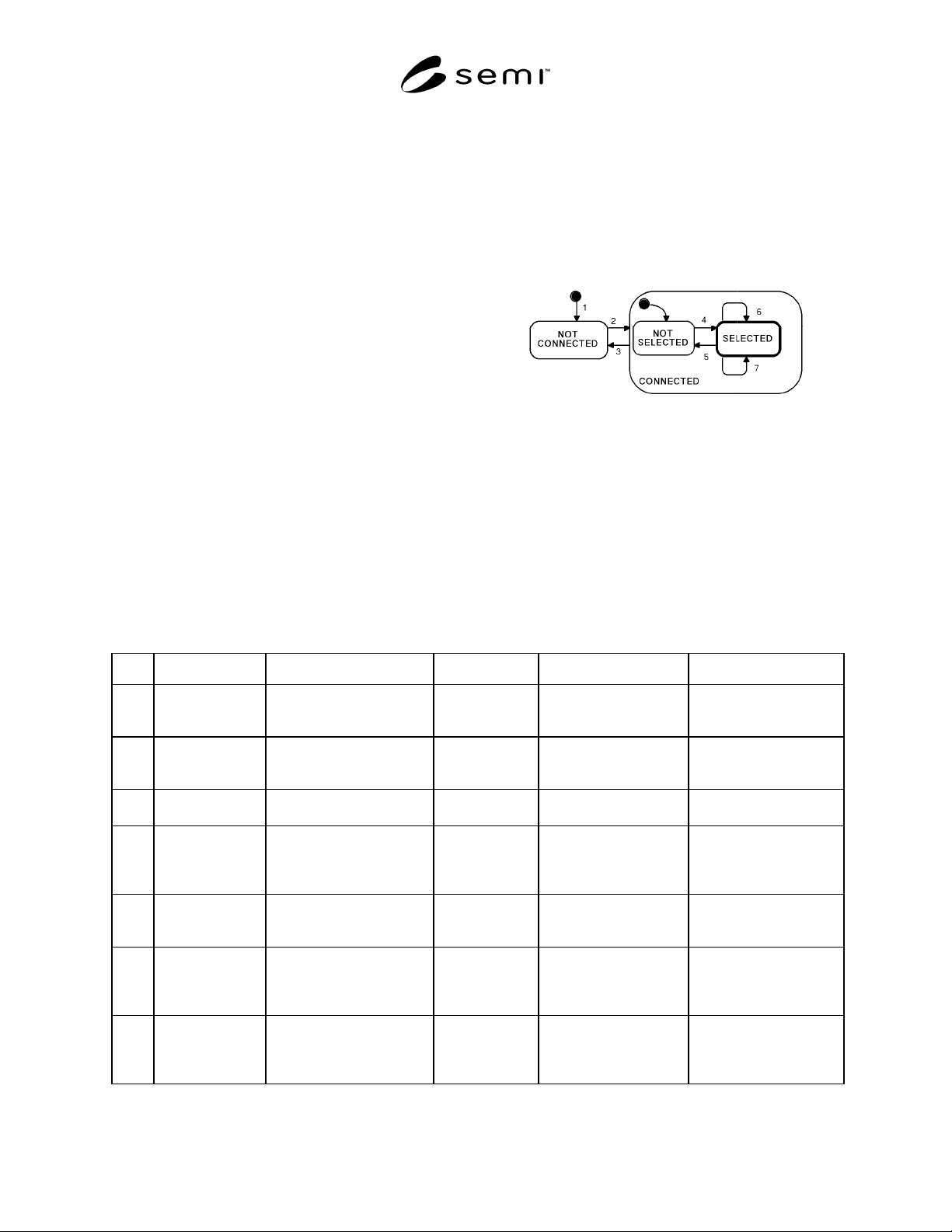
5.7 HSMS-GS State Machine — The HSMS-GS state
machine is the same as the HSMS Generic Services
state machine with the addition of the two new state
transitions (#6 and #7) and the use of the Selection
Count in the other transitions as described in the state
transition table below.
Figure 1
5.8 State Descriptions — The state descriptions are the
same as HSMS Generic Services.
5.9 State Transition Table — The state transition table
is almost identical with the state transition table for
HSMS Generic Services. For convenience, however,
the entire table is reproduced and extended here, not
just those areas which differ from it.
Table 1
# Current State Trigger New State Actions Comment
1 ... Local entity specific
preparation for TCP/IP
communication.
NOT
CONNECTED
Local entity-specific. Action depends on
connection procedure to be
used: active or passive.
2 NOT
CONNECTED
A TCP/IP connection is
established for HSMS
communication.
CONNECTED -
NOT
SELECTED
Set Selection Count = 0
and create empty Selecte
d
Entity List.
none
3 CONNECTED Breaking of TCP
Connection.
NOT
CONNECTED
Local entity-specific. none
4 NOT SELECTED Successful completion of
HSMS Select Procedure.
SELECTED Set Selection Count = 1
and add selected Session
Entity to Selected Entity
List.
none
5 SELECTED Deselect or Separate
procedure resulting in
Selection Count = 0.
NOT
SELECTED
Local entity-specific. See transition 7 below.
6 SELECTED Successful completion of
HSMS Select Procedure
when Selection Count > 0.
SELECTED Increment Selection
Count and add selected
Session Entity to Selected
Entity List.
none
7 SELECTED Successful completion of
HSMS Deselect or Separate
when Selection Count > 1.
SELECTED Decrement Selection
Count and remove
selected Session Entity
from Selected Entity List.
If this transition results in
Selection Count = 0,
immediately trigger state
transition 5.
SEMI E37.2-95 © SEMI 1995, 2003 3
6 HSMS-GS Use of TCP/IP
6.1 There is no additional HSMS-GS specification for
the use of TCP/IP beyond the above mentioned creation
of the empty “Selected Entity List” upon entry into the
CONNECTED state, NOT SELECTED substate.
7 HSMS-GS Specific Procedures
HSMS-GS provides further specification of the
following procedures.
7.1 Select Procedure — The select procedure is
permitted in both the NOT SELECTED state and the
SELECTED state. The procedure for both the initiator
and the responding entity is the same as HSMS Generic
Services, with the following additional conditions:
1. If the responding entity contains no Session Entity
in its Session Entity List whose ID matches the
SessionID in the Select.req, a Select Status of No
Such Entity is used in the Select.rsp.
2. If the responding entity is unable to provide access
to the selected entity because it is usable on only a
single TCP/IP connection at any one time and it is
already in use on a different TCP/IP connection, a
response code of Entity In Use is used in the Sel-
ect.rsp.
3. If the responding entity finds the SessionID already
in its Selected Entity List, a response code of
Entity Selected is used in the Select.rsp.
7.1.1 The Select Status values referenced above are all
defined in Section 8.
7.1.2 If none of the above is true, the Select completes
successfully, and a Select Status of 0 is provided in the
Select.rsp. Both entities will add the SessionID from
the Select.req to the Selected Entity List.
7.2 Data Procedure — The Data Procedure is as
defined in HSMS Generic Services. Note that the
SessionID of any Data Message must match a
SessionID in the SelectedEntityList. If a Data Message
is received with a SessionID other than one from the
Selected Entity List, a Reject.req message is sent in
response by the receiving entity. The reason code will
be Entity Not Selected.
7.3 Deselect Procedure — The Deselect procedure is
restricted by the following conditions:
1. The SessionID must be in the Selected Entity List.
2. The corresponding SessionEntity is in a state which
permits Deselect. This decision is local entity
specific and not subject to the HSMS-GS.
7.3.1 If both of the above are true, then the Deselect
can proceed. Assuming that the Deselect completes
successfully, the SessionID is removed from the
Selected Entity List, and the Selection Count is
decremented. The transition to the NOT SELECTED
state transpires only if the resulting Selection Count is
equal to zero (i.e., an empty Selected Entity List).
7.4 Linktest Procedure — As defined by HSMS.
7.5 Reject Procedure — As defined by HSMS. Note,
in particular, the use of Reject in response to certain
data messages (above).
7.6 Separate Procedure — The Separate procedures
and state transitions are subject to the same restrictions
and conditions as the Deselect.
7.7 Communications Failures — As defined by HSMS.
Note that any abrupt termination has the effect of
deselecting all entities in the Selected Entity List.
8 HSMS-GS Message Format Issues
8.1 Session ID — In HSMS-GS Select, Data, Deselect,
Reject, and Separate messages, the SessionID will
equal the Session Entity ID of the target Session Entity
which must equal the Session ID of a Session Entity
contained in the Session Entity List. In the Linktest, it
is 0xFFFF, as in HSMS.
8.2 PType — HSMS-GS messages are generally PType
= 0 (SECS-II-encoded) as defined in HSMS. Although
other PTypes are permitted, specific application
domains may restrict the use of HSMS-GS to Ptype = 0.
8.3 SType — Only HSMS-defined STypes are
permitted in HSMS-GS.
8.4 Select/Deselect Status — The following additional
enumeration applies to the Select/Deselect status in
HSMS-GS:
Table 2 SelectStatus
Value Description
4 No Such Entity — Session ID does not correspond to
any Session Entity ID available at this connection.
5 Entity In Use (by another connection) — Session
Entity corresponding to session ID is not sharable
connections and is already selected by another
connection.
6 Entity Selected (by current connection) — Session
entity corresponding to Session ID is already selected
on current connection.
9 Special Considerations
9.1 There are no special considerations above and
beyond those described in HSMS Generic Services.