semi合集-English.pdf - 第6973页
SEMI S10-1103 © SEMI 1996, 2003 3 6.3 Define Use and Limits of the Equipment — Consider at least the following aspects: • Lifecycle stages, • Person(s) involved, • Areas in which equipment is used, • Sup port equipment i…
SEMI S10-1103 © SEMI 1996, 2003 2
NOTE 3: Likelihood groups are defined in Appendix 1.
5.1.8 maintenance — planned or unplanned activities
intended to keep equipment in good working order.
5.1.9 modification — change of the equipment that
may introduce new hazards and risks.
5.1.10 residual risk — risk remaining after
engineering, administrative, and work practice controls
have been implemented.
5.1.11 risk — the expected magnitude of losses from a
hazard, expressed in terms of severity and likelihood.
5.1.12 risk assessment — a procedure through which
knowledge and experience of design, use, incidents and
accidents and harm are brought together to measure the
risks for specified scenarios of the equipment being
assessed. Risk assessment includes determining the use
and limits of the machinery, hazard identification, and
risk estimation.
5.1.13 risk estimation — derivation of the risk
associated with a particular situation from a
combination of the severity and the likelihood.
5.1.14 risk evaluation — the process of deciding if risk
reduction is required.
5.1.15 risk reduction — the process by which the risk
is reduced to a lower level.
5.1.16 service — unplanned activities intended to
return equipment that has failed back in good working
order.
5.1.17 severity — the extent of potential credible harm.
NOTE 4: Severity groups are defined in Appendix 1.
6 Procedures
6.1 General Guidelines
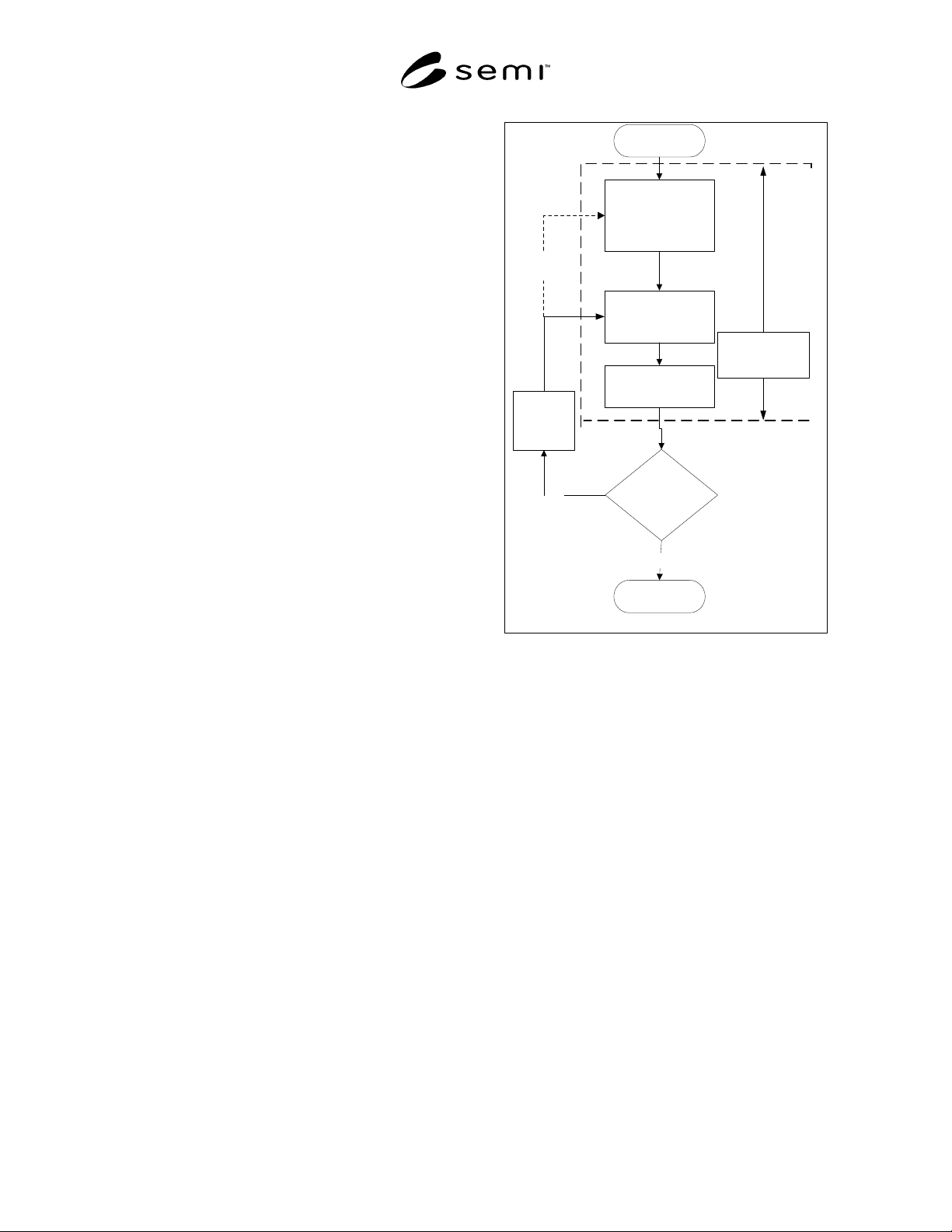
6.1.1 Figure 1 shows the essential steps of the risk
assessment and control process.
6.1.2 A risk assessment should be performed to
identify and evaluate potential hazards in the equipment
being assessed. Risk assessment should be initiated
early in the design phase and updated as the design
matures.
Prepare
(see 6.2)
Determination of the
use and limits of the
equipment (see 6.3)
Hazard identification
(see 6.4)
Risk estimation
(see 6.5)
Risk
evaluation:
reduction needed?
(see 6.6)
Implement
risk
reduction
(See 6.7)
RISK
ASSESSMENT
see
6.1.3
END
No
Yes
Figure 1
Risk Assessment Flowchart
6.1.3 After a significant modification (i.e. one that can
introduce new hazards and/or risks in the design),
reconsideration of use and limits of the equipment may
be necessary (see Figure 1).
6.2 Preparations for Hazard Identification and Risk
Estimation Process
6.2.1 The assessment should be carried out by those
with the necessary knowledge and experience of the
task, equipment, or process being assessed.
NOTE 5: To have an effective process, good preparation is
essential.
6.2.2 Select the reviewers (e.g., designers, equipment
manufacturers, field engineers, end-users, third party
evaluators, a risk assessment leader and someone with
experience in hazard identification).
6.2.3 Select the risk assessment technique.
6.2.4 Collect information on the design (e.g., drawings,
mock-up, and hardware).
6.2.5 Determine the scope of the assessment.

SEMI S10-1103 © SEMI 1996, 2003 3
6.3 Define Use and Limits of the Equipment —
Consider at least the following aspects:
• Lifecycle stages,
• Person(s) involved,
• Areas in which equipment is used,
• Support equipment intended to be used with the
equipment, and
• Chemicals or family of chemicals to be used in the
equipment.
6.3.1 All lifecycle stages should be considered during
the hazard identification e.g.:
• Design & development
• Equipment manufacturing
• Transportation
• Install
• Maintenance & Service
• Use
• Modification
• Decommissioning
• Disposal (include reuse, recycling)
6.4 Hazard Identification — Identify anticipated
hazards that could result, in a reasonably foreseeable
scenario, in harm at each lifecycle stage by using an
appropriate technique. Hazards can be identified under
those headings defined in SEMI S2.
NOTE 6: See Related Information 1 for an example of a
checklist to assist in identifying hazards and Related
Information 2 for examples of hazard analysis techniques.
6.5 Risk Estimation
6.5.1 There are numerous ways of estimating the risk
associated with a hazard. Some risk estimates are based
on identifying the observed and reasonably foreseeable
outcomes from a hazard and assigning an expected
frequency to each (see Section 6.5.2). Other risk
estimates are obtained by comparing the equipment
qualitatively to similar equipment (see Section 6.5.3).
6.5.2 The risk estimation using outcome and frequency
consists of several parts:
6.5.2.1 Identification of each observed or reasonably
foreseeable outcome of a hazard.
6.5.2.2 Assignment of a severity group to each
outcome. The preferred severity groups are given in
Table A1-1.
6.5.2.3 Assignment of a likelihood group to an
outcome representing each severity group. The
preferred likelihood groups are given in Table A1-2.
The likelihood, also called the Probability of
Occurrence of Harm can be a function of:
• Frequency and duration of exposure to the hazard,
• Probability of the occurrence of harm during
exposure, and
• Probability of avoiding harm during exposure,
based on the presence, the extent, or the lack of
controls.
6.5.2.4 Identification of the overall risk associated with
the hazard, using a suitable table. The preferred risk
category assignments are given in Table A1-3.
6.5.2.4.1 The risk for each severity/likelihood
combination should be determined.
6.5.2.4.2 The greatest risk from all of the combinations
should be considered the overall risk for the hazard.
6.5.3 Benchmark Method — Benchmarks an
anticipated or observed hazardous situation against a
similar situation. Based on the circumstances in which
the hazard occurs, a risk category (Very High to Very
Low) is assigned to the risk.
NOTE 7: Benchmarking method should only be used if
sufficient adequate and reliable information is available on a
similar model or situation.
6.6 Risk Evaluation
6.6.1 Each hazard or set of hazards is evaluated to
decide if risk reduction is needed.
6.6.2 Risk evaluation can be an individual internal
process for the equipment manufacturer or the
equipment user, or a joint effort by all involved parties.
NOTE 8: This document does not establish a level of risk for
which reduction is required. In the evaluation of risk
reduction, various aspects may be taken into account,
including:
• Customer expectations,
• Social expectations,
• Feasibility (e.g., Costs, technical possibility),
• Legal requirements,
• Industry accident history,
• International industry standards, and
• Good engineering and manufacturing practices.
6.7 Risk Reduction
6.7.1 The risk assessment may be used to assist in the
identification and selection of control measures to

SEMI S10-1103 © SEMI 1996, 2003 4
reduce the risk. Following risk reduction measures, the
assessment may need to be reviewed.
NOTE 9: This document does not specify risk reduction
measures that may be necessary following risk assessment.
SEMI S2 suggests that the following should be considered in
the design and construction of equipment:
• Regulatory requirements,
• SEMI guidelines,
• International industry standards, and
• Good engineering and manufacturing practices.
7 Documentation
7.1 The risk assessment, evaluation, and reduction
should be documented and the documentation should
contain at least the following:
• risk assessment technique used,
• reviewers,
• date,
• identification of the equipment considered,
• hazards identified,
• risk estimation,
• the criteria used to determine if risk reduction is
required,
• risk evaluation, and
• control measures implemented to reduce the risk
from identified hazards.
NOTE 10: The risk assessment documentation can be used as
input for safety reviews, e.g., SEMI S2, S8 or S14 report.
8 Related Documents
8.1 SEMI Standards
SEMI S8 — Safety Guidelines for Ergonomics
Engineering of Semiconductor Manufacturing
Equipment
8.2 US Military Standards
1
MIL STD 1629A — Failure Modes, Effects and
Criticality Analysis
MIL STD 882D — Standard Practice for System Safety
8.3 International Electrotechnical Commission
Standards
2
1 Available through the Naval Publications and Forms Center, 5801
Tabor Avenue, Philadelphia, PA 19120-5099, USA. Telephone:
215.697.3321
IEC 60812 — Analysis Techniques for System
Reliability - Procedure for Failure Mode and Effects
Analysis (FMEA)
IEC 61025 — Fault Tree Analysis (FTA)
IEC 61508-5: (1999-04) — Functional Safety of
Electrical/Electronic/Programmable Electronic Safety
Related Systems - Part 5: Examples of Methods for the
Determination of Safety Integrity Levels
IEC 61508-5:(1998-12) — Related Systems - Part 5:
Examples of Methods for the Determination of Safety
Integrity Levels
8.4 ANSI Standards
3
ANSI/RIA R15.06: 1999 — Industrial Robots and
Robot Systems — Safety Requirements
ANSI B11 TR3-2000 — Risk Assessment and Risk
Reduction – A Guide to Estimate, Evaluate and Reduce
Risks Associated with Machine Tools
8.5 ISO Standards
4
ISO 14121: 1999 — Safety of machinery - Principles
for risk assessment
ISO/TR 13849-1:1999/EN 954-1: — Safety of
machinery - Safety-related parts of control systems.
Part 1: General principles for design
ISO/TR 12100-1:1992/EN 292-1: — Safety of
machinery - Basic concepts, general principles for
design. Part 1: Basic terminology, methodology
ISO/TR 12100-2:1992/EN 292-2: — Safety of
machinery - Basic concepts, general principles for
design. Part 2: Technical principles and specifications
8.6 Other Documents
SEMATECH
5
#9202963A-ENG; — Failure Mode and
Effects Analysis (FMEA): A Guide for Continuous
Improvement for the Semiconductor Equipment
Industry
2 Available through the International Electrotechnical Commission,
3, rue de Varembé, Case Postale 131, CH-1211 Geneva 20,
Switzerland. Telephone: 41.22.919.02.11; Fax: 41.22.919.03.00
Website: http://www.iec.ch
3 Available through the American National Standards Institute, New
York Office: 11 West 42nd Street, New York, NY 10036, USA.
Telephone: 212.642.4900; Fax: 212.398.0023 Website:
http://www.ansi.org
4 Available through the International Organization for
Standardization, ISO Central Secretariat, 1, rue de Varembé, Case
postale 56, CH-1211 Geneva 20, Switzerland. Telephone:
41.22.749.01.11; Fax: 41.22.733.34.30 Website: http://www.iso.ch
5 Available through International SEMATECH, 2706 Montopolis
Drive, Austin, TX, USA website: http://www.sematech.org