semi合集-English.pdf - 第2565页
SEMI E90-0705 © SEMI 1999, 2005 5 7 Overvie w 7.1 Purpose of Substrate Tracking 7.1.1 Substrate tracking consists of the fo llowing capabilities, as described below: 7.1.2 Substrate Loc ation Tracking — Substrate Locatio…

SEMI E90-0705 © SEMI 1999, 2005 4
6.4 Service Message Representation
6.4.1 Service Resource Definition — A service resource definition table defines the specific sets of messages for a
service group, as shown in the following table:
Message Service Name Type Description
Message name N or R Purpose of the service.
6.4.1.1 Type can be either N = Notification or R = Request. Notification type messages are initiated by a service
provider and the provider does not expect to get the response from the service user or requester.
6.4.1.2 Request messages are initiated by a service user or requester. The Request message asks for data or an
activity from the provider. Request messages expect a specific response message (no presumption on the message
context).
6.4.2 Service Parameter Dictionary — A service parameter dictionary table defines the parameters for one or more
services, as shown in the following table:
Parameter Form Description
Parameter X Data type The parameter called X is B in A.
6.4.2.1 A row is provided in the table for each parameter of the service. The first column contains the name of the
parameter. This is followed by columns describing form and contents of the corresponding primitive.
6.4.2.2 The Form column is used to indicate the type of data contained in a parameter. (See ¶5.2 for definitions.)
6.4.2.3 The Description column in the Service Parameter Dictionary table describes the meaning of the parameter,
the values it can assume, and any interrelationships with other parameters.
6.4.2.4 To prevent the definition of numerous parameters named “XxxList”, this document adopts the convention of
referring to the list as “(List of) Xxxx”. In this case, the definition of the variable Xxx will be given, not of the list.
The term “list” indicates a collection (or set) of zero or more items of the same data type. Where a list is used in
both the request and the response, the list order in the request is retained in the response. A list must contain at least
one element unless zero elements are specifically allowed.
6.4.3 Service Message Definition — A service message definition table defines the parameter used in a service, as
shown in the following table:
Parameter Req/Ind Rsp/Conf Description
Parameter X see below see below A description of the service.
6.4.3.1 The columns labeled Req/Ind and Rsp/Conf link the parameters to the direction of the message. The
message sent by the initiator is called the “Request”. The receiver terms this message the “Indication”. The receiver
may then send a “Response”, which the original sender terms the “Confirmation”.
6.4.3.2 The following codes appear in the Req/Ind and Rsp/Conf columns, and are used in the definition of the
parameters (e.g., how each parameter is used in each direction):
“M” — Mandatory Parameter – must be given a valid value.
“C” — Conditional Parameter – may be defined in some circumstances and undefined in others. Whether a value
is given may be completely optional or may depend on the values of other parameters.
“U” — User-Defined Parameter
“-” — The parameter is not used.
“=”— (for response only) Indicates that the value of this parameter in the response shall match the value in the
primary (if defined).

SEMI E90-0705 © SEMI 1999, 2005 5
7 Overview
7.1 Purpose of Substrate Tracking
7.1.1 Substrate tracking consists of the following capabilities, as described below:
7.1.2 Substrate Location Tracking — Substrate Location Tracking provides the capability to determine the current
location of substrates in the equipment. The indication of the substrate location will help the user to understand the
environment to which the substrate is exposed in the equipment.
7.1.3 Batch Location Tracking — Batch Location Tracking provides the capability to determine the current location
of a group of substrates in the equipment. Typical example of a substrates group is a batch in batch process
equipment.
7.1.4 Substrate History Record — Substrate History Record provides the capability to read the history of substrates
in the equipment. The user can inquire about the history of a particular substrate, substrate location, or batch location
with substrate position in a batch. A history includes the series of locations that the substrate has visited in the
equipment.
7.1.5 Substrate Process Tracking — Substrate Process Tracking provides the capability of tracking current
substrate processing state. For example, the user may determine whether a substrate is processed or not by
requesting its state when the process has been completed abnormally. The user may use the state transitions to
trigger wafer level data collection.
7.2 View of Substrate Tracking
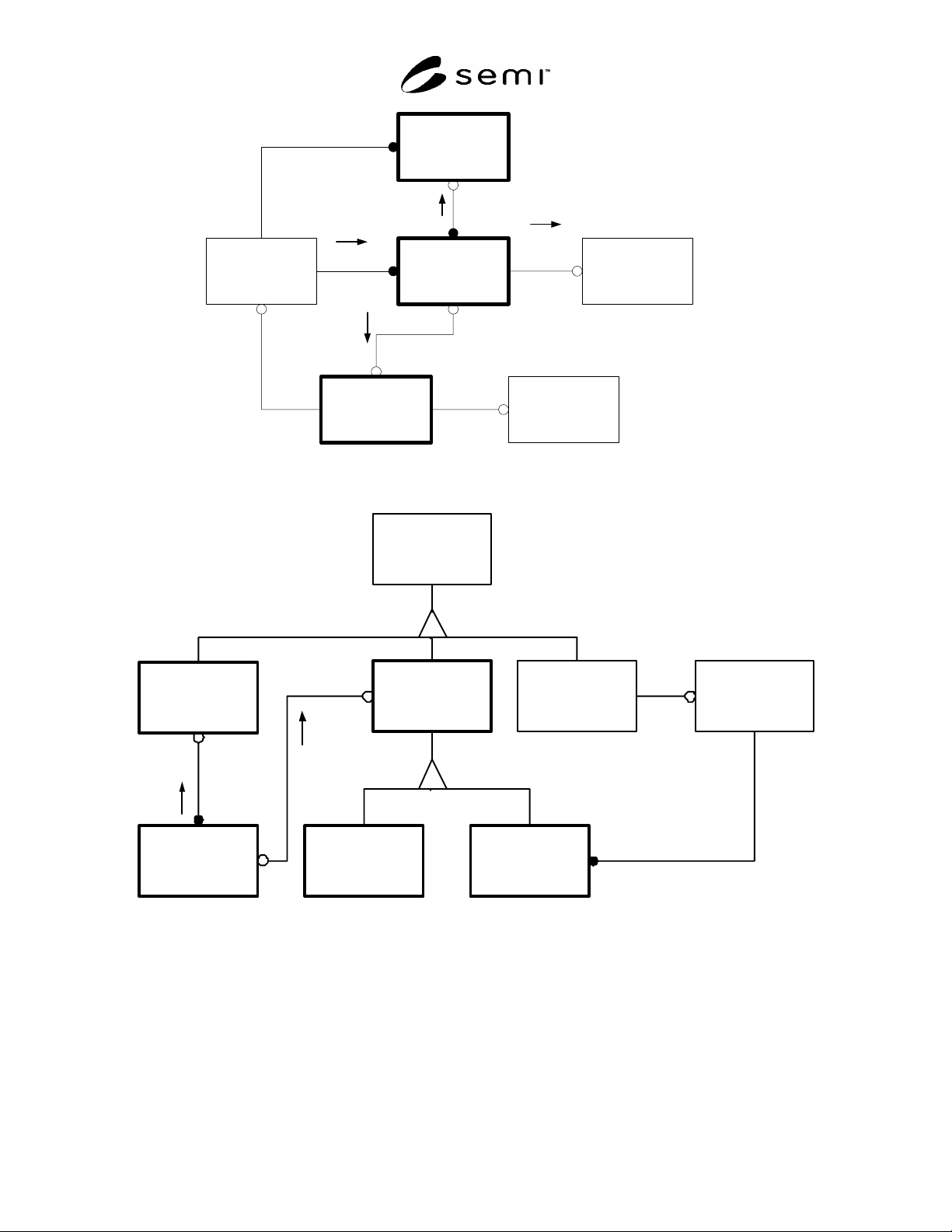
7.2.1 Figure 1 shows the view of Substrate Tracking using the OMT representation. It is assumed that substrates are
available before usage of the services. Substrate carriers may or may not be used to load the substrates to the
equipment. Substrates are loaded into the equipment and travel through substrate locations and batch locations. The
equipment must maintain all information necessary to track substrates in the equipment.
7.3 Substrate Location and Batch Location
7.3.1 A substrate location is a discrete position that can hold a substrate in the equipment. This document will not
define where the substrate location exists. Substrate locations shall be determined by the design of equipment and
the applications. For example, to track the order of process chambers that is applied to a substrate process in a multi-
chamber single wafer process equipment, it is appropriate to designate process chambers for substrate locations. On
the other hand, in batch process equipment, process chambers are designated for batch locations and substrate
locations are not used to track the order of process chambers that is applied to the substrates of a batch. All substrate
locations shall be documented by the equipment supplier.
7.3.2 Batch Location indicates the physical location of a group of substrates (e.g., batch) on the equipment.
Generally in batch process equipment, Batch Location is assigned to a process chamber and changed when a batch is
transferred from one chamber to another. Individual substrate positions in a batch (e.g., slot positions of a batch
container or a process carrier) might be informed with Batch Location. Batch Locations and notation of the
substrate positions in a batch are defined and documented by the equipment supplier.
7.3.3 Figure 2 shows the concept of the substrate location using OMT representation. This figure is provided to
clarify the definition of locations.
SEMI E90-0705 © SEMI 1999, 2005 6
Substrate Lot
belongs
to
Equipment
Processes
1+
Substrate
Location
1+
held
Substrate
Carrier
1+
Batch
Location
held
provides
provides
Figure 1
Overview of Substrate Tracking
Car r ier
Location
Carrier
holds
Substrate
Location
Equipment
Substrate
Location
Car rier
Substrate
Location
Mater ial
Location
Substrate
has
Batch
Location
held
held
Figure 2
Concept of Substrate Location
7.3.4 Material Location is classified into Substrate Location, Batch Location, and Carrier Location. A Carrier
Location may hold a carrier, a Substrate Location may hold a substrate, and a Batch Location may hold a group of
substrates. Typical example of a substrates group is a batch in batch process equipment.
7.3.5 Substrate Location is classified into Equipment Substrate Location and Carrier Substrate Location. Carrier has
Carrier Substrate Locations. A Carrier Substrate Location is the location which can hold a substrate in a carrier. An
Equipment Substrate Location is the location which can hold a substrate on the equipment resource.
7.3.6 Substrate travels on substrate locations and/or batch locations.