semi合集-English.pdf - 第234页
SEMI E35-0305 © SEMI 1995, 2005 3 5.1.12 TP — Throughput 5.2 Definitions 5.2.1 alpha error — the error that occurs when a conforming item is incorrectly reported as nonconforming. This is also called Type I error. 5.2.2 …
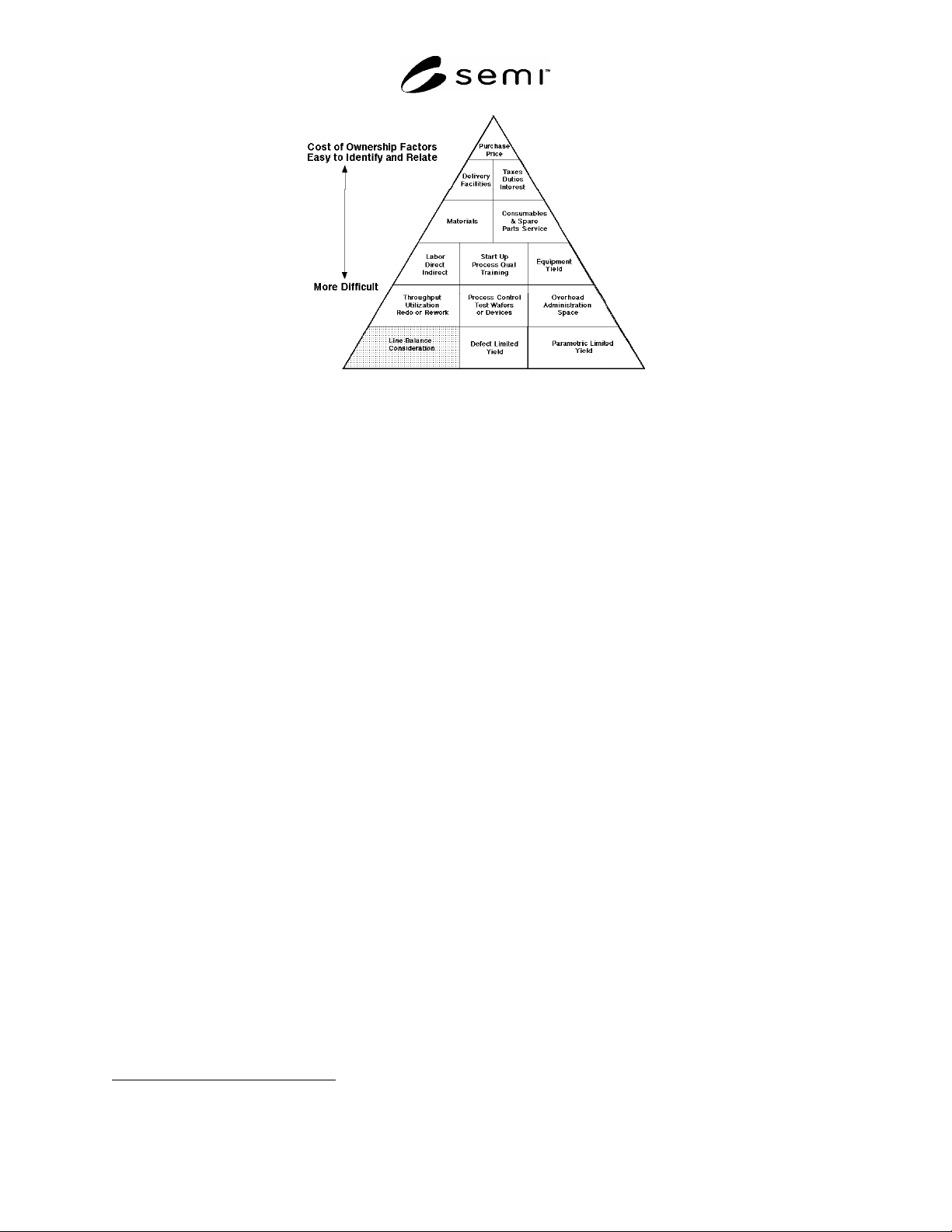
SEMI E35-0305 © SEMI 1995, 2005 2
Figure 1
Relationship of Factors to Difficulty of Collection and Validation
4 Referenced Standards
4.1 SEMI Standards
SEMI E10 — Specification for Definition and Measurement of Equipment Reliability, Availability, and
Maintainability (RAM)
SEMI E81 — Provisional Specification for CIM Framework Domain Architecture
SEMI E89 — Guide for Measurement System Capability Analysis
4.2 ISO Document
1
International Vocabulary of Basic and General Terms in Metrology, Second Edition [VIM]
NOTICE: Unless otherwise indicated, all documents cited shall be the latest published versions.
5 Terminology
5.1 Abbreviations and Acronyms
5.1.1 CEO — Cost of equipment ownership
5.1.2 COO — Cost of ownership
5.1.3 CYL — Cost of yield loss
5.1.4 DLY — Defect limited yield
5.1.5 ER — Equipment required (integer number)
5.1.6 EY — Equipment yield
5.1.7 GUE — Good unit equivalents
5.1.8 P/T — Precision-to-tolerance (ratio)
5.1.9 PLY — Parametric limited yield
5.1.10 PRY — Product yield
5.1.11 PU — Production utilization (total)
1 International Organization for Standardization, ISO Central Secretariat, 1, rue de Varembé, Case postale 56, CH-1211 Geneva 20, Switzerland.
Telephone: 41.22.749.01.11; Fax: 41.22.733.34.30, Website: /www.iso.ch

SEMI E35-0305 © SEMI 1995, 2005 3
5.1.12 TP — Throughput
5.2 Definitions
5.2.1 alpha error — the error that occurs when a conforming item is incorrectly reported as nonconforming. This is
also called Type I error.
5.2.2 alpha probability,
— the probability of an alpha error, also called the alpha error rate.
5.2.3 baseline cost of ownership — a constrained version of cost of ownership (COO) that only includes equipment
yield [i.e., defect limited yield and parametric limited yield are not included].
5.2.4 beta error — the error that occurs when a nonconforming item is incorrectly reported as conforming. This is
also called Type II error.
5.2.5 beta probability,
— the probability of a beta error, also called the beta error rate.
5.2.6 bias,
— the difference between the mean value of measurements made on the same object and a true value.
NOTE 3: In many cases the true value of bias is unknown. A value established by reference gauges or a consensus value may be
used as a substitute.
5.2.7 comprehensive cost of ownership — cost of ownership (COO) calculated with no constraints.
5.2.8 constrained cost of ownership — cost of ownership (COO) version with a set of defined restrictions to
facilitate comparisons or to remove ambiguity.
5.2.9 consumable — part of the piece of equipment that is worn out by the process operation of the piece of
equipment and requires replacement after less than one year of operation.
5.2.10 cost footprint — the area (A) of the smallest horizontal rectangle that contains all of the shadow footprint
and half of the easement space around the piece of equipment. This is calculated as:
DeDsDeWeWsWtA
2/12/1 (1)
DsDeWsWe
4/1
where:
De = Depth of the piece of equipment
Ds = Combined depth of the piece of equipment and easement space
We = Width of the piece of equipment
Ws = Combined width of the piece of equipment and easement space
5.2.11 cost of equipment ownership (CEO) — a factor in cost of ownership that includes all costs not associated
with yield loss.
5.2.11.1 Discussion — See ¶ 6.4 and ¶8.3 for more details.
5.2.12 cost of ownership (COO) — full cost of embedding, operating, and decommissioning in a factory
environment equipment needed to accommodate the required volume of production units.
5.2.13 cost of yield loss (CYL) — a unit lost at the end of a given step represents the loss of the cost of the starting
unit and the manufacturing to that point. In addition, units leaving a step may be lost at some later step. Calculating
CYL therefore requires knowing the starting unit cost and the accumulated cost of manufacturing before the unit is
lost. Therefore, CYL should be tracked as a separate cost for factory optimization.
5.2.14 cumulative distribution function (CDF) — a mathematical formula that describes the probability a
measurable event occurs at or below a specific value.
5.2.15 default or default value — a value to be used if actual data are not available. Also called example value.
Where possible, actual data should be used in COO calculations.
5.2.16 defect limited yield (DLY) — the fraction of units that are not lost from defects added by the equipment. For
wafer processing, defect yield is usually derived from a model.

SEMI E35-0305 © SEMI 1995, 2005 4
5.2.17 distribution — a characterization of the probability of realization for a measurable event over the range of
values that the measurements may assume.
5.2.18 easement space — the floor space that must remain clear to the rear and sides of the piece of equipment (but
not in front of the load face plane). This includes safety aisles, ergonomic maintenance access space, component
removal space, and room for doors to swing out.
5.2.19 equipment required (ER) — the integer number of pieces of equipment required to obtain the throughput for
the step.
5.2.20 equipment throughput — see throughput.
5.2.21 equipment yield (EY) — the fraction of units received by the equipment that can be passed to the next step
based on any criteria such as damaged units, or units determined to be defective by inspection or test. Inclusion of
equipment yield results in a decreasing population of units flowing through the factory. At later steps, equipment
will process fewer units than the full factory unit starts. For test equipment, validly rejected units are scrap, but not
a component of equipment yield.
5.2.22 fixed costs — costs incurred once and usually associated with the acquisition and incorporation of a piece of
equipment into the factory.
5.2.23 good unit equivalents (GUE) — the calculated number of equivalent units required to produce the same
number of units output if product yield was 100%.
5.2.24 joint probability — a probability density or cumulative distribution function comprised of two or more
random variables.
5.2.25 lifetime — the time over which the fixed and recurring costs are spread on an annualized basis.
5.2.25.1 production lifetime — the number of years a piece of equipment is used for manufacturing.
5.2.25.2 tax lifetime — the number of years as defined in compliance with local tax or accounting depreciation
practices.
5.2.26 lower specification limit (LSL) — value of a characteristic, below which a product is said to be
nonconforming.
5.2.27 material — bulk gas, specialty gas, or general or specialty chemical used in the process. Includes monitor
units consumed in the support of the piece of equipment.
5.2.28 measurand — particular attribute of a phenomenon, body, or substance subject to measurement [VIM].
5.2.29 measurement variability — differences associated with making multiple measurements on a given
measurand under specific conditions.
NOTE 4: Common (general) estimators of measurement variability are the variance, standard deviation, and variance
components. Specific estimators include repeatability and reproducibility.
5.2.30 monitor unit — test or filler unit (e.g., wafer or device) consumed in the support of the piece of equipment.
Also called test unit.
5.2.31 operational uptime (OU) — the percentage of time the piece of equipment is in a condition to perform its
intended function during the period of operations time. This calculation is intended to reflect overall operational
performance for a piece of equipment (SEMI E10).
5.2.31.1 Discussion — As defined, OU has components attributable to both the unit manufacturer and the
equipment supplier.
5.2.32 parametric limited yield (PLY) — the fraction of units that are not lost from device parameters being outside
the required range.
5.2.33 precision-to-tolerance (P/T) ratio — ratio of the precision of a measurement system (MS) to the tolerance
(i.e., absolute magnitude of the full range of the product specification) (SEMI E89).
5.2.34 probability density function (PDF) — a mathematical formula that specifies the relationship between values
that a random variable may assume and their likelihood of occurrence. It is the first derivative of the CDF.