semi合集-English.pdf - 第4669页
SEMI C3.56-06 00 © SEMI 2000 1 SEMI C3.56-0600 SPECIFICA TION FOR DIBORANE MIXTURES This specif ication was technic ally approved by the Global Ga ses Committee and is the direct responsib ility of the Europe an Ga ses C…
SEMI C3.32-0301 © SEMI 1987, 2001 6
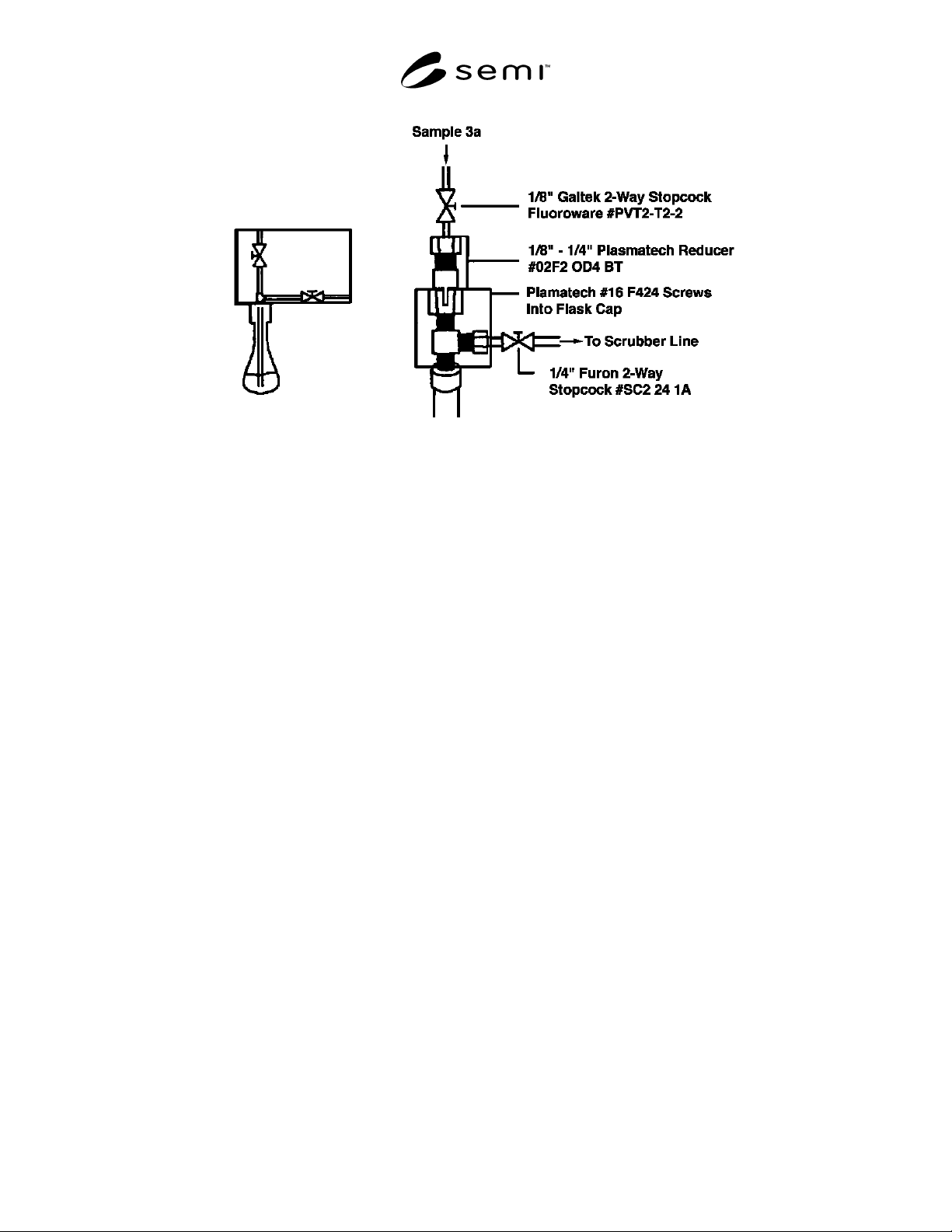
Figure 4
NOTICE: This specification does not purport to address safety issues, if any, associated with its use. It is the
responsibility of the user of this specification to establish appropriate safety and health practices and determine the
applicability of regulatory limitations prior to use. SEMI makes no warranties or representations as to the suitability
of the specification set forth herein for any particular application. The determination of the suitability of the
specification is solely the responsibility of the user. Users are cautioned to refer to manufacturer’s instructions,
product labels, product data sheets, and other relevant literature respecting any materials or equipment mentioned
herein. This specification are subject to change without notice.
The user’s attention is called to the possibility that compliance with this specification may require use of
copyrighted material or of an invention covered by patent rights. By publication of this specification, SEMI takes no
position respecting the validity of any patent rights or copyrights asserted in connection with any item mentioned in
this specification. Users of this specification are expressly advised that determination of any such patent rights or
copyrights, and the risk of infringement of such rights, are entirely their own responsibility.
Copyright by SEMI® (Semiconductor Equipment and Materials
International), 3081 Zanker Road, San Jose, CA 95134. Reproduction o
f
the contents in whole or in part is forbidden without express written
consent of SEMI.
SEMI C3.56-0600 © SEMI 20001
SEMI C3.56-0600
SPECIFICATION FOR DIBORANE MIXTURES
This specification was technically approved by the Global Gases Committee and is the direct responsibility of
the European Gases Committee. Current edition approved by the European Regional Standards Committee on
April 4, 2000. Initially available at www.semi.org May 2000; to be published June 2000.
1 Purpose
1.1 To define the specification and analytical methods
and validate the specifications for diborane mixtures.
2 Scope
2.1 Diborane is not used as a pure gas but as a mixture
with balance gases of N
2
, H
2
, Ar, He, or SiH
4
.
2.2 The quality of the mixture is affected by a number
of factors which include:
• the purity of the gases used for mixture
preparation;
• component filling precision;
• the cylinder preparation process and in-situ
reactions of diborane with the internal surface of
the cylinder.
2.2.1 Furthermore, the elapsed time after filling is
important due to the chemical instability, and hence
decomposition, of the diborane (see Appendix 1).
2.2.2 All component gases shall adhere to the
appropriate SEMI specification, if available.
2.3 The quality of the final mixture can be checked
after manufacturing by analyzing each cylinder for the
concentration of diborane and for key impurities
(tracers), namely H
2
, N
2
, O
2
.
2.4 This specification does not purport to address
safety issues, if any, associated with its use. It is the
responsibility of the users of this specification to
establish appropriate safety and health practices and
determine the applicability of regulatory limitations
prior to use.
3 Referenced Standards
3.1 DIN Standard
1
DIN 50457-1
NOTE 1: As listed or revised, all documents cited shall be the
latest publications of adopted standards.
1 Deutches Institut für Normung e.V., BeuthVerlag GmbH,
burggrafenstrasse 4-10, D10787 Berlin, Germany, www.din.de
4 Specifications
4.1 Mixing Tolerances
Concentration of Diborane Preparation Tolerance Level
10–999 ppm
± 20%
0.1–10%
± 5%
4.2 Analytical precision: Determination of Diborane
Content
Concentration of Diborane Analytical Precision
10–99 ppm
± 3%
100–999 ppm
± 2%
0.1–10%
± 2%
N.B. Analytical precision is based on at least 6 replicate
determinations
4.3 Impurities
4.3.1 In the final mixture the concentration of
impurities should fulfill the following condition:
()
•+
•= )(
100
)(
100
)()(
mainc
x
diboranec
x
mix
i
main
i
diborane
i
c
c
i
(mix) — concentration of impurity i in the
mixture (ppm)
c
i
(diborane) — maximum concentration of impurity i
in diborane (ppm)
c
i
(main) — maximum concentration of impurity i
in the balance gas (ppm)
x
(diborane)
— concentration of diborane in the
mixture (%)
x
(main)
— concentration of balance gas in the
mixture (%)
5 Analytical Procedure for t he Determination
of Diborane Concentration
NOTE 2: This procedure is for the determination of the
diborane content using a Fourier Transform Infrared analyzer.
5.1 Detection limit — 2 ppm (mole/mole)

SEMI C3.56-0600 © SEMI 2000 2
5.2 Instrument parameters
5.2.1 Cell path length
5.2.1.1 10 cm (mixtures 100 ppm to 10%)
5.2.1.2 10 m (mixtures up to 100 ppm)
Wavenumber 2444–2739 cm
-1
Resolution 4 cm
-1
5.2.2 Sample Flow
5.2.2.1 20 l/h at 10 cm path length
5.2.2.2 40 l/h at 10 m path length
5.3 Calibration standard — diborane in hydrogen
NOTE 3: Depending on the concentration of diborane and the
storage temperature the standard can be unstable (Section 5).
It is recommended to use an appropriate standard with a
diborane concentration as low as possible and to store it at
low temperature. If there are doubts about the stability of the
standard the diborane concentration can be verified by wet
chemical methods. (See DIN 50457-1.)
5.4 Operating Procedures
5.4.1 Purge the sampling system leading to the cell
and the cell with dry nitrogen for 15 minutes and until a
zero absorbance is obtained between 2444–2739 cm
-1
.
Then purge the cell with the calibration standard and
record the absorption of diborane. When a steady
absorbance reading is obtained, after approximately 5–
10 minutes, the true concentration of the standard shall
be recorded. Record the pressure in the gas cell using a
calibrated pressure-measuring device.
5.4.2 To determine the concentration of diborane in
the mixture set the sample flow through the cell
following the same procedures as detailed above.
Record the absorption at the same wave number as the
calibration standard. Ensure that gas cell pressures are
equal during calibration and the determination.
Calculate the concentration of diborane. The result must
conform to the specification in Section 4 of this
standard.