semi合集-English.pdf - 第7079页
SEMI S18-1102 © SEMI 2002 17 abatement syste m may be allo wed to start when a leak is detected. 18.5 Maintenance 18.5.1 The gas abatement system manufacturer should provide the user wit h recommended maintenance procedu…

SEMI S18-1102 © SEMI 2002
16
corrosive, these ports should be compatible with the
hazards presented.
17.3.3 Due to the hazards associated with silane family
gas deposits, only maintenance workers trained to
handle the potential for reactions, small fires or
explosions should be allowed to perform maintenance
on exhaust ducts for silane family gases.
17.3.3.1 Maintenance management should investigate
the thickness and composition of the deposits and
establish the proper method of maintenance.
17.3.3.2 If the investigation indicates the deposit is
reactive or unstable, a procedure to stabilize or
neutralize the deposit before opening the duct to air
should be implemented.
17.3.3.3 Equipment suppliers should also notify users
that stabilizing or neutralizing procedures provided in
the maintenance manuals might not work for exhaust
lines with multiple silane family gas-using systems
attached.
17.3.4 The exhaust piping should be designed to have a
means of monitoring the exhaust line for determining if
the exhaust line is blocked.
18 Exhaust Treatment Systems
18.1 Selection
18.1.1 Refer to SEMI F5 for techniques and
information to determine the appropriate abatement
(exhaust treatment) system.
18.1.2 The user should determine the composition,
concentration, absolute amount per minute and possible
phases (solid, liquid or gas) of all chemicals, to be
treated, before requesting quotations on abatement
systems. This information is very important to design
an appropriate abatement system.
18.1.3 The information should be provided for normal
operation and all reasonable foreseeable failures.
18.2 Absorbent Systems — Gas leak detection may
also be needed as breakthrough detection for absorbent
systems. To ensure that each gas treatment system
functions properly, it should have a gas detection and
alarm system that detects breakthrough of absorbent.
The location of sample points should be appropriate to
detect breakthrough of the absorbent according to the
treatment system instructions.
18.2.1 When breakthrough is detected, the gas source
which supplies silane family gas or other hazardous gas
to the equipment connected to the failed abatement
system should be shut off. Absorbent in the failed
abatement system should be replaced immediately.
Alternatively a switching system can be employed to
switch to a back-up absorbent bed or redundant
treatment system.
18.3 Design
18.3.1 Point-of-use gas abatement systems are
described in SEMI F5.
18.3.2 A gas abatement system should be selected with
consideration for both equipment and facilities.
18.3.3 Some gas abatement systems need enclosures.
Such enclosures should be monitored for leaks. Upon
leak detection, an alarm should be activated and the gas
source should be shut down.
18.3.4 When abnormal status of an abatement system
is detected, the gas source(s) which supply gas to the
equipment connected to the gas abatement system
should be stopped.
18.3.5 In a combustion-type gas treatment system, a
flame detector, an airflow rate sensor, an exhaust
temperature monitor and a gas concentration monitor at
the outlet could be used for detecting abnormal status of
those parameters.
18.3.6 If a wet-type gas abatement system is used
downstream of an adsorbent or combustion gas
treatment system, it should be designed to prevent
reverse flow of water into the upstream system.
Monitoring to determine any abnormal operating
condition of the wet-type system should be provided.
18.3.6.1 The system should also be equipped with a
water leak sensor.
18.4 Operation
NOTE 54: The concentrations of exhaust gas at the outlet of
a gas abatement system must not exceed the maximum
allowable concentrations established by laws and regulations
of the region where the system is used, even in an emergency
situation.
18.4.1 Adequate performance of the abatement system
should be ensured at all times.
NOTE 55: Constant monitoring of the concentration at the
outlet may be required by some jurisdictions. The source gas
may also have to be shut down if the emissions reach the
maximum allowable amount.
NOTE 56: It may not be necessary for abatement systems to
be constantly “on-line” in some jurisdictions when gas is
“stored” and not “dispensed”. In such a situation, the

SEMI S18-1102 © SEMI 2002
17
abatement system may be allowed to start when a leak is
detected.
18.5 Maintenance
18.5.1 The gas abatement system manufacturer should
provide the user with recommended maintenance
procedures considering the characteristics of silane
family gases and by-products in written form, even if
the manufacturer maintains the system. Maintenance
workers should be provided training as specified by the
manufacturer.
18.5.2 Interlocks or bypasses should be provided at
appropriate locations to stop the flow of process
effluent to the exhaust treatment system during
maintenance or malfunction.
18.5.3 After a malfunction alarm is activated, the
abatement system should not be automatically restarted.
The cause of the alarm should be carefully inspected
and maintenance or service of system should be
performed if necessary.
19 Related Documents
NOTE 57: As listed or revised, all documents cited shall be
the latest publications of adopted standards.
19.1 Compressed Gas Association
CGA P-32 Safe Storage and Handling of Silane and
Silane Mixtures
19.2 SEMATECH, Inc. / International SEMATECH,
Inc
9
.
96083168A-ENG Effects of Leak Size and
Geometry on Releases of 100% Silane (ESHB001)
96013067A-ENG Ignition Characteristics of
Releases of 100% Silane (ESHB001)
95092976A-ENG Comparative Analysis of a Silane
Cylinder Delivery System and a Bulk Silane
Installation (ESHB001)
94062405A-ENG Silane Safety Improvement
Project S71 Final Report
19.3 Factory Mutual Property Loss Prevention Data
Sheet, 7-7
10
Semiconductor Fabrication Facilities
NOTICE: SEMI makes no warranties or
representations as to the suitability of the guideline set
9 SEMATECH Inc./International SEMATECH Inc., 2706 Montopolis
Drive, Austin, TX 78741-6499 (or www.sematech.org)
10 Factory Mutual Engineering, 1151 Boston-Providence Turnpike
(PO Box 9102) Norwood, MA, 02062 or http://www.fmglobal.com;
(877) 364-6726 (toll free for U.S. & Canada) or (781) 255-4681, or
print out an order formand fax it to us at (781) 255-4359.
forth herein for any particular application. The
determination of the suitability of the guideline is solely
the responsibility of the user. Users are cautioned to
refer to manufacturer’s instructions, product labels,
product data sheets, and other relevant literature
respecting any materials mentioned herein. This
guideline is subject to change without notice.
The user’s attention is called to the possibility that
compliance with this guideline may require use of
copyrighted material or of an invention covered by
patent rights. By publication of this guideline, SEMI
takes no position respecting the validity of any patent
rights or copyrights asserted in connection with any
item mentioned in this guideline. Users of this
guideline are expressly advised that determination of
any such patent rights or copyrights, and the risk of
infringement of such rights, are entirely their own
responsibility.
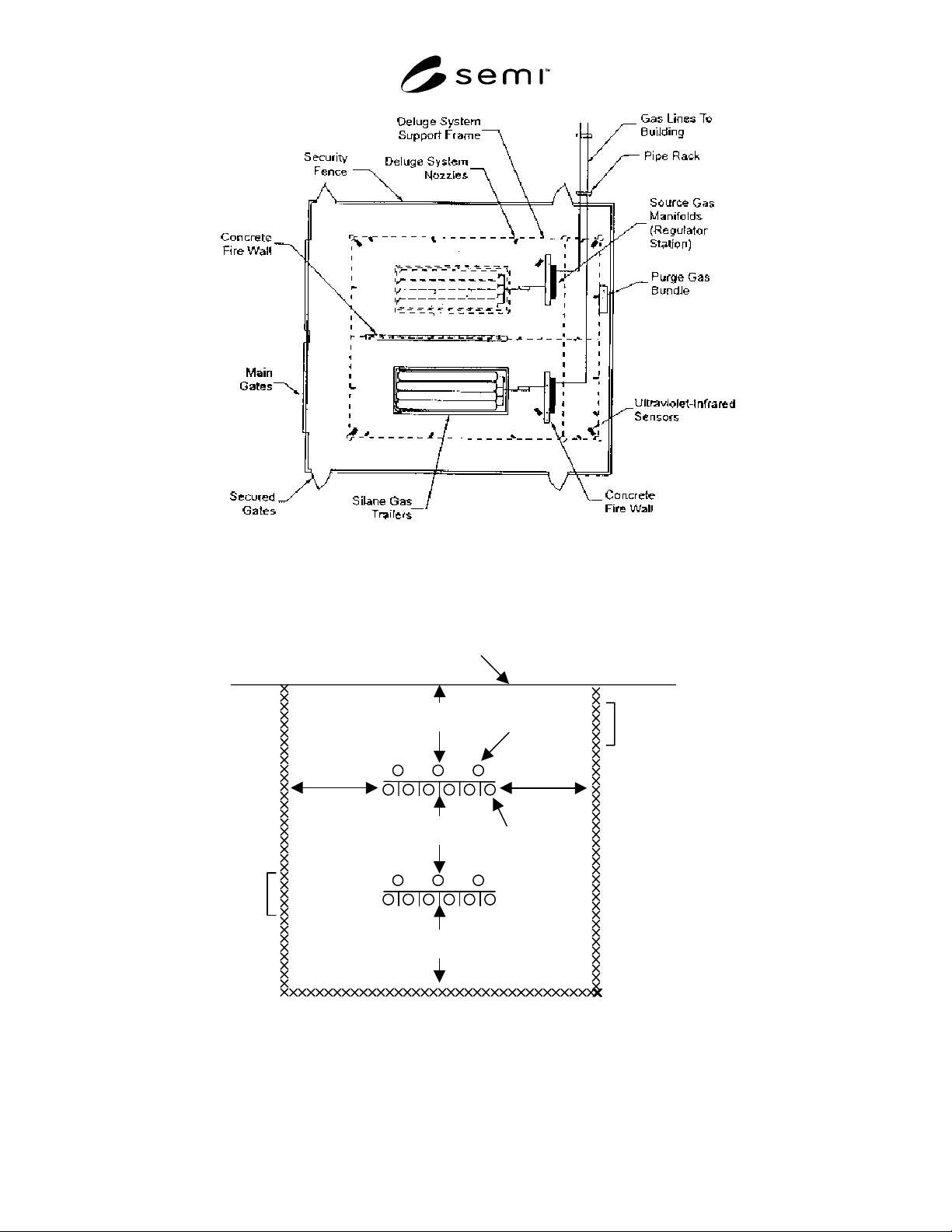
SEMI S18-1102 © SEMI 2002 18
© 2001 Factory Mutual Insurance Company. Reprinted with permission from FM Global Property Loss Prevention Data Sheet 7-7
‘Semiconductor Fabrication Facilities’
Figure 1
Bulk Silane Storage/Dispensing Facility
Fabrication building /Support building
Exit
Exit
Open chain-link fence
2.7m (9ft)
2.7m (9ft)
2.7m (9ft)
2.7m
(9ft)
2.7m
(9ft)
Purge
cylinders
Gas
cylinders
2.7 m
2.7 m (9 f t
)
2.7 m
2.7 m
(
9 f t
)
2.7 m
(
9 f t
)
(9 f t )
(9 f t )
© 2001 Factory Mutual Insurance Company. Reprinted with permission from FM Global Property Loss Prevention Data Sheet 7-7
‘Semiconductor Fabrication Facilities’
Figure 2
Exterior Dispensing Areas for Cylinder Rack System