semi合集-English.pdf - 第1918页
SEMI E54.1-1000 © SEMI 1996, 2000 24 Table 29 D M Instance Behavior State Transit ion Matrix* # Current State Trigge r New State Action Comment 1 INITIALIZED/ SE LF TES TIN G DM Object determ ines internally that the dev…
SEMI E54.1-1000 © SEMI 1996, 200023
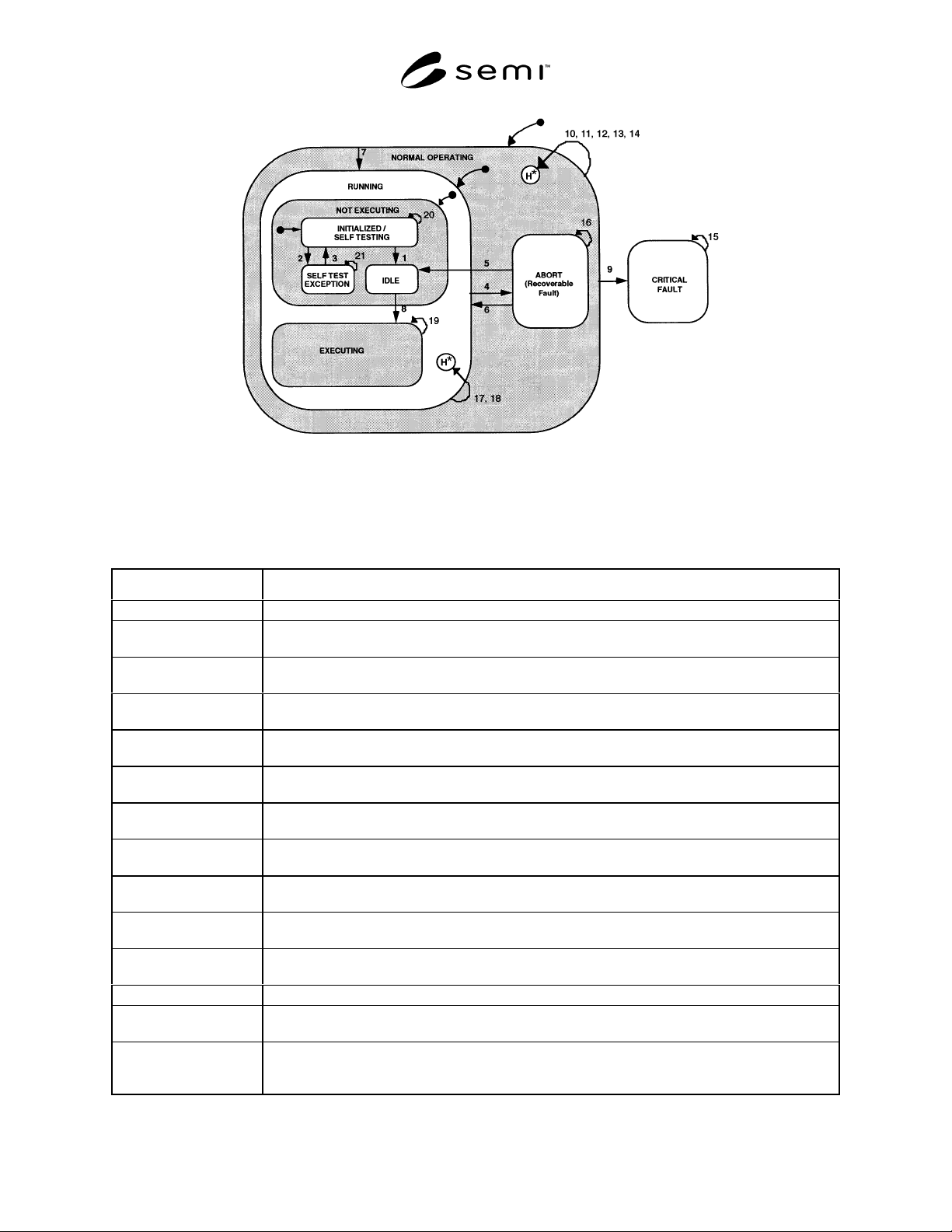
Figure 6
DM Object Instance Behavior*
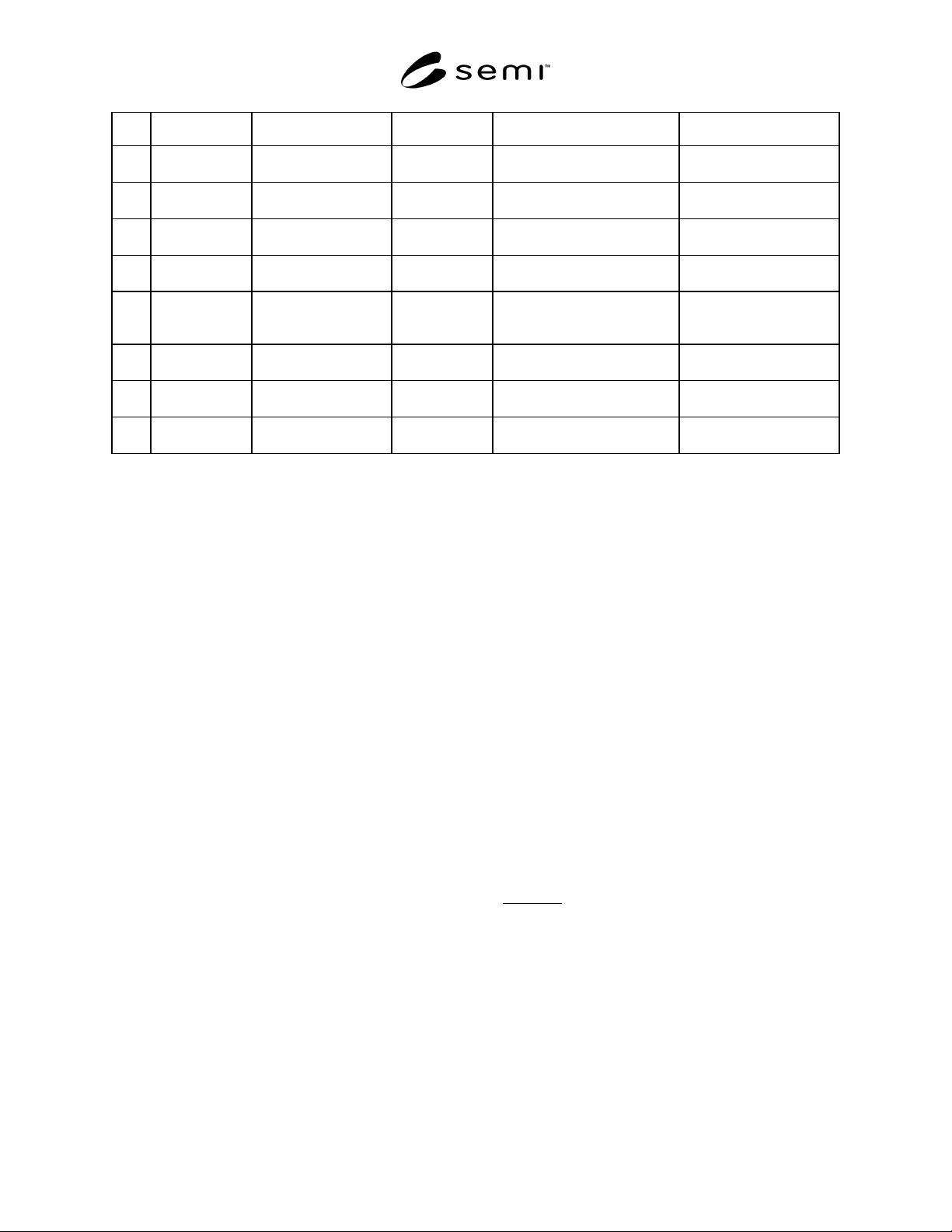
*Transitions 10 through 21 are recursive (i.e., the New State is the same as the Current State (including all nested sub-states)).
Table 28 DM Instance Behavior State Description
State Description
NORMAL OPERATING Object instance exists. Object services can be processed.
RUNNING This is the entry sub-state to NORMAL OPERATING. Object instance is not in an aborted state.
Object is capable of reporting attribute values, including exceptions.
NOT EXECUTING Device is not executing (e.g., it is not performing its device-specific function). A detailed description
of this state is outside the scope of this document.
This state may be further specified in an appropriate sensor/actuator network specific device model
specification.
EXECUTING Device is executing (e.g., it is performing its device-specific function). A detailed description of this
state is outside the scope of this document.
This state may be further specified in an appropriate sensor/actuator network specific device model
specification.
INITIALIZED/SELF
TESTING
This is the entry sub-state to NORMAL OPERATING and RUNNING.
Object instance exists and has been initialized; all attributes have appropriate initial values(as
indicated herein and in an appropriate sensor/actuator network specific device model specification).
Device is performing device-specific and device type-specific tests to determine if it is qualified to be
running.
Note that as this is a sub-state of RUNNING, object is not initialized unless it is capable of reporting
attribute values, including exceptions.
SELF TEST
EXCEPTION
Object has detected an exception condition during self testing. The details of the exception are stored
in the appropriate attribute values of the DM object.
IDLE Object and device have been initialized and have successfully completed self testing.
ABORT Object instance is in an aborted state; a detailed description of this state is outside the scope of this
document. The object will not initiate communication over the network while in this state.
CRITICAL FAULT The object (and device) are in a fault state from which there is no recovery. Object services cannot be
processed. The conditions required for exit from a critical fault are outside the scope of this
document.

SEMI E54.1-1000 © SEMI 1996, 2000 24
Table 29 DM Instance Behavior State Transition Matrix*
# Current State Trigger New State Action Comment
1 INITIALIZED/
SELF TESTING
DM Object determines
internally that the
device is initialized and
self test passed.
IDLE Set Device Status attribute to
appropriate value.
Device is in an idle state.
2 INITIALIZED/
SELF TESTING
One or more exceptions
reported as a result of
device testing.
SELF TEST
EXCEPTION
Report exceptions through
appropriate attribute settings in
DM object. Set Device Status
attribute to appropriate value.
Conditions resulting in the
reporting of a self test
exception are
device-specific.
3 SELF TEST
EXCEPTION
Exception condition
cleared.
INITIALIZED/
SELF TESTING
Set Device Status attribute to
appropriate value. Initiate self
testing procedure from
beginning.
Enter RUNNING/NOT
EXECUTING/INITIALIZ
ED/SELF TESTING.
4 RUNNING Abort request. ABORT Abort response. Set Device
Status attribute to appropriate
value.
Abort request may be
generated internally (e.g.,
as a result of Self Test
catastrophic failure).
5 ABORT Recover request;
Device Status attribute
value == ABORT
FROM IDLE
OREXECUTING.
IDLE Recover response. Set Device
Status attribute to appropriate
value.
Enter IDLE state.
6 ABORT Recover request;
Device Status attribute
value == ABORT
FROM INITIALIZED/
SELF TESTING OR
SELF TEST
EXCEPTION.
INITIALIZED/S
ELF TESTING
Recover response. Initiate self
testing procedure from
beginning. Set Device Status
attribute to appropriate value.
Enter RUNNING/NOT
EXECUTING/
INITIALIZED/SELF
TESTING.
7 NORMAL
OPERATING
Reset request. RUNNING Reset response. DM Object is
initialized. Set Device Status
attribute to appropriate value.
Valid for all sub-states of
NORMAL OPERATING.
Move to RUNNING/NOT
EXECUTING/
INITIALIZED/SELF
TESTING.
8 IDLE Execute service request
(this service request
may be
internally generated).
EXECUTING Execute response. Set Device
Status attribute to appropriate
value.
Device is now executing.
9 NORMAL
OPERATING
Critical Fault detected. CRITICAL
FAULT
The object (and device) is in a
fault state from which there is
no recovery. Object services
generally cannot be processed.
The mechanism for exit
from a critical fault is
device-specific.
10 NORMAL
OPERATING
GetAttribute or Set
Attribute request.
NORMAL
OPERATING
Get or Set Attribute appropriate
response.
Valid for all sub-states of
NORMAL OPERATING.
11 NORMAL
OPERATING
PerformDiagnostics
request.
NORMAL
OPERATING
PerformDiagnostics response.
Diagnostic is performed if
possible. Exceptions are set
within DM object as necessary.
Conditions which are
deemed exceptions are
device-specific.
12 NORMAL
OPERATING
Lock or Unlock request. NORMAL
OPERATING
Adjust write access to READ
only attributes of all device
objects as appropriate. Lock or
Unlock service response.
The mechanism for exit
from a critical fault is
device-specific.
13 NORMAL
OPERATING
GetExceptionQueue or
Clear Exception Queue
request.
NORMAL
OPERATING
GetExceptionQueue response
with appropriate exception
queue data. Clear appropriate
Valid for all substates of
NORMAL OPERATING.
SEMI E54.1-1000 © SEMI 1996, 200025
exception queue and send
service response.
14 NORMAL
OPERATING
Invalid service request. NORMAL
OPERATING
Error response to appropriate
request.
Valid for all sub-states of
NORMAL OPERATING.
15 CRITICAL
FAULT
Any service request. CRITICAL
FAULT
none Object services generally
cannot be processed.
16 ABORT Abort or Execute
request.
ABORT Error response. Not valid requests in this
state.
17 RUNNING Recover request. RUNNING Error response. Recover request only valid
while in ABORT state.
18 RUNNING Internally generated
PublishAttribute
Notification Service.
RUNNING Attribute Identified by Attribute
ID in PublishAttribute Service
is Published.
Notification only occurs if
specific conditions are met
(see Section 7.3.3).
19 EXECUTING Execute Request. EXECUTING Error response. Not a valid request in this
state.
20 INITIALIZED/
SELF TESTING
Execute service request. INITIALIZED/
SELF TESTING
Error response. Not a valid request in this
state.
21 SELF TEST
EXCEPTION
Execute service request. SELF TEST
EXCEPTION
Error response. Not a valid request in this
state.
* Transitions 10 through 21 are recursive (i.e., the New State is the same as the Current State (including all nested sub-states)).
The following also applies to DM behavior:
A DM instance service may be requested internally by
the DM object.
If a SetAttribute request is received over the network
for an attribute that is not network-settable, the attribute
value is not changed and an error service response is
generated.
When processing an Abort, Recover, or Reset service
request, the DM object issues a corresponding Abort,
Recover, or Reset service request to the SAC object.
While in the Abort state, the DM object will not initiate
communications over the network (e.g., it will not
initiate communication of exceptions over the network).
It may, however, communicate over the network in
response to service requests.
All DM services have the same behavior associated
with invalid service requests unless otherwise indicated.
Common service error responses are listed in Appendix
2.
The following identifies additional behavior associated
with specific values of DM object attributes:
The Device Status attribute value indicates the state of
the DM object (see Table 18). It is updated on
appropriate state transitions within the DM object (see
Table 29). Attribute values 1 through 6 represent valid
states. A value of zero indicates that the DM state is
unknown; conditions under which a zero value may
occur are outside the scope of this document.
The Reporting Mode attribute determines five different
conditions under which alarms and warnings are
reported through communication of the Exception
Status attribute (see Table 19). Both warnings and
alarms have separate values within Reporting Mode.
This allows alarms to be reported more aggressively
than warnings because alarms are presumably more
time-critical. The behavior associated with the five
Reporting Mode conditions which are used for both
alarms and warnings is described in the following
paragraphs. Optionality indicates that the mode may or
may not be supported; this optionality may be further
specified in a sensor/actuator network specific device
model and/or device manufacturer specification.
_ Request — When a bit in the status attribute
transitions from cleared to set, the device will not report
until requested. When the exception condition no longer
exists, both the exception status bit and the specific bit
in the exception detail attribute are cleared. In this
mode, a device may go in and out of an exception
condition without ever reporting the condition because
there has been no request. The device must always
respond to a request for exception conditions,
regardless of Reporting Mode state.
_ Optional RequestLatched — When a bit in the status
attribute transitions from cleared to set, the device will
not report until requested. When the exception
condition no longer exists, the exception status bit and
the specific bit in the exception detail attribute are not
cleared until they have been requested and reported.
This mode guarantees that a brief occurrence of an
exception condition will always be reported, barring an
unrecoverable communications error. Within each
exception variable, active bits will be cleared as they
are reported.