semi合集-English.pdf - 第2645页
SEMI E94.1-1104 © SEMI 2001, 2004 6 Attribute Name Attribute Da ta Form: SECS-II Structure “ProcessOrderMgmt” 51 (U1) ProcessOrderMgmt ProcessOrderMgm t is enumerated as fol lows: 1 = ARRIVAL 2 = OPTIMIZE 3 = LIST “PRJob…
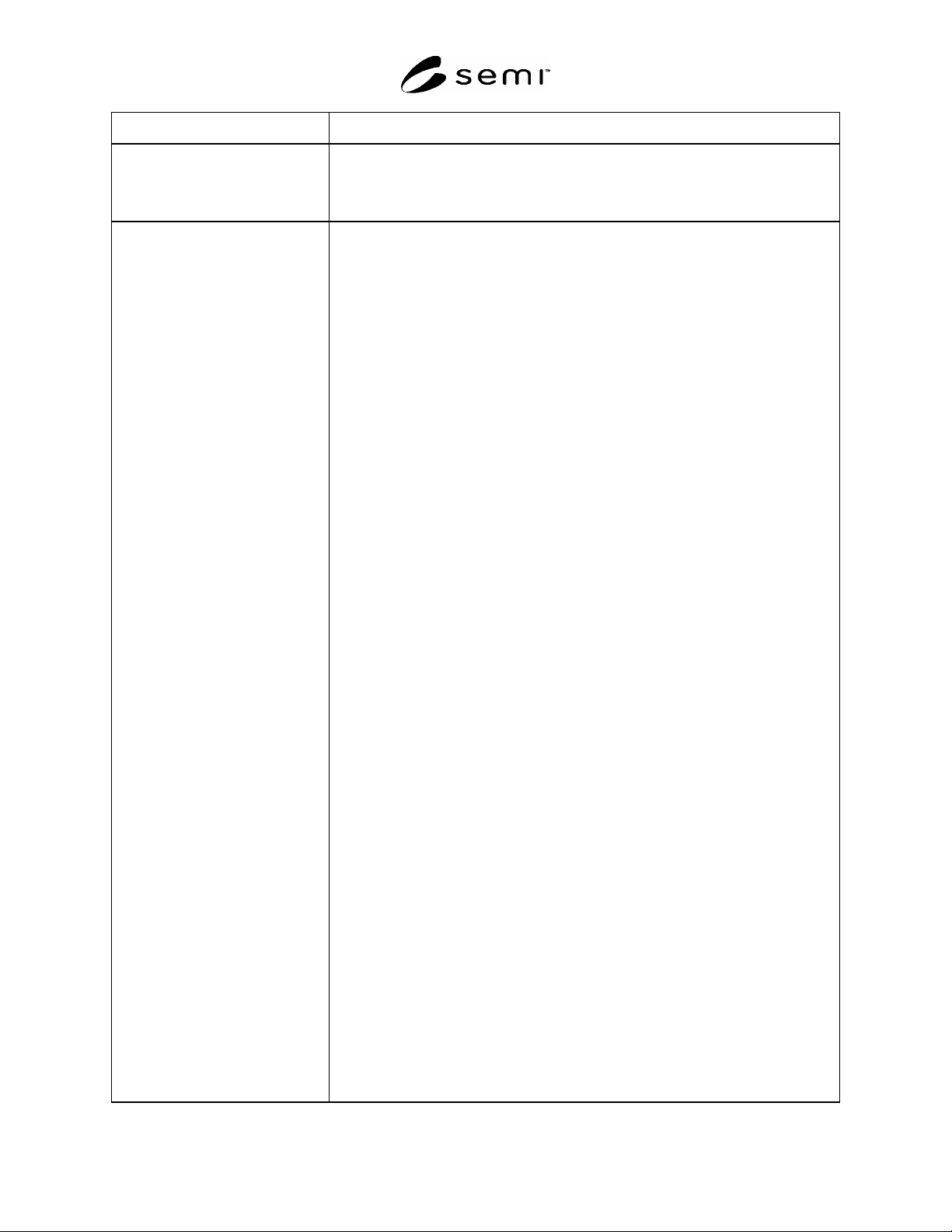
SEMI E94.1-1104 © SEMI 2001, 2004 5
Attribute Name Attribute Data Form: SECS-II Structure
“PauseEvent” L,n n = number of collection events
1. <CEID
1
>
…
n. <CEID
n
>
“ProcessingCtrlSpec” L,p p = number of process jobs assigned to control job
1. L,3
1. <PRJOBID
1
>
2. L,m ControlRule
1
1. L,2
1. 20 (A) RuleName
1
2. (Any format) RuleValue
1
…
m. L,2
1. 20 (A) RuleName
m
2. (Any format) RuleValue
m
3. L,n OutputRule
1
1. L,2
1. 51 (U1) MaterialStatus
1
2. (Any format) OutputRuleValue
1
…
n. L,2
1. 51 (U1) MaterialStatus
n
2. (Any format) OutputRuleValue
n
…
p. L,3
1. <PRJOBID
p
>
2. L,m ControlRule
p
1. L,2
1. 20 (A) RuleName
1
2. (Any format) RuleValue
1
…
m. L,2
1. 20 (A) RuleName
m
2. (Any format) RuleValue
m
3. L,n OutputRule
p
1. L,2
1. 51 (U1) MaterialStatus
1
2. (Any format) OutputRuleValue
1
…
n. L,2
1. 51 (U1) MaterialStatus
n
2. (Any format) OutputRuleValue
n
ControlRule
1) m = 0 indicates no ControlRule specified
2) RuleName and RuleValue are equipment specific
OutputRule
1) n = 0 indicates no OutputRule specified
2) There is no defined OutputRuleValue. The content and format of OutputRuleValue
is equipment dependent per SEMI E94 intent.
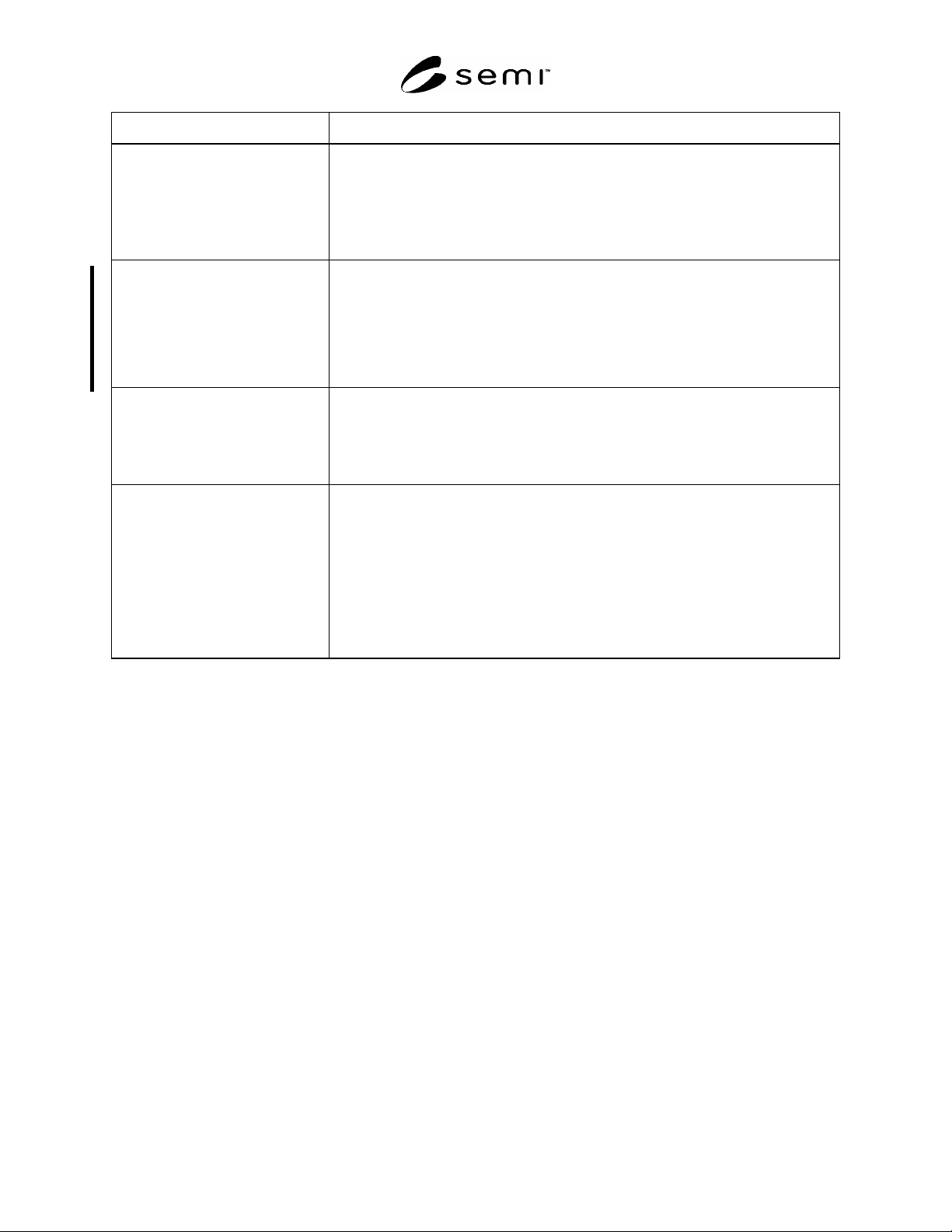
SEMI E94.1-1104 © SEMI 2001, 2004 6
Attribute Name Attribute Data Form: SECS-II Structure
“ProcessOrderMgmt” 51 (U1) ProcessOrderMgmt
ProcessOrderMgmt is enumerated as follows:
1 = ARRIVAL
2 = OPTIMIZE
3 = LIST
“PRJobStatusList”
L,n n = number of process jobs defined in the control job
1. L,2
1. <PRJOBID
1
>
2. <PRSTATE
1
>:
n. L,2
1. <PRJOBID
n
>
2. <PRSTATE
n
>
“StartMethod” 11 (BOOLEAN) StartMethod
StartMethod is as follows:
TRUE – Auto
FALSE – UserStart
“State” 51 (U1) State
State is enumerated as follows:
0 = QUEUED
1 = SELECTED
2 = WAITINGFORSTART
3 = EXECUTING
4 = PAUSED
5 = COMPLETED
NOTICE: SEMI makes no warranties or representations as to the suitability of the standards set forth herein for any
particular application. The determination of the suitability of the standard is solely the responsibility of the user.
Users are cautioned to refer to manufacturer's instructions, product labels, product data sheets, and other relevant
literature, respecting any materials or equipment mentioned herein. These standards are subject to change without
notice.
By publication of this standard, Semiconductor Equipment and Materials International (SEMI) takes no position
respecting the validity of any patent rights or copyrights asserted in connection with any items mentioned in this
standard. Users of this standard are expressly advised that determination of any such patent rights or copyrights, and
the risk of infringement of such rights are entirely their own responsibility.

SEMI E95-1101 © SEMI 2000, 20011
SEMI E95-1101
SPECIFICATION FOR HUMAN INTERFACE FOR SEMICONDUCTOR
MANUFACTURING EQUIPMENT
This specification was technically approved by the Global Information and Control Committee and is the
direct responsibility of the North American Information and Control Committee. Current edition approved
by the North American Regional Standards Committee on August 27, 2001. Initially available at
www.semi.org September 2001; to be published November 2001. Originally published February 2000.
1 Purpose
1.1 This standard addresses the area of processing
content with the direct intention of developing common
software standards, so that problems involving operator
training, operation specifications, and efficient develop-
ment can be resolved more easily.
1.2 This standard is written to be “tool-neutral” without
reference to, or reliance on, specific capabilities of
platforms or operating systems. Neither is it intended
that choices of software tools or detailed implement-
ation strategies be dictated.
1.3 Note that all figures in this standard are schematic,
are not drawn to scale, and unless otherwise specified,
are not intended to provide implementation details
about number of buttons, button sizes, panel sizes, etc.
2 Scope
2.1 This standard specification applies to
manufacturing equipment used in the production of
semiconductors.
2.2 This standard may be applicable to other areas such
as the manufacture of flat panel displays, but specific
application to these areas is outside the scope of this
document.
2.3 This standard does not purport to address safety
issues, if any, associated with its use. It is the
responsibility of the users of this standard to establish
appropriate safety and health practices and determine
the applicability of regulatory limitations prior to use.
3 Referenced Standards
None.
4 Terminology
4.1 condition — a property of a displayed object or
value (textual or numeric) that visually indicates, if
applicable, whether the current state of an object or the
current value violates the defined bounds of normal
operational states or parameters, whether that violation
is categorized as a minor exception (a caution) or a
severe exception (an alarm), and provides no visual
indication if no exception has occurred.
4.2 display objects — user interface elements
displayed on the screen, such as function selection
buttons, keyboard input buttons, graphics representing
the equipment, etc.
4.3 functional area — a grouping of one or more views
presenting information and control capabilities to the
user.
4.4 icon — an icon (diagrammatic image) is a bitmap
or other image used in GUI environments such as
windowing systems to show different types of objects,
improve operability, and help the user better understand
the functionality underlying buttons.
4.5 navigation model — the navigation model
determines how a user interacts with a system to access
functionality and information.
4.6 salience — a salience is a solid (or textured),
colored border shown around a display object to
indicate an alarm, caution, or other condition, or to
draw the user’s attention to the display object.
5 Requirements
5.1 Each of the following sections is designated with
one of the following labels:
5.1.1 Sections designated:
Description
provide background information and set
the context for subsequent specifica-
tions;
Mandatory provide a specification of a requirement
which shall both be present and imple-
mented as specified;
Conditional
provide a specification of a requirement
which shall be implemented as specified
if such a feature is implemented on the
tool;
Recommended
provide a recommended capability and
implementation of that capability, but
neither their presence nor their imple-
mentation is required.