semi合集-English.pdf - 第2569页
SEMI E90-0705 © SEMI 1999, 2005 9 SubstTypeList SubstUsageList 8.5.3 As an example of how the variables are cons tructed for related state transitions, the value of SubstIDList sh all be the list of SubstID d ata ite…
SEMI E90-0705 © SEMI 1999, 2005 8
8.5 Each Substrate Object instantiated on the equipment must maintain an independent instance of the Substrate
Object State Model. When discrete and unrelated state transitions occur for Substrate Object models, each shall
trigger a separate collection event. However, when related state transitions occur for a group of Substrate Object
models (such as with internal buffer equipment material transfers), each model does not trigger a separate collection
event. Instead, a single collection event shall be triggered (for all related Substrate Objects in the group). The data
items defined in Table 15 are required to be valid for collection events triggered by state model transitions in the
following way:
8.5.1 These variables from Table 15 must be valid for collection events triggered by discrete state transitions:
AcquiredID (equipment with substrate ID readers only)
SubstID
SubstIDStatus (equipment with substrate ID readers only)
SubstBatchLocID (batch process equipment only)
SubstDestination
SubstHistory
SubstSubstLocID
SubstLotID
SubstMtrlStatus
SubstPosInBatch (batch process equipment only)
SubstProcState
SubstSource
SubstState
SubstType
SubstUsage
8.5.2 These variables from Table 15 must be valid for collection events triggered by a group of related state
transitions:
AcquiredIDList (equipment with substrate ID readers only)
SubstIDList
SubstIDStatusList (equipment with substrate ID readers only)
SubstBatchLocIDList (batch process equipment only)
SubstDestinationList
SubstHistoryList
SubstLocIDList
SubstLotIDList
SubstMtrlStatusList
SubstPosInBatchList (batch process equipment only)
SubstProcStateList
SubstSourceList
SubstStateList

SEMI E90-0705 © SEMI 1999, 2005 9
SubstTypeList
SubstUsageList
8.5.3 As an example of how the variables are constructed for related state transitions, the value of SubstIDList shall
be the list of SubstID data items that identify the Substrate Objects related by the collection event.
8.6 Each Substrate Location Object instantiated on the equipment must maintain an independent instance of the
appropriate Substrate Location Object State Model. Each Substrate Location Object shall trigger a separate
collection event for each state transition. The data items defined in Table 16 are required to be valid for collection
events triggered by each state model transition.
8.7 Each Batch Location Object instantiated on the equipment must maintain an independent instance of the Batch
Location Object State Model. Each Batch Location Object shall trigger a separate collection event for each state
transition. The data items defined in Table 17 are required to be valid for collection events triggered by each state
model transition.
9 Substrate Object Definition
9.1 A substrate is a base upon which a product unit is built in the manufacturing equipment. Wafers and flat panel
displays are examples of substrates. A substrate may be associated with a lot, which the factory uses for tracking
purposes.
9.1.1 The substrate object shall be created when the substrate is registered by the equipment. There are two
possible ways of registering the substrate.
(1) The substrate is registered by the equipment when the information for the carrier containing the substrate is
registered. The information required to create a substrate object must be provided with the carrier. However, the
specification of carrier management services is outside the scope of this standard. Substrate Tracking
implementations shall be consistent with the Carrier Management standard. For instance, if the Carrier Management
standard specifies the method of identifying the substrates in a carrier, then Substrate Tracking shall recognize those
identifiers.
(2) The substrate is registered when the substrate is transferred directly (not in a carrier) to the equipment by the
Create service defined in SEMI E39 to inform the equipment of this event.
9.2 Substrate Object State Model
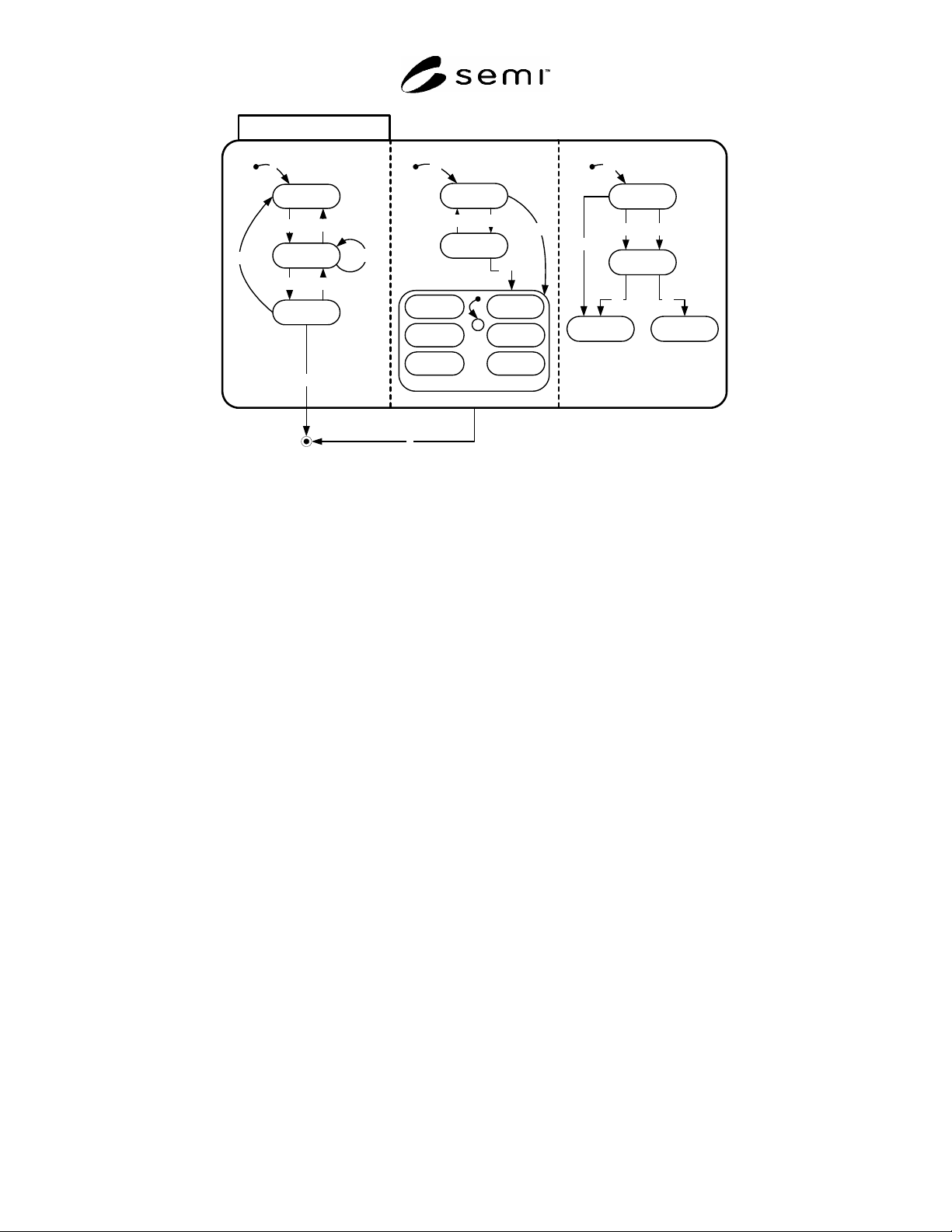
9.2.1 A substrate has both a state indicating where it is located and a state indicating the progress of processing.
These states are represented by the SUBSTRATE TRANSPORT and the SUBSTRATE PROCESSING states,
which are concurrent substates of the SUBSTRATE State Model shown in Figure 3.
9.2.2 If the equipment provides a mechanism for reading substrates, then, the equipment shall include a state model
in parallel with the Substrate Transport and Substrate Processing States called “Substrate Reading Status” See
Figure 3 and Table 1 for additional requirements.
9.3 Substrate Object State Definitions
9.3.1 ABORTED — The process has been aborted during the processing. The substrate will require special
treatment.
9.3.2 AT DESTINATION — The substrate has been placed at its designated destination substrate location. The
substrate may have been placed at a carrier substrate location when the carrier is used to unload the substrate from
the equipment, or at an equipment substrate location when the substrate is to be removed by itself from the
equipment.
9.3.3 AT SOURCE — The state which the substrate is originally received. The substrate is held at carrier substrate
location when a carrier is used to supply the substrate.
9.3.4 AT WORK — The substrate has been taken from the original substrate location or destination substrate
location, and is traveling on intermediate equipment substrate locations. The substrate has been taken out of the
carrier and placed into the equipment when a carrier is used to supply the substrate.
SEMI E90-0705 © SEMI 1999, 2005 10
AT SOURCE
AT
DESTINATION
1
AT WORK
8
NEEDS
PROCESSING
PROCESSING COMPLETE
10
IN PROCESS
14
SUBSTRATE
PROCESSED ABORTED
REJECTED
C
LOST
STOPPED SKIPPED
4
NOT
CONFIRMED
WAITING FOR
HOST
CONFIRMED
CONFIRMATION
FAILED
17
2120
16
13
7
5 6
32
12
11
9
18 19
SUBSTRATE TRANSPORT SUBSTRATE PROCESSING SUBSTRATE READING STATUS
Figure 3
Substrate Object State Model
A-1.1.1.1
9.3.5 IN PROCESS — Substrate is being processed. One or more substrate properties are being changed by the
processing instructions or measurement of the substrate in the equipment. The nature of the process depends upon
the equipment processing capabilities.
9.3.6 LOST — The terminal state when the substrate has been broken and/or removed from the equipment by an
external entity and it no longer exists at the equipment.
9.3.7 NEEDS PROCESSING — Processing requirements exist that have not yet been fulfilled. This is the default
entry state when the substrate is originally received. In some cases, the substrate may return to this state while it
waits for additional processing to be performed.
9.3.8 PROCESSED — All substrate processing has successfully completed. No further processing will be
performed by the equipment.
9.3.9 PROCESSING COMPLETE — The state in which the substrate has completed all processing associated with
a recipe specification. The substrate processing completed because the process requirement was aborted, stopped or
successfully completed. The substrate is no longer changed by the recipe’s processing instructions or its
measurment/inspection requirements completed. This state is a super-state of the terminal states of the substrate;
PROCESSED, ABORTED, REJECTED, LOST, STOPPED, or SKIPPED.
9.3.10 REJECTED — The state which the substrate has been processed completely; however, the result of the
processing may have a problem. The substrate will require special treatment. This substate is not required for
equipment that is unable to identify rejected substrates.
9.3.11 SKIPPED — As directed by an operator or a host, the substrate was not processed.
9.3.12 STOPPED — The process has been stopped during the processing. The substrate will require special
treatment.
9.3.13 SUBSTRATE — The superstate of the SUBSTRATE TRANSPORT and SUBSTRATE PROCESSING.
SUBSTRATE TRANSPORT and SUBSTRATE PROCESSING are concurrent substates. The state is created when
the substrate is initially registered to the equipment, and deleted when the substrate is removed from the equipment.
9.3.14 SUBSTRATE PROCESSING — The superstate of NEEDS PROCESSING, IN PROCESS, PROCESSING
COMPLETE which represents the processing state of the substrate.
9.3.15 SUBSTRATE TRANSPORT — The superstate of the AT SOURCE, AT WORK, AT DESTINATION
which represents the transport state of the substrate within the equipment.