semi合集-English.pdf - 第6637页
SEMI C23-0301 © SEMI 1981, 2001 BUFFERED O XIDE ETCHANTS 2 7.2 For the example above, the pe r m issible range of concent ration for amm onium fluoride sh all be 34.8 ± 0.5% and f or hydrofluoric aci d 6.33 ± 0.15%. 8 Re…
BUFFERED OXIDE ETCHANTS SEMI C23-0301 © SEMI 1981, 20011
SEMI C23-0301
SPECIFICATIONS FOR BUFFERED OXIDE ETCHANTS
These specifications were technically approved by the Global Process Chemicals Committee and are the
direct responsibility of the North American Process Chemicals Committee. Current edition approved by the
North American Regional Standards Committee on October 17, 1999. Initially available at www.semi.org
February 2001; to be published March 2001. This document replaces SEMI C2.2 and C7.23 in their entirety.
Originally published in 1981 and 1997 respectively; previously published June 1999.
1 Purpose
1.1 The purpose of this document is to standardize
requirements for buffered oxide etchants used in the
semiconductor industry and testing procedures to
support those standards. Test methods have been shown
to give statistically valid results. This document also
provides guidelines for grades of buffered oxide
etchants for which a need has been identified. In the
case of the guidelines, the test methods may not have
been statistically validated yet.
2 Scope
2.1 The scope of this document is all grades of
buffered oxide etchants used in the semiconductor
industry.
2.2 These standards do not purport to address safety
issues, if any, associated with their use. It is the
responsibility of the user of these standards to establish
appropriate safety and health practices and determine
the applicability of regulatory limitations prior to use.
3 Limitations
3.1 None.
4 Referenced Documents
4.1 SEMI Standards
SEMI C1 — Specifications for Reagents
4.2 ASTM Standards
1
ASTM D5127 — Standard Guide for Ultra Pure Water
Used in the Electronics and Semiconductor Industry
NOTE 1: As listed or revised, all documents cited shall be the
latest publications of adopted standards.
5 Terminology
5.1 buffered oxide etchant — any combination of
ammonium fluoride and hydrofluoric acid in which the
concentrations are expressed in terms of the equivalent
1 American Society for Testing and Materials, 100 Barr Harbor
Drive, West Conshohocken, Pennsylvania 19428-2959, USA.
Telephone: 610.832.9585, Fax: 610.832.9555. Website:
www.astm.org
relative volumes of 40% ammonium fluoride solution
and 49% hydrofluoric acid. In the expression, the
relative volumes shall be reduced to a ratio of the
smallest whole numbers which properly describes the
composition. For example, a 7:1 buffered oxide etchant
contains the equivalent of 7 volumes of 40.0%
ammonium fluoride and 1 volume of 49% hydrofluoric
acid.
NOTE 2: Density at temperature.
6 Composition
6.1 For analytical purposes, the absolute
concentrations of ammonium fluoride and hydrofluoric
acid corresponding to the above definition shall be
calculated according to the following equations.
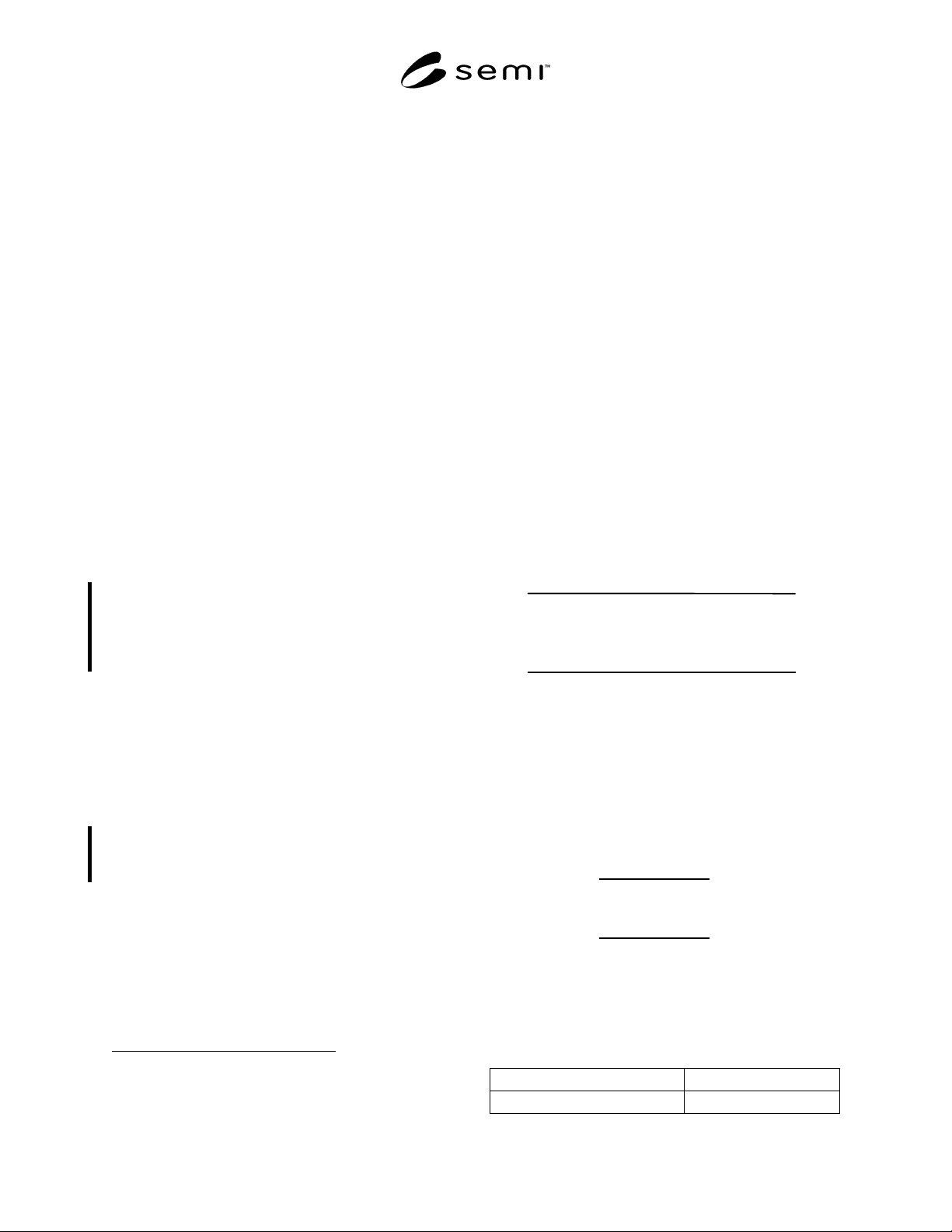
Weight % NH
4
F=
volume
×
density
×
concentration
()
N
H
4
F
volume
×
density
()
N
H
4
F
+ volume
×
density
()
HF
Weight % HF =
volume
×
density
×
concentration()
HF
volume
×
density()
N
H
4
F
+ volume
×
density()
HF
where volume and density are expressed in consistent
units and concentration is in weight percent to three
significant figures.
6.2 Sample calculation for 7:1 buffered oxide etchant
using 40.0% ammonium fluoride, density 1.111 g/mL,
and 49.0% hydrofluoric acid, density 1.153 g/mL. The
absolute percentage concentration of each component
follows:
Weight % NH
4
F=
7 ×
1
.
111
×
40
.
0
7×1.111+1 ×1.153
= 34.8
%
Weight % HF =
1×1.153× 49.0
7
×1
.
111+1 ×1
.
1
53
= 6.33
%
7 Tolerances
7.1 The tolerances allowed for the absolute percentage
of each of the components of a buffered oxide etchant
shall be:
Ammonium Fluoride: ± 0.5%
Hydrofluoric Acid: ± 0.15%
SEMI C23-0301 © SEMI 1981, 2001 BUFFERED OXIDE ETCHANTS2
7.2 For the example above, the permissible range of
concentration for ammonium fluoride shall be 34.8 ±
0.5% and for hydrofluoric acid 6.33 ± 0.15%.
8 Requirements
8.1 The requirements for buffered oxide etchants for
Grades 1 and 2 are listed in Table 1.
9 Grade 1 Procedures
9.1 Hydrofluoric Acid — Weigh accurately
approximately 4.0 grams of sample, transfer to a
polyethylene beaker, and dilute with water to about 100
mL. Titrate with standardized 1 N sodium hydroxide.
The endpoint may be detected colorimetrically by
adding 3 drops of methyl red indicator solution and
titrating to a definite yellow (no orange) endpoint. As
an alternate method, the endpoint may be detected
potentiometrically using an HF resistant pH electrode
previously standardized in pH 4 and pH 7 buffers.
Titrate to pH 6.5 with continuous stirring. Save the
solution for the determination of ammonium fluoride.
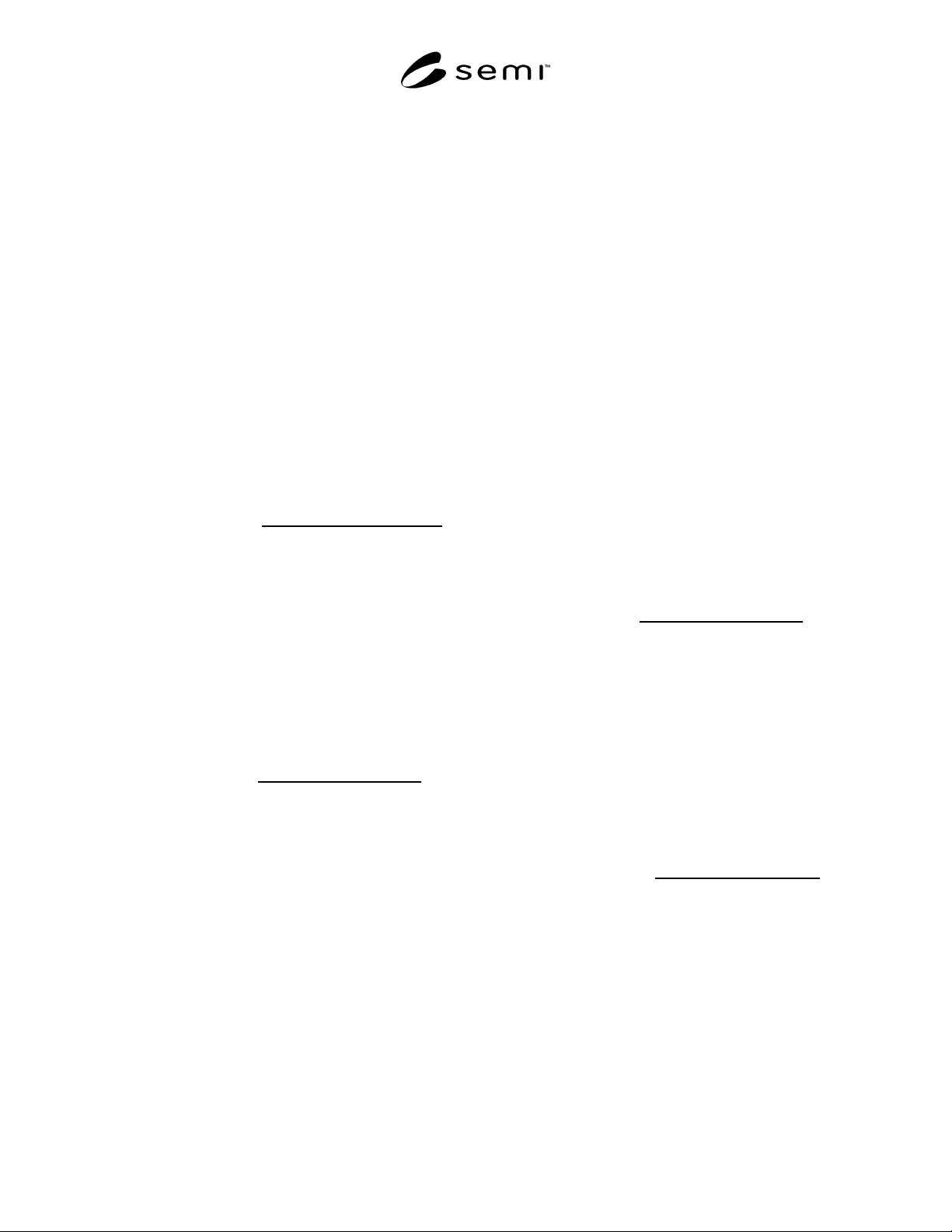
% Hydrofluoric Acid
=
mL
×
N
of
N
aOH
×
2.001
Weight of sample g
()
9.2 Ammonium Fluoride — Add 40 mL of neutralized
formaldehyde solution (see Section 9.2.1) to the
solution from the preceding test and stir magnetically
for 30 minutes. Titrate with standardized 1 N sodium
hydroxide. The endpoint may be detected
colorimetrically using 10 drops of phenolphthalein
indicator and titrating to a stable pink end point. As an
alternative method, the endpoint may be detected
potentiometrically using an HF resistant electrode
previously standardized in pH 7 and 9 buffers. Titrate
to pH 8.5 with continuous stirring.
%
Ammonium Fluoride
=
mL
×
N
of NaOH
×
3.704
Weight of sample g
()
9.2.1 Neutralized Formaldehyde Solution — Dilute 20
mL of 37% formaldehyde solution with 20 mL of water
and neutralize with 0.1 N sodium hydroxide solution to
the phenolphthalein endpoint.
9.3 Arsenic and Antimony (as As) — To 30 mL (33 g)
of sample in a polyfluorocarbon dish, add 20 mL of
nitric acid and 5 mL of hydrochloric acid and evaporate
in a sand bath in a hood to dryness. Completely
volatilize the ammonium fluoride, but do not bake. Add
10 mL of water and 5 mL of sulfuric acid and evaporate
to dense fumes of sulfur trioxide. Cool, cautiously add
10 mL of water, and reevaporate to dense fumes of
sulfur trioxide. Cool, and cautiously wash into a
generator flask with water to make a volume of 35 mL.
Proceed as described in the General Method for Arsenic
(and Antimony) under SEMI C1, Section 3.4.5, starting
with the sentence which begins, “Swirl the flask...” Any
red color in the silver diethyldithiocarbamate solution
of the sample should not exceed that in the standard
containing 0.001 mg of arsenic ion (As).
9.4 Trace Element Contents — Determine the levels
of specified trace elements and establish that they do
not exceed the specification limits using a suitable
emission spectrographic procedure (see SEMI C1,
Section 3.5, Guidelines for Determination of Trace
Elements by Emission Spectrography).
10 Grade 2 Procedures
NOTE 1: Each laboratory is responsible for verifying the
validity of the method within its own operation.
10.1 Hydrofluoric Acid — Weigh accurately
approximately 4.0 grams of sample, transfer to a
polyethylene beaker, and dilute with water to about 100
mL. Titrate with standardized 1 N sodium hydroxide.
The endpoint may be detected colorimetrically by
adding 3 drops of methyl red indicator solution and
titrating to a definite yellow (no orange) endpoint. As
an alternate method, the endpoint may be detected
potentiometrically using an HF resistant pH electrode
previously standardized in pH 4 and pH 7 buffers.
Titrate to pH 6.5 with continuous stirring. Save the
solution for the determination of ammonium fluoride.
% Hydrofluoric Acid =
mL
×
N
of
N
aOH
×
2.001
Weight of sample (g)
10.2 Ammonium Fluoride — Add 40 mL of
neutralized formaldehyde solution (see Section 10.2.1)
to the solution from the preceding test and stir
magnetically for 30 minutes. Titrate with standardized 1
N sodium hydroxide. The endpoint may be detected
colorimetrically using 10 drops of phenolphthalein
indicator and titrating to a stable pink endpoint. As an
alternative method, the endpoint may be detected
potentiometrically using an HF resistant electrode
previously standardized in pH 7 and 9 buffers. Titrate to
pH 8.5 with continuous stirring.
% Ammonium Fluoride =
mL
×
N
of
N
aOH
×
3.704
Weight of sample (g)
10.2.1 Neutralized Formaldehyde Solution — Dilute
20 mL of 37% formaldehyde solution with 20 mL of
water and neutralize with 0.1 N sodium hydroxide
solution to the phenolphthalein endpoint.
10.3 Chloride — Mix 2.2 mL (2.5 g) of sample with
20 mL of water containing 0.5 g of boric acid. Add 1
mL of nitric acid and 1 mL of silver nitrate reagent
solution, and allow to stand for 5 minutes. Any
turbidity produced should be no greater than that
BUFFERED OXIDE ETCHANTS SEMI C23-0301 © SEMI 1981, 20013
produced when 0.01 mg of chloride ion (Cl) is treated
as the sample.
10.4 Nitrate — To 2 mL of water in a white plastic
beaker, add 0.9 mL (1g) of sample, 1 mL of sulfuric
acid, 0.05 mL of 0.01 N (0.002 M) potassium
permanganate, mix, and decolorize with sodium
arsenite reagent solution. Dilute to 50 mL with brucine
sulfate reagent solution and mix. Heat the solution in a
preheated (boiling water) bath for 10 minutes. Cool
rapidly in an ice bath to room temperature. The yellow
color of the sample should be no greater than that
produced when 0.01 mg of nitrate ion (NO
3
) is treated
as the sample.
10.5 Phosphate — To a 9 mL (10 g) sample in a
platinum dish, add 1 mL of sodium carbonate reagent
solution and 40 mL of nitric acid. Evaporate carefully,
to prevent spattering, to near dryness. Cool, wash down
the sides of the dish with 5 mL of nitric acid, and
evaporate to dryness. Repeat the evaporation with nitric
acid two times to ensure complete removal of all the
fluoride. To the cooled dish, add 25 mL of 0.5 N
sulfuric acid to dissolve the residue, warming if
necessary. Cool, transfer to a color comparison tube,
and add 1 mL of ammonium molybdate reagent
solution, 1 mL of p-(methylamino)phenol sulfate
reagent solution, and allow to stand at room
temperature for 2 hours. Any blue color should be no
greater than that produced when 0.01 mg of phosphate
ion (PO
4
) is treated as the sample.
10.6 Sulfate — To 23 mL (25 g) of sample, add 10 mL
of sodium carbonate reagent solution and heat gently
until sample has been volatilized. To the residue, add 5
mL of hydrochloric acid and evaporate to dryness in a
hood. Dissolve the residue in 10 mL of water and 1 mL
of dilute hydrochloric acid (1 + 19); filter if necessary.
Add 1 mL of barium chloride reagent solution, mix, and
allow to stand for 10 minutes. Any turbidity developed
should be no greater than that produced when 0.05 mg
of sulfate ion (SO
4
) solution is treated as the sample.
10.7 Trace Metals Analysis
10.7.1 The following method has given satisfactory
results in determining metal ion impurities at the values
specified for each of the following metals: aluminum
(Al), antimony (Sb), arsenic (As), boron (B), calcium
(Ca), chromium (Cr), copper (Cu), gold (Au), iron (Fe),
lead (Pb), magnesium (Mg), manganese (Mn), nickel
(Ni), potassium (K), silver (Ag), sodium (Na), tin (Sn),
titanium (Ti), and zinc (Zn). Alternate methods may be
used as long as appropriate studies demonstrate a
recovery between 75–125% of a known sample spike
for half of the value of each specified element.
10.7.2 Special Reagents
10.7.2.1 Nitric Acid, Ultrapure — Use nitric acid
specified for low metal ion content.
10.7.2.2 4% Nitric Acid Solution — Dilute 40 mL of
ultrapure nitric acid to 1 L using water meeting the
criteria for Type E1.1 in ASTM D5127.
10.7.2.3 Water — The water used for all the dilution,
calibration, and standards should meet at a minimum
the criteria for Type E1.1 in ASTM D5127 in regard to
cation analysis.
10.7.2.4 Indium Internal Standard — Make up a
indium internal standard solution to a concentration of
20 µg/mL (ppm) from an appropriate concentrated
indium standard solution.
10.7.3 Sample Preparation
10.7.3.1 In a clean environment, weigh 10.0 g sample
into a cleaned Teflon beaker and evaporate the sample
on a 250°C hotplate to near dryness. Carefully add 1
mL of the ultrapure nitric and 3 mL of water and gently
warm for several minutes. Cool to room temperature,
add 25 µL of the indium internal standard, and dilute
with Type E1.1 water to a final weight of 25.0 g.
10.7.4 Analysis
10.7.4.1 Using the prepared solutions and blanks,
analyze sodium, potassium, calcium, and iron by
graphite furnace atomic absorption (GFAA) and the
remaining elements by inductively coupled plasma
mass spectrometry (ICP/MS). For calibration, the
standards are made up in 4% nitric acid solution with
final concentration of 20 ng/g of the indium internal
standard. Run a reagent blank.
11 Grade 3 Procedures
11.1 This section does not apply to this chemical.
12 Grade 4 Procedures
12.1 This section does not apply to this chemical.
13 Grade 5 Procedures
13.1 This section does not apply to this chemical.
14 VLSI Grade Procedures
14.1 This section does not apply to this chemical.
15 Tier A Procedures
15.1 This section does not apply to this chemical.
16 Tier B Procedures
16.1 This section does not apply to this chemical.