semi合集-English.pdf - 第2286页
SEMI E81-0600 © 1999, 2 000 23 • Manu fact uri ng ope rato rs and othe r fa ctor y personnel are im portant resources to facilitate and superv ise material proces sing an d handl ing, preventive m a intenance, and in som…
SEMI E81-0600 © 1999, 2000 22
NamedEntity
(from Resource AIG)
MaterialTrackingLocation
(from Machine Group)
MaterialGroup
0..*
contains
0..*
MaterialContainer
(from Durable Mgt Comp)
InventoryRegionSystem
(from Inventory Region Mgt Comp)
Material
0..*
0..1
0..*
0..1
holds
0..*
0..*
0..*
0..*
is grouped in
0..*0..*
0..1
0..*
0..1
0..*
holds
in
0..*
0..*
0..*
0..*
is
associated
with
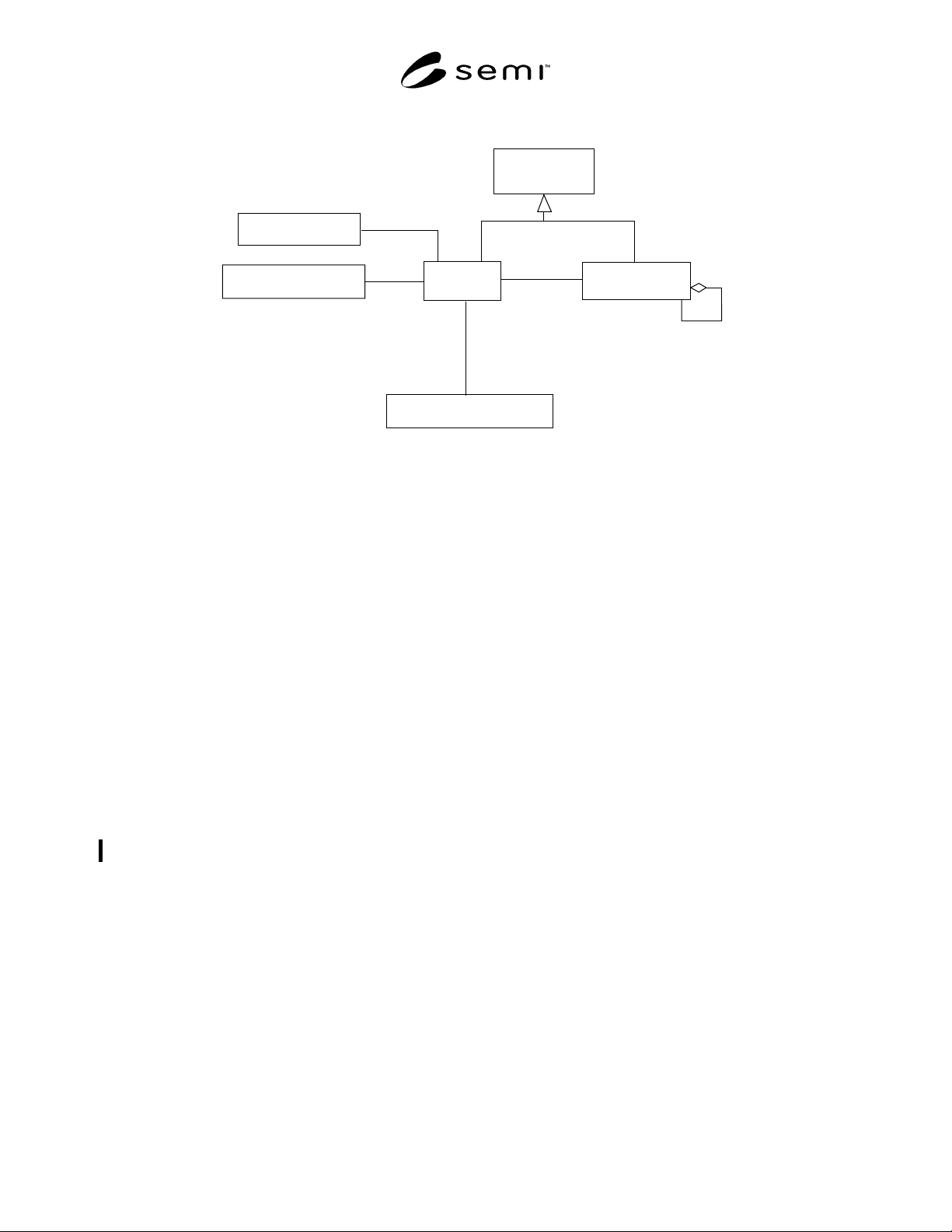
Figure 6
Material Interface Architecture
7.3.3 Factory Resource Architecture
7.3.3.1 Factory resources, such as machines, people
and reticles, are the entities that participate in
transforming material into products. The CIM
Framework defines an overall domain architecture for
factory resources that supports
• resource tracking and maintenance (resource usage
counters, maintenance procedures, etc.),
• hierarchical organization (e.g., a factory is
organized into areas which group machines and
people),
• composition of resources (e.g., a machine is
composed of chambers, load ports and sensors),
and
• an object-oriented type structure (transport
machines and production machines are types of
machines; machines, ports, durables and people are
support resources, etc.).
7.3.3.2 This section defines the CIM Framework
resource architecture.
7.3.3.3 Factory Resource Hierarchy
7.3.3.3.1 A factory is usually viewed as a hierarchy of
resources organized in groups, as in Figure 7. Each
level or portion of the hierarchy has an associated task
scope.
• An enterprise often includes multiple factories. The
task of the enterprise is to deliver products to
customers.
• A factory is made up of areas and bays with
interbay material handling systems. The task of the
factory is to manufacture product in response to
product requests.
• Areas or bays are made up of processing and
metrology equipment with intrabay material
handling systems. The task of the areas or bays is
to perform a group of process operations on groups
of materials, move material to the processing
equipment, and perform maintenance and other
supporting tasks. For a simple factory, the area
level is optional. For a complex factory, there may
be multiple area levels, with areas made up of sub-
areas.
• Complex processing equipment (such as a cluster
tool) is made up of processing chambers and
internal material handling and storage resources.
The task of the processing equipment is to perform
a process or metrology step or a closely related
group of steps on a material lot or process group.
The task of the processing resource in the
processing equipment (such as a chamber in a
cluster tool) is to perform a single process step on a
single wafer or on a collection of wafers in a
process resource group.
• Material handling and transport systems are made
up of interconnected stockers, tracks, conveyers,
robotic handlers and other material storage and
movement equipment. The task of the material
handling systems is to store and move materials in
transport groups.
SEMI E81-0600 © 1999, 200023
• Manufacturing operators and other factory
personnel are important resources to facilitate and
supervise material processing and handling,
preventive maintenance, and in some cases,
perform manufacturing steps such as moving
material or performing a visual inspection.
• Other factory resources include durables (reticles,
cassettes, pods, etc.) and consumables (gases,
utilities, etc.).
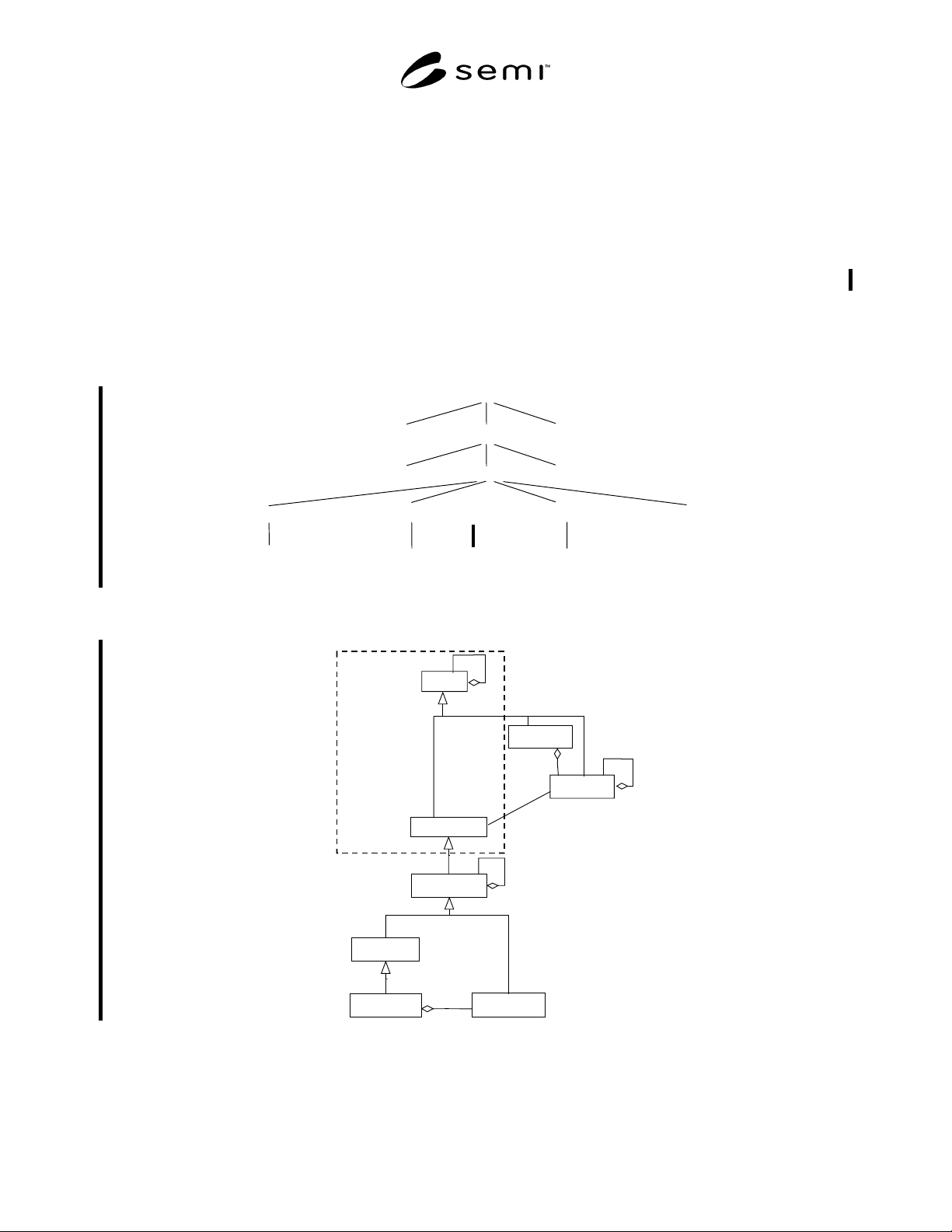
• The information model in Figure 8 shows the CIM
Framework Resource Composition Architecture.
The interfaces in the box labeled Resource Abstract
Interface Group define the generic resource
architecture. In general, resources can be composed
of other resources. In particular, at the factory and
area levels, Factory can be composed of Areas and
an Area can be composed of other Areas. Areas
group Support Resources, such as machines and
persons. This is not a strict composition so that
support resources can be in more than one Area
grouping. At the machine level, Machine
Resources are composed of other Machine
Resources, in general. In particular, Production
Machines are composed of Process Resources.
Production Machine
Transport Machine Storage Machine
Transport Resource Storage Resource
Enterprise
A
rea
Factory
Process Resource
Person
... ...
... ...
Figure 7
Factory Resource Hierarchy Model
Resource
MachineResource
Machine
ProductionMachine
ProcessResource
0..*0..*
0..*0..*
MESFactory
SupportResource
Area
0..*0..*
0..*0..*
groups
0..*
0..*
0..*0..*
Generic
Resource
Architecture
(part)
Figure 8
Resource Composition Architecture
SEMI E81-0600 © 1999, 2000 24
ComponentManager
Sensor
MachineResource
Production Machine
ProcessResource
0..*
SupportResource
Durable
Material
Consumable
TransportMachineStorageMachine
any
OwnedEntity
is owned by
another
HistoryCollection
NamedEntity
0..1
is associated
with
Port
Machine
Person
0..*
0..*
0..*
0..*
assigned to
Capability
Resource
0..*
0..*
0..*
0..*
possible
0..*
0..*
assigned
0..*
0..*
Resource
Abstract
Interface Group
(part)
Area
MESFactory
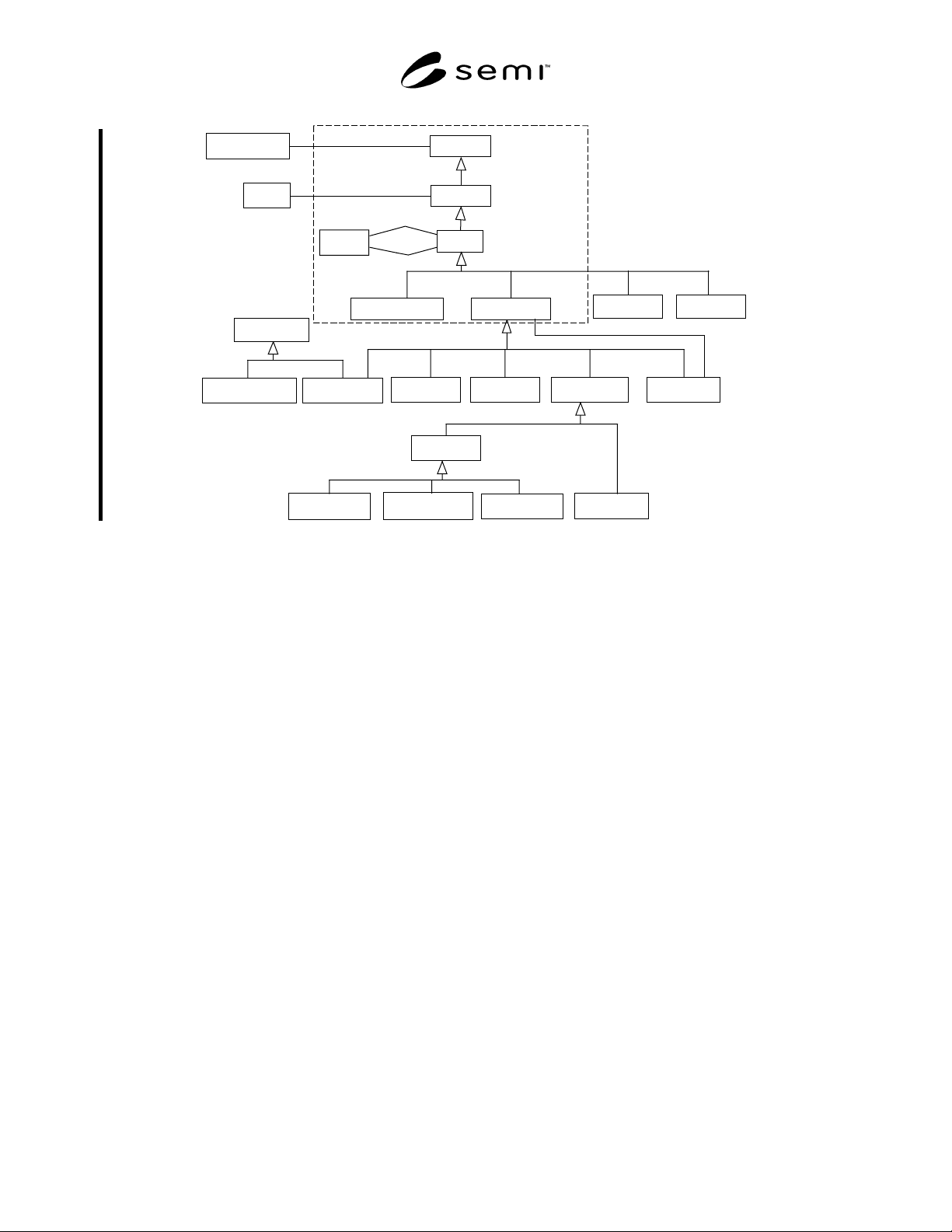
Figure 9
Resource Type Architecture
7.3.3.3.2 Figure 9 shows the CIM Framework
Resource Type Architecture. Specializations of these
interfaces, such as Machine Resource and Durable,
provide component-specific details that extend the
generic resource architecture. The functions added at
each level of type specialization are discussed next.
7.3.3.3.3 Named Entity
7.3.3.3.3.1 The CIM Framework Named Entity
interface provides for names and histories to be
associated with any CIM Framework entity, including
resources.
7.3.3.3.4 Owned Entity
7.3.3.3.4.1 The Owned Entity interface provides for
resources to be organized into hierarchies.
7.3.3.3.5 Resource
7.3.3.3.5.1 The Resource interface provides for
• composition of subresources into complex
resources,
• representing resource capabilities (such as capacity
or process capability) (See Section 7.3.3),
• a simple state model (available, not available) and
services to startup and shutdown the resource, and
• modeling of resource levels as in Figure 7 and
Figure 8.
7.3.3.3.5.2 Each Resource has an attribute called
resourceLevel to support the factory resource
composition hierarchy of Figure 8. The CIM
Framework defines the following resource levels:
Factory (called MESFactory so as not to be confused
with the OMA’s object Factory type), Area, Machine
and Machine Resource. The Area level is optional, or it
may have multiple levels (such as an area called
LithoBay with sub-areas called Zone1 and Zone2).
Other levels can be defined. The resourceLevel concept,
combined with the Named Entity and Owned Entity,
also provide a name scoping facility.
7.3.3.3.6 Support Resource
7.3.3.3.6.1 The Support Resource interface provides
services for reserving resources (to support scheduling,
for example) and to track resource utilization and
effectiveness and associate maintenance tasks with
resources (see Figure 10 and Section 7.3.3.5). The
support resources include machine resources, material
load ports, sensors, durables and people.
7.3.3.3.7 Machine Resource
7.3.3.3.7.1 The Machine Resource interface provides
attributes for machine description, serial number, model
number, vendor, software version, etc. The interface