semi合集-English.pdf - 第1512页
SEMI E32-0997 © SEMI 1994 , 1997 7 characteris tics. These may be fixed-arm robots, robot arms on a f ixed track, AGVs with or without robot arms, overh ead gantries, cars on tracks, or even transf er syste ms cont aini …

SEMI E32-0997 © SEMI 1994, 1997 6
Object — Webster's defines an object as “something
perceptible.” In the software world, an object is a
combination of attributes and behavior. It may refer to
something concrete, such as a transfer object, or to a
concept, such as a transfer job.
Ownership — An equipment is said to “own” a transfer
object from the time the object is transferred into one of
its ports until it is transferred out of the equipment. This
indicates that the equipment has physical control of the
transfer object.
Passive Transfer — A transfer that involves one active
and one passive partner. During a passive transfer, the
active partner retains control of the transfer envelope
during the entire physical transfer.
Passive Transfer Partner — (Opposite of Active
Transfer Partner) A transfer partner is considered
passive when it takes no part in the physical micro level
transfer, moving nothing within the transfer envelope.
This term refers to the physical micro level transfer
phase only. Setup activities prior to the transfer may be
performed by a Passive Transfer Partner (e.g., a port
door may be opened during setup phase).
Port — A point on the equipment at which a change of
equipment ownership of a transfer object occurs. A port
is not itself a material location, but shall have an
associated location. A port may be thought of as an
access point to an a material location on an equipment.
The definition of the term port includes any dedicated
mechanisms that either prepare for, facilitate, or are
capable of interfering with the transfer. All equipment
shall have a minimum of one port.
NOTE 2: While they are of use to the host system, the
commonly used designations “Input Port” and “Output Port”
are irrelevant in the context of this document. They are based
on a flow of material through an equipment rather than the
movement of transfer objects (which may be carriers rather
than the material itself). Transfer objects may have to be
moved into and out of both these types of ports.
Receiving Port — For a specific transfer, the port into
which a transfer object is to be placed.
Sending Port — For a specific transfer, the port from
which a transfer object is to be removed.
Static Port — (Opposite of Dynamic Port) A port with
no associated mechanisms capable of assisting or
interfering with the transfer of an object. A transfer
partner utilizing a static port for the transfer shall
always be passive.
Transfer Agent — An equipment specialized to the
transport of material from one equipment (or storage
area) to another.
Transfer Envelope — The three-dimensional space
occupied during the transfer by the transfer object and
all associated transfer mechanisms of both transfer
partners. This defines the space in which transfer
activity occurs and in which the potential for physical
interference with the transfer exists.
Transfer Job — The set of atomic transfers
constructed by the host to accomplish a cohesive
material movement objective. See the section on
compound transfers below.
Transfer Object — A physical object that is
transferred to and from equipment, such as a product
material, an empty carrier, or a carrier containing
material to be processed. Tools (e.g., stepper reticles)
and expendable materials also may be transfer objects.
The term “material” is used interchangeably with
“transfer object.”
Transfer Partners — In a given atomic transfer, the
equipment sending a transfer object and the equipment
receiving the transfer object are transfer partners.
Transfer Specification — The list of data provided by
the host to define an atomic transfer.
Transfer System Controller — Entity that is responsible
for management of multiple transfer agents. The
transfer system controller presents a single
communications interface to its host representing these
multiple agents.
3 Overview
Material movement is concerned with the transfer of
objects (WIP, tools, expendable materials, etc.) among
process equipment, buffers, and storage facilities. These
objects may optionally be contained (singly or in mass)
within a carrier. Empty carriers may also be considered
objects.
Material movement may include several different types
of entities. These are divided into two classes: Host and
Equipment. The host is the supervising entity which
organizes the transfer and gives the appropriated
instructions to each equipment involved. An equipment
physically participates in the transfer, either sending or
receiving material. The class of equipment may be
divided into three types:
Process Equipment — Equipment which performs
value-added operations on the factories’ products. This
includes those equipment which physically changes the
product and those which measure/test the product.
Transfer Agent — A type of equipment specialized to
the movement of transfer objects from place to place
within a factory. Transfer agents themselves may be of
different types and with widely-differing
SEMI E32-0997 © SEMI 1994, 19977
characteristics. These may be fixed-arm robots, robot
arms on a fixed track, AGVs with or without robot
arms, overhead gantries, cars on tracks, or even transfer
systems containing a heterogenous collection of other
transfer agents. Humans also may act as transfer agents.
Storage Areas — A type of equipment used to hold
transfer objects pending further processing (if product)
or use (if reticles, etc.) within the factory. A storage
area may be as sophisticated as an automated WIP Bin
or as simple as a shelf.
3.1 Macro and Micro Levels — Material movement is
separated into two levels. The more abstract level,
called the macro level, consists of all message
transactions used by the host in its coordination role. At
the macro level, the host is responsible for determining
what material is to be moved, from where, to where,
and when. The host shall provide each party involved in
a transfer job with the information necessary to perform
its part of that transfer job.
A transfer job may be composed of multiple handoff
operations, or “Atomic Transfers.” Each atomic transfer
involves only two equipment, termed “Transfer
Partners.” In order to perform this handoff operation,
the transfer partners must achieve a level of
synchronization. The communications between the
transfer partners is called the micro level of material
movement.
These communications occur between the two partners
in a “peer-to-peer” fashion. Micro communications may
be implemented via a direct equipment-to-equipment
connection
2
or by passing messages indirectly through
the host.
The macro and micro levels are designed to work
together so that the host may initiate the transfer and
then allow the transfer partners to perform the job
interactively. However, these two levels may be used
separately. For instance, the macro level may be
combined with functionality of the SEMI E23 (Cassette
Transfer Parallel I/O Interface Specification) standard.
Additionally, under some conditions there may not be a
host coordinating the transfer. Instead, one of the
transfer partners might be in control. Here, the micro
level may still be used to accomplish the transfer. The
controlling partner would perform the coordination
functions normally in the domain of the host.
In this standard, the macro and micro levels are defined
separately, each with its concepts, behavior, and
services.
2 In this context, connection is intended to mean a direct logical link,
rather than a hard wired connection.
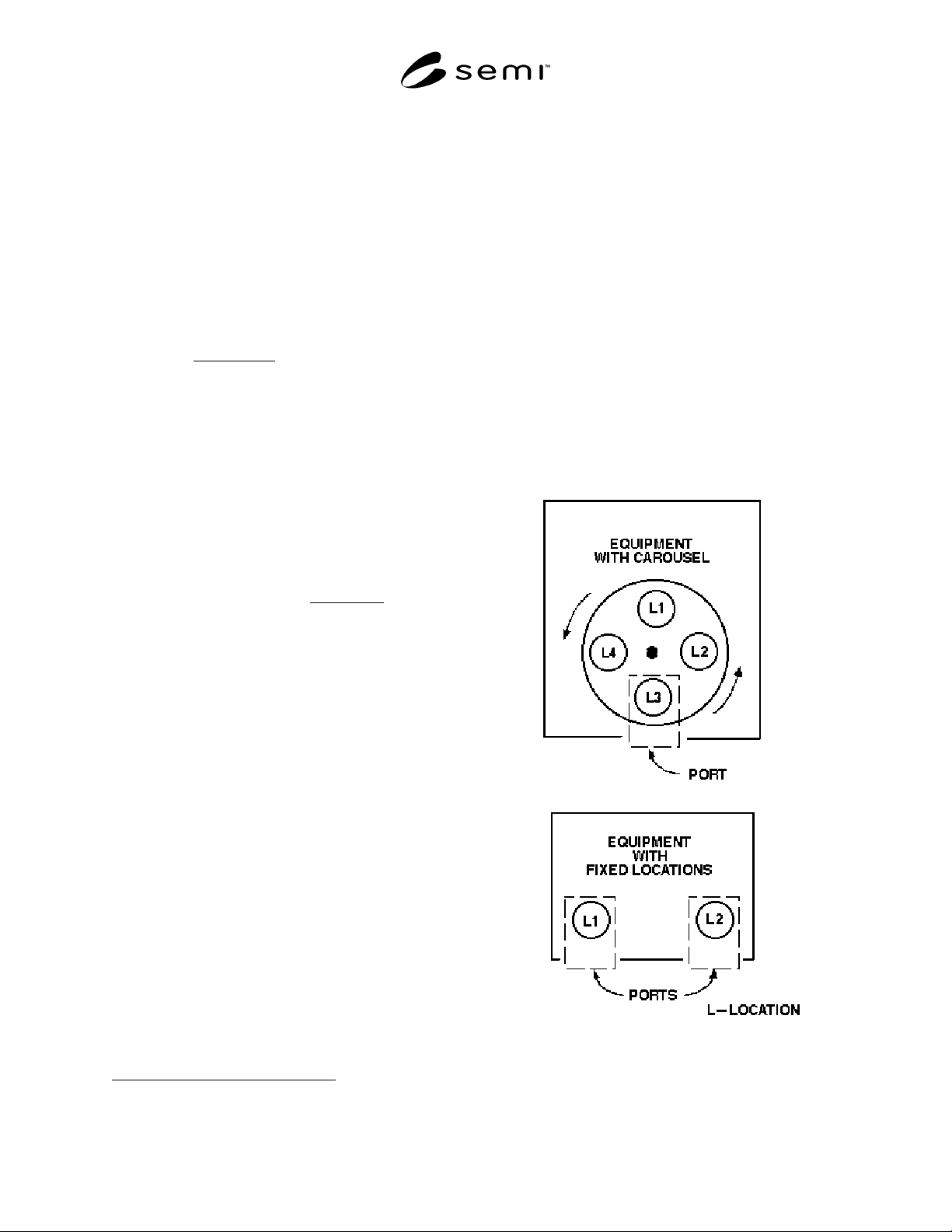
3.2 Ports and Locations — A port may be considered
a point of entry to the equipment. A location is a
receptacle for a transfer object. At any time, a port shall
be linked to at least one location. However, some
locations may be internal and never be linked to a port.
For “typical” factory equipment, there is a permanent
one-to-one correspondence between the port and a
location. However, not all semiconductor equipment
follows this pattern. For instance, the port on a transfer
agent that includes a robot arm and multiple on-board
storage locations is actually the gripper on the robot
arm. The gripper is also a location. In another case, a
port may actually feed a rotating carousel containing
multiple locations. The port in this example would be
the access door to the carousel. The location linked to
this type of port would be the one in front of the door at
transfer time and would change whenever the carousel
rotates. Figure 3.1 helps to illustrate the difference
between ports and locations.
Figure 3.1
Port vs. Location

SEMI E32-0997 © SEMI 1994, 1997 8
It is important to note that the attribute of “full” or
“empty” belongs to a location rather than a port. A port
that has just received a transfer object may be able to
receive another immediately. Likewise, a port that has
sent a transfer object may have more material available
to send.
3.3 Compliance — Compliance to this standard
includes adherance to all stated requirements in this
document. This includes all defined messages services,
state models, and communications scenarios.
This standard may be divided into two parts:
• Material Movement Macro Level, and
• Material Movement Micro Level.
An equipment may be compliant to one of these parts
without the other. Details of compliance to each of
these parts are defined in the body of this document.
4 Macro Level
The set of host<->equipment interactions needed to
facilitate a transfer is called the macro level. These
interactions concentrate on the definition of the transfer
specification, and leave the details of the physical
transfer to the micro level interactions.
In addition to the services defined in Section 4, the
GetAttr service defined by SEMI E39, Object Services
Standard, is supported by this standard. The definition
for the GetAttribute service defined in Section 4 will be
removed and no longer supported in 1998.
4.1 Macro Level Concepts — The macro level is
designed with the intent of creating a widely applicable,
host coordinated material movement capability. The
result is a sequence of interactions from host to
equipment that is used to accomplish the coordination
of material movement required on the manufacturing
floor.
The elements of material movement common to all
transfers make up the framework. Other elements which
differ from implementation–to–implementation are
pushed, as much as possible, into the data portions of
communications. The common elements identified are
as follows:
• The host is responsible for designating the transfer
partners which are compatible for transfer.
• The host must supply the necessary information for
the transfer to each partner.
• Once transfer is defined, the responsibility moves
to the transfer partners, especially the designated
“primary” partner
3
. The host may monitor the
3 See the definition for “primary transfer partner” in Section 4.1.1.
transfer, but leaves the details to the transfer
partners.
• The transfer partners inform the host of milestones
during the process and of process completion.
Some of the elements which are more implementation-
specific are:
• Which partner is the sender and which is the
receiver of material. This has no intrinsic
relationship to other details, such as the selection of
the primary transfer partner.
• Whether a transfer partner is passive or actively
participates in the transfer. This also becomes a
data issue.
• The method (mechanism) of an interactive transfer.
This may vary depending on the transfer partners'
capabilities and system design. Interaction with
different partners may require different methods.
Transfer recipes containing this information may
be specified by the host as a part of the transfer
specification.
The host must have some knowledge of the capabilities
of the transfer partners it designates to perform a
transfer. It must understand which partners are
compatible. If compatible, it must know the proper role
for each partner of the transfer and what methods must
be used. If an interactive transfer is warranted, the host
must be able to determine which partner should be the
primary. Definition of the mechanism for such
determinations by the host is beyond the scope of this
document.
4.1.1 Macro Level Definitions
Abort — The immediate termination of an active job,
including a complete stop of all transfer job-related
movement. An abort may be initiated by the host (and
optionally by the operator). An abort by the host is
directed at a transfer job, not at an individual atomic
transfer. When told to abort, a transfer job shall, in turn,
abort its atomic transfers. The abort command is
intended to be used only in situations where there is risk
of material or hardware damage.
Allocate — The formal reservation of an entity's
resources for a specific purpose. In this document, it
refers to the reservation of an equipment's resources for
a specific transfer job or atomic transfer. Allocation of
needed material locations for a transfer job occurs just
prior to that job becoming active. Allocation of required
port-related resources occurs just prior to the start of an
atomic transfer.
Commit — The commit by the equipment indicates a
readiness to begin the actual material handoff. The