semi合集-English.pdf - 第6971页
SEMI S10-1103 © SEMI 1996, 2003 1 SEMI S10-1103 SAFETY GUIDELINE FOR RISK ASSESSMENT AND RISK EVALUATION PROCESS This safety guideline was technically approved b y the Environmental , Health, & Safety Comm ittee and …
SEMI S9-1101 © SEMI 1995, 20017
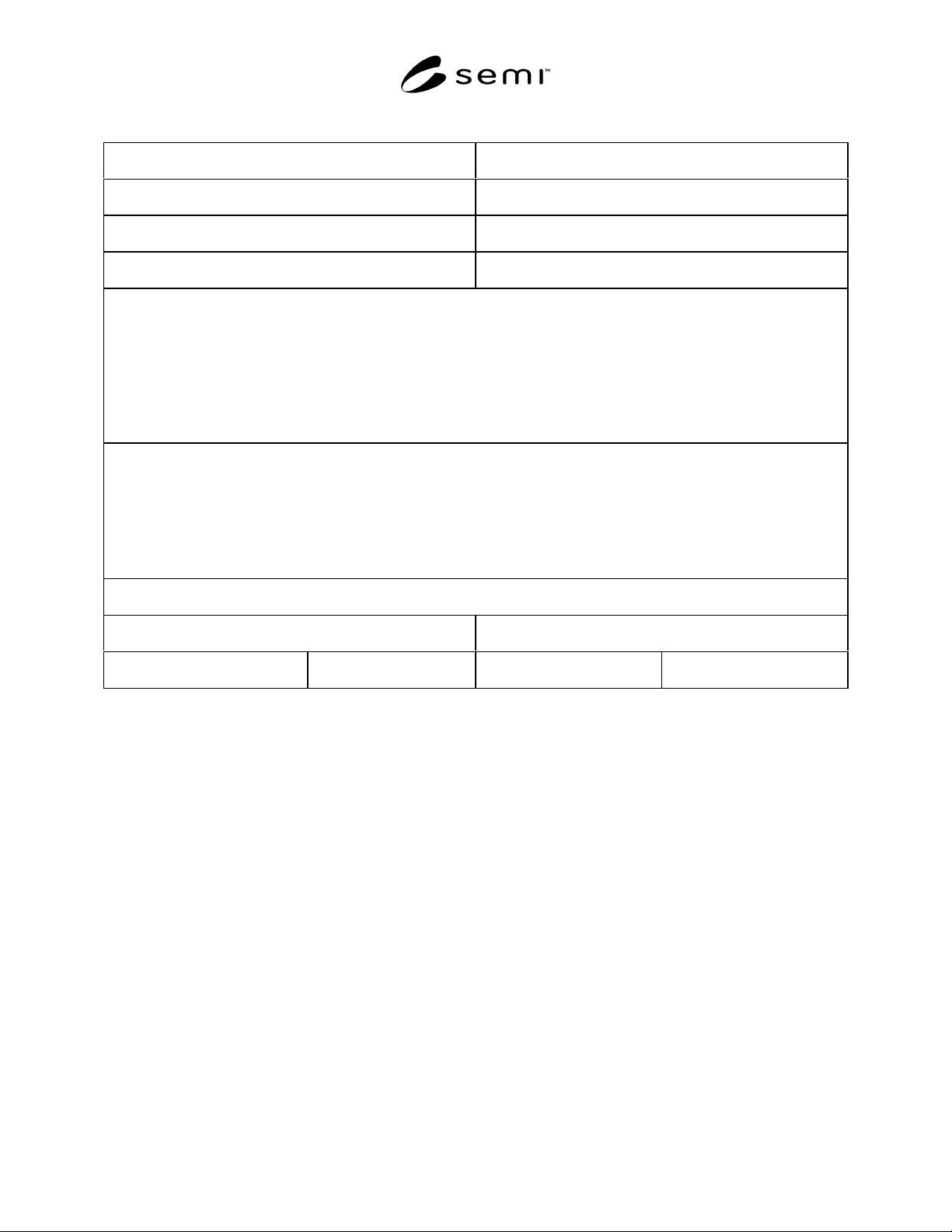
Table 2 Sample Blank Test Data Form
Manufacturer: Tester’s Name:
Name of Equipment: Model No.:
Serial No.: Date:
Location of Test Performed:
(Test Name)
Test Method:
Test Result:
Tester: Reviewed:
Equipment Used: Model No.: Serial No.: Last Date Calibrated:
11 Related Documents
11.1 SEMI Standards
SEMI S1 — Safety Guidelines for Equipment Safety Labels
11.2 IEC Documents
IEC 60204 — Safety of Machinery – Electrical equipment of Machines, Part 1: General Requirements
IEC 60950 — Safety of Information Technology Equipment
NOTICE: SEMI makes no warranties or representations as to the suitability of the guidelines set forth herein for
any particular application. The determination of the suitability of the guideline is solely the responsibility of the
user. Users are cautioned to refer to manufacturer's instructions, product labels, product data sheets, and other
relevant literature, respecting any materials or equipment mentioned herein. These guidelines are subject to change
without notice.
By publication of this guideline, Semiconductor Equipment and Materials International (SEMI) takes no position
respecting the validity of any patent rights or copyrights asserted in connection with any item mentioned in this
guideline. Users of this guideline are expressly advised that determination of any such patent rights or copyrights,
and the risk of infringement of such rights are entirely their own responsibility.
Copyright by SEMI® (Semiconductor Equipment and Materials
International), 3081 Zanker Road, San Jose, CA 95134. Reproduction o
f
the contents in whole or in part is forbidden without express written
consent of SEMI.

SEMI S10-1103 © SEMI 1996, 2003 1
SEMI S10-1103
SAFETY GUIDELINE FOR RISK ASSESSMENT AND RISK
EVALUATION PROCESS
This safety guideline was technically approved by the Environmental, Health, & Safety Committee and is the
direct responsibility of the European Environmental, Health, & Safety Committee. Current edition approved
by the European Regional Standards Committee on July 1, 2003. Initially available at www.semi.org
October 2003; to be published November 2003. Originally published December 1996.
NOTICE: This document was completely rewritten in
2003.
NOTICE: Paragraphs entitled “NOTE:” are not an
official part of this document and are not intended to
modify or supersede the official guideline.
1 Purpose
1.1 The purpose of this guideline is to establish general
principles for risk assessment to enable identification of
hazards, risk estimation and risk evaluation in a
consistent and practical manner. The document
provides a framework for carrying out risk assessments
on equipment in the semiconductor and similar
industries and is intended for use by supplier and
purchaser as a reference for EHS considerations.
1.2 Use of this safety guideline is intended to assist in
the development of a strategy to prioritize and control
risks.
2 Scope
2.1 This guideline is intended to apply to the
assessment of risks considering the lifecycle of the
equipment.
NOTE 1: It can also be applied to processes or facilities.
2.2 This guideline outlines a hazard identification, risk
estimation, and risk evaluation process.
NOTICE: This safety guideline does not purport to
address all of the safety issues associated with its use.
It is the responsibility of the users of this safety
guideline to establish appropriate safety and health
practices and determine the applicability of regulatory
or other limitations prior to use.
3 Limitations
3.1 This guideline is not intended to be used to verify
compliance with local regulatory requirements.
3.2 This guideline does not cover risk reduction,
mitigation, avoidance or transfer techniques.
3.3 This guideline is not intended to explain specific
risk assessment techniques, such as Fault Tree Analysis
(FTA), Event Tree Analysis (ETA), Hazard and
Operability Studies (HAZOP) and Failure Mode Effect
Analysis (FMEA). However, it recognizes that these
techniques exist and that they are adequately covered
elsewhere.
NOTE 2: Related Information 2 provides summary
information and references for applicable techniques.
3.4 Use SEMI S14 for fire risk assessment criteria for
equipment.
4 Referenced Standards
4.1 SEMI Standards
SEMI S2 — Environmental, Health, and Safety
Guideline for Semiconductor Manufacturing Equipment
SEMI S14 — Safety Guidelines for Fire Risk
Assessment and Mitigation for Semiconductor
Manufacturing Equipment
NOTICE: Unless otherwise indicated, all documents
cited shall be the latest published versions.
5 Terminolgy
5.1 Definitions
5.1.1 controls —
means to prevent or avoid a hazard
from causing loss.
5.1.2 exposure to a hazard — situation in which a
hazard is present which may (but does not necessarily)
result in harm.
5.1.3 frequency of exposure — how often personnel or
equipment are exposed to a hazard.
5.1.4 harm — physical injury or damage to health of
people, or damage to equipment, buildings or
environment.
5.1.5 hazard — condition that has the potential to
cause harm.
5.1.6 lifecycle — the entire life of an item of
equipment, from conceptual design through to disposal.
5.1.7 likelihood — the expected frequency with which
harm will occur. Usually expressed as a rate (e.g.,
events per year, per product, or per substrate
processed).
SEMI S10-1103 © SEMI 1996, 2003 2
NOTE 3: Likelihood groups are defined in Appendix 1.
5.1.8 maintenance — planned or unplanned activities
intended to keep equipment in good working order.
5.1.9 modification — change of the equipment that
may introduce new hazards and risks.
5.1.10 residual risk — risk remaining after
engineering, administrative, and work practice controls
have been implemented.
5.1.11 risk — the expected magnitude of losses from a
hazard, expressed in terms of severity and likelihood.
5.1.12 risk assessment — a procedure through which
knowledge and experience of design, use, incidents and
accidents and harm are brought together to measure the
risks for specified scenarios of the equipment being
assessed. Risk assessment includes determining the use
and limits of the machinery, hazard identification, and
risk estimation.
5.1.13 risk estimation — derivation of the risk
associated with a particular situation from a
combination of the severity and the likelihood.
5.1.14 risk evaluation — the process of deciding if risk
reduction is required.
5.1.15 risk reduction — the process by which the risk
is reduced to a lower level.
5.1.16 service — unplanned activities intended to
return equipment that has failed back in good working
order.
5.1.17 severity — the extent of potential credible harm.
NOTE 4: Severity groups are defined in Appendix 1.
6 Procedures
6.1 General Guidelines
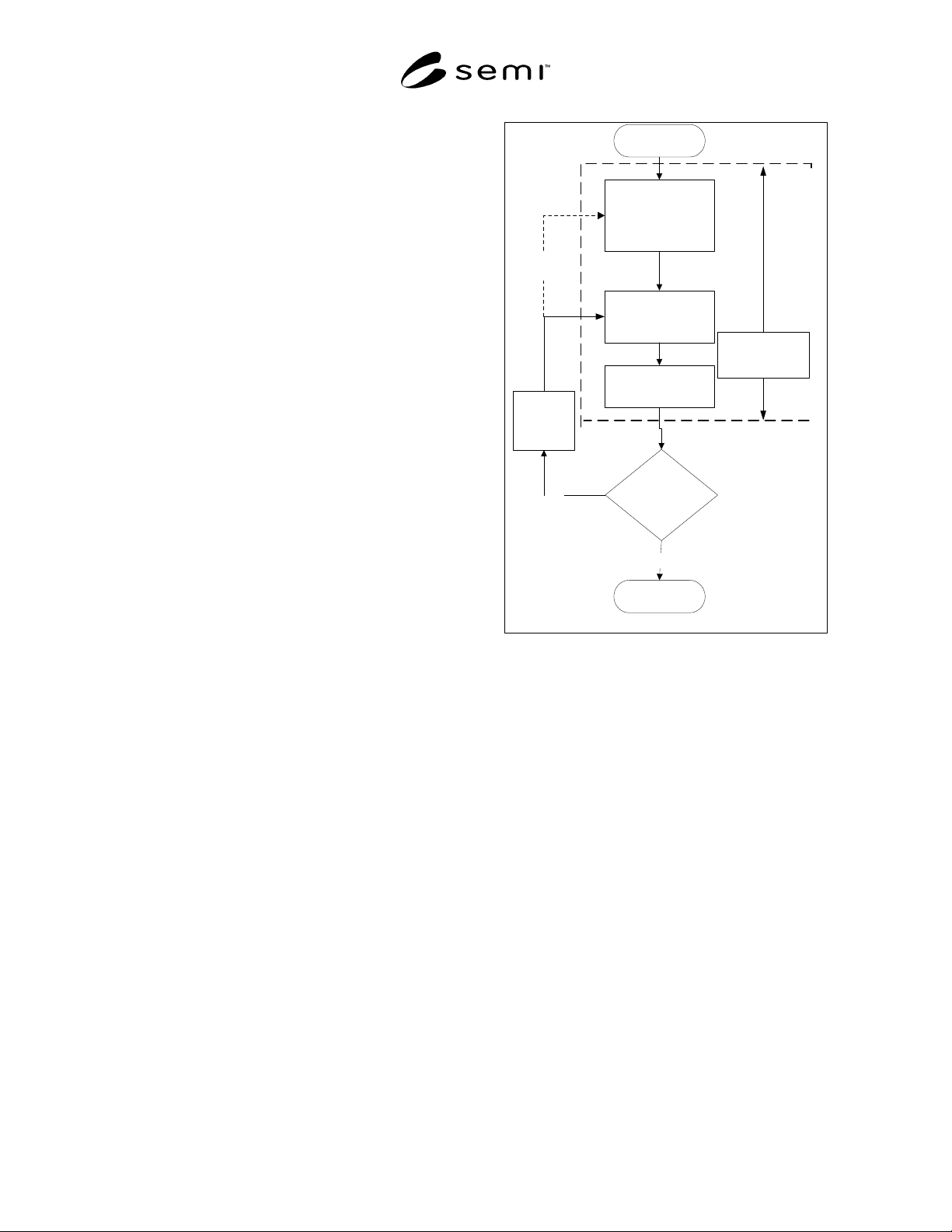
6.1.1 Figure 1 shows the essential steps of the risk
assessment and control process.
6.1.2 A risk assessment should be performed to
identify and evaluate potential hazards in the equipment
being assessed. Risk assessment should be initiated
early in the design phase and updated as the design
matures.
Prepare
(see 6.2)
Determination of the
use and limits of the
equipment (see 6.3)
Hazard identification
(see 6.4)
Risk estimation
(see 6.5)
Risk
evaluation:
reduction needed?
(see 6.6)
Implement
risk
reduction
(See 6.7)
RISK
ASSESSMENT
see
6.1.3
END
No
Yes
Figure 1
Risk Assessment Flowchart
6.1.3 After a significant modification (i.e. one that can
introduce new hazards and/or risks in the design),
reconsideration of use and limits of the equipment may
be necessary (see Figure 1).
6.2 Preparations for Hazard Identification and Risk
Estimation Process
6.2.1 The assessment should be carried out by those
with the necessary knowledge and experience of the
task, equipment, or process being assessed.
NOTE 5: To have an effective process, good preparation is
essential.
6.2.2 Select the reviewers (e.g., designers, equipment
manufacturers, field engineers, end-users, third party
evaluators, a risk assessment leader and someone with
experience in hazard identification).
6.2.3 Select the risk assessment technique.
6.2.4 Collect information on the design (e.g., drawings,
mock-up, and hardware).
6.2.5 Determine the scope of the assessment.