semi合集-English.pdf - 第7856页
SEMI T13-1104 © SEMI 2004 16 11.2.1.2 Acquired Data — During processing materials on equipm ent, it m ay acquire suc h data as values on sensors and set points on actuat ors/controll ers. Some of the data could be sample…
SEMI T13-1104 © SEMI 2004 15
been already available on the equipment. If not, it
acquires the data before reporting. If the acquisition
was impossible, no data is replied.
10.5.4.2.2 setPlanningItems — This service specifies
expecting data items for die tracing. The items are
chosen from potential and reportable data list for die
tracing in specification exchanged between equipment
vendor and user. Otherwise both party need to prepare a
kind of metadata which describes reportable data items
and their properties including data sources equipment
itself electrically to allow user’s application to specify
expecting data item by looking up the metadata.
10.5.4.2.3 flush — This optional service let equipment
send all planned data which have been already acquired
but not sent yet. Same data will responded with
acquireDTD service if all planned data items are
specified. This service is typically used when the Tracer
of this Machine is replaced.
10.5.4.2.4 registerTracer — This optional service
allows switching corresponding Tracer dynamically.
10.5.4.3 Behavior of Die Trace Machine — Behavior
is defined to complete responsibility of the Die Trace
Machine. The behavior is often specified through
collaboration with its outside and state model.
Collaboration is reflected on some association of this
class with others. The collaboration may happen when
some service on this class is requested if the service
needs some related service on any associating class to
complete the original service. They are described in a
part of service definitions above. State model is the
other part of representation of the behavior of this class.
Because this class is stateless, this class defines no state
model.
11 Suggestive Complements
11.1 Illustrative Models in Production Line — Device
Tracking needs to cover throughout production line
widely from very early stage of materials through
almost final product for consumers. However specific
production systems may be somewhat different
depending on stages, the following models illustrate
typical issues in interrelation between production and
tracking.
11.2 Data around Machine and Circuit Module —
There are many acquired or measured data and context
information of such production systems as
Manufacturing Execution System (MES) and Work In
Process (WIP). Each data or information could be
independent or a part of Die Trace Data.
11.2.1 Obtained Data — Many sorts of data can be
obtained on each piece of equipment. A part of the data
or the summarized/processed data could be Die Trace
Data.
11.2.1.1 Examined Data — If Die Trace Machine is
metrology, inspection or test equipment, measured,
inspected or tested result data is obtained on the
equipment respectively. Such data as a whole, a part of
the data or even the data which is
summarized/processed, it could be a kind of Die Trace
Data. As long as the equipment has one or more
modules which have such functions, the equipment can
provide the data even if it has process capability.
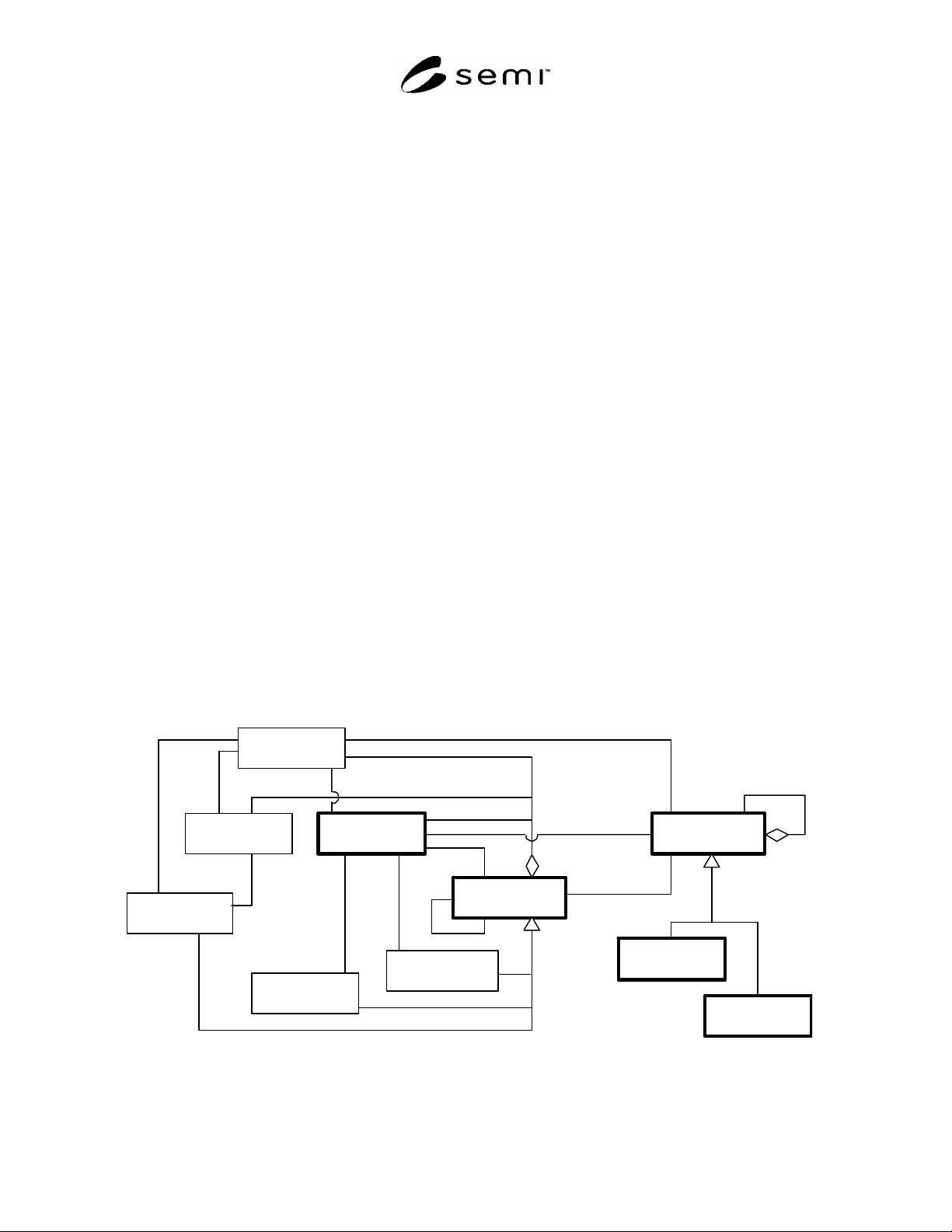
Circui t Module
Die
Mother
Substrate
0..*
Die Trace Data
(DTD)
characterizes
0
..*
refers
links
0
..*
Production Job
Die Trace
Machine
Recipe
Adjusted
Par ame te r
Examined Data
Acquired Data
provides
compensates
measures
on
pr ocess es
on
s
p
ecifies
specifies
specifies
specifies
0
..*
0
..*
0
..*
processe
d
or
measured
0..1
0
..1
0
..1
Figure 15
Possible Die Trace Data around Machine and Circuit Module
SEMI T13-1104 © SEMI 2004 16
11.2.1.2 Acquired Data — During processing materials
on equipment, it may acquire such data as values on
sensors and set points on actuators/controllers. Some of
the data could be sample values to deduce whether the
process is done as expected or not. Acquired data while
it is idle, preparation or diagnosis may suggest
equipment healthy state. Process logs are the other
examples which record detail actions that such
instructive prescription as process recipe doesn’t
describe. In these senses this kind of data could be a
kind of Die Trace Data. Identification of
mounted/placed device may be one of examples of this
data.
11.2.1.3 Adjusted Parameters — Process recipes are
fixed process prescriptions to instruct or guide how
process is done. To avoid increasing number of recipes
dramatically, adjustable parameters to allow some
flexibility for each recipe is often used.
Dispatching/scheduling function of Manufacturing
Execution System (MES) or Advanced Process Control
(APC) system often assigns their values. These values
may help inferring how process was turned out.
11.2.2 Context Data — Meaningful data has its
property which makes sure where it was obtained, when
it was, which phase or step of a course of procedure,
how it links with the other data or entities, and so on.
Without the property data itself doesn’t make sense
even if it is so accurate or high resolution. Context data
must be a part of Die Trace Data.
11.3 Die Trace Data to get New Data — To get Die
Trace Data on an equipment for certain process, Die
Trace Data for previous process may be required. For
example, for devices on a tray to be mounted on lead
frames or PCBs, it is difficult to get interrelation
between devices and base substrates if identification
codes for the devices are unknown while the substrates’
identifications are managed. On some limited processes
and production lines MES provides a part of Die Trace
Data of previous process to equipment. For example,
wafer ID information for a carrier is given for 300 mm
process equipment. Good die information on a dicing
frame is given to die bonding machine because the
machine may not be aware of good dice to mount onto
lead frames or dice may not tell for inkless systems.
However, the information may not be given if dice are
provided on such a strip as tray or tape because only
good dice are mounted on the strip. Die Tracing system
may need to provide such data.
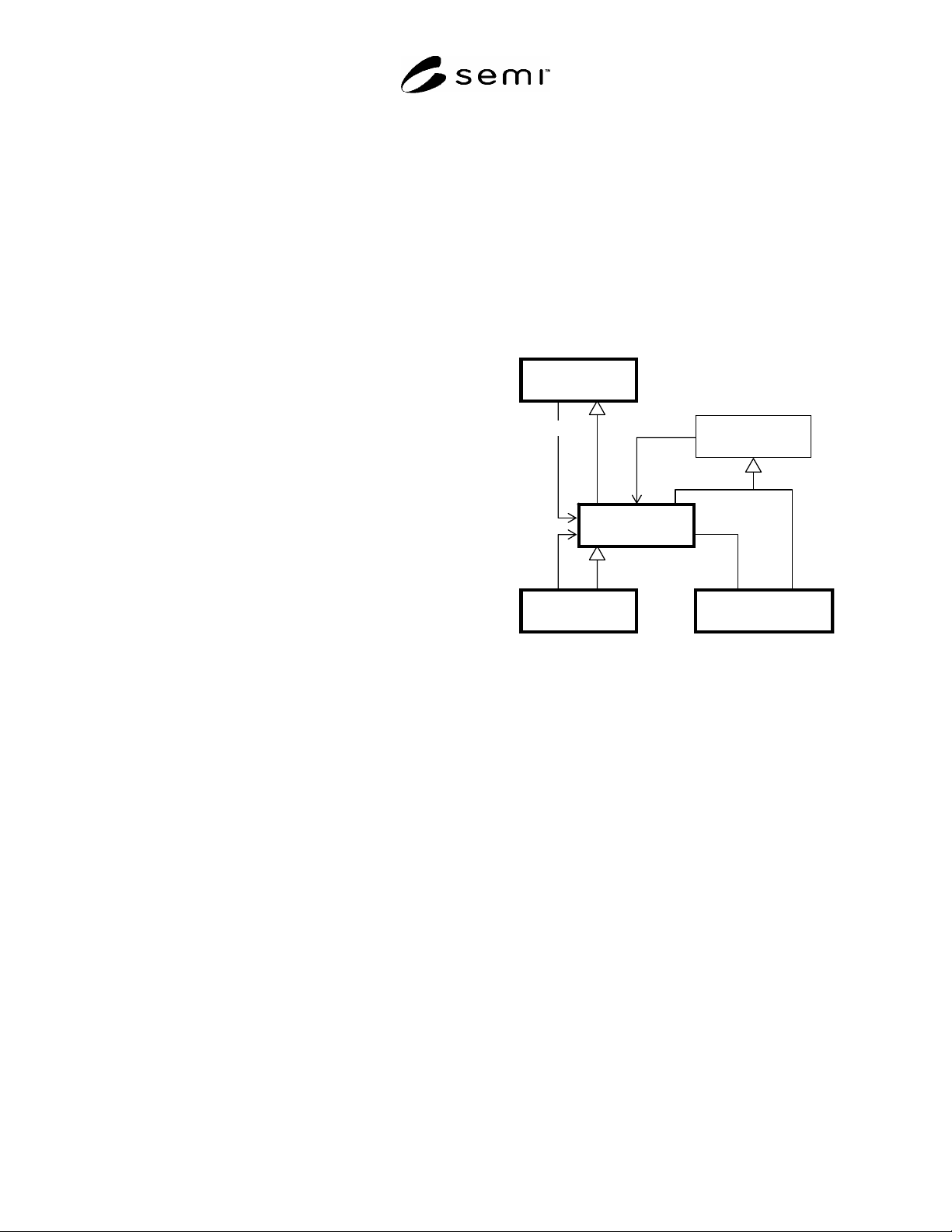
11.3.1 Quasi Object for Data Transfer — To fix above
problem it should be clarified that Die Trace Machine
may need to get a part of Die Trace Data on previous
process and Die Tracer may be asked for such data by
the machine. To make sure the nature on Die Tracing
system, it solves the problem for the system to assume
some class object having the nature. Die Trace Staff
class on Figure 16 has the role.
11.3.1.1 Die Trace Staff Quasi Class — This class has
the responsibility to ask some Die Trace Data to Die
Tracer if the data is required for tracking. Because it is
inherited to Die Trace Machine and Die Tracer, the
Machine may ask a part of Die Trace Data to the Tracer
and the Tracer can ask the data to the other Die Tracer
if the Tracer doesn’t have the previous data. This is
unofficial class so that this document may not give
specific definition. However, the capabilities defined in
the other classes provide the its capability.
collects
1..*
1
..*
requests
Die Trace
Manager (DTM)
Die Tracer
(Tracer)
1..*
manages
Die Trace Machine
(Machine)
Die Trace Client
(Client)
0..*
Die Trace Staff
(Staff)
inquires
investigation
reports
Figure 16
Die Trace Staff Quasi Class
12 Services for Device Tracking
12.1 Services — This section defines content of service
messages provided by classes in this document.
12.1.1 Format and Protocol — The message format
and communication protocol may not be defined here
because they are dependent to specific implementation.
12.1.2 Public Interface — Each service definition is a
part of definition of public interface. Implementation of
services may not be always required if a set of the
message communication between objects or a part of it
are not required in intended system or deployment unite
provided by user and suppliers.
12.2 Service Definition — Service definitions are given
for each class.
12.2.1 CircuitModule — The following tables defines
services of Circuit Module class.
12.2.1.1 Service List — Circuit Module class has the
following services.

SEMI T13-1104 © SEMI 2004 17
Table 1 Service List for Circuit Module
Operation Description Type Reqd
showProperty Inquires all or a part of attributes (property) of CircuitModule. R Y
showDaughter Inquires all CircuitModules which this CircuitModule has or mounted on. R Y
12.2.1.2 showProperty — This service is used to inquire all a part of property of CircuitModule. The following
table defines its parameters.
Table 2 Service Definition of showProperty for Circuit Module
Parameter Req/Ind Rsp/Conf Description
Designation C - Selected Name in Property.
Property - M Property of CircuitModule.
ServiceStatus - M Result of service request.
12.2.1.3 showDaughter — This service is used to inquire CircuitModules mounted on this CircuitModule. The
following table defines its parameters.
Table 3 Service Definition of showDaughter for Circuit Module
Parameter Req/Ind Rsp/Conf Description
Clarifier - M Clarifier of CircuitModule.
ServiceStatus - M Result of service request.
12.2.1.4 Parameter List — Above services use the following parameters.
Table 4 Service Parameter Definitions for Circuit Module
Parameter Definition Form
Clarifier ID or some code to identify CircuitModule clearly:
concatenation of ID and any or all of device type, product name
and Manufacturer.
Text.
Designation One or more attribute names separated by space. Text.
Property A part or all of attributes of CircuitModule. However
CircuitModule has attributes illustrated on Figure 8 at least,
additional attributes are dependent on type and production
stage: dice may have Quality or Rank.
Text (structured).
ServiceStatus Result of service to show successful or reason of failure. Text.
12.2.2 DieTraceClient — The following tables defines services of Die Trace Client class.
12.2.2.1 Service List — Die Trace Client class has the following services.
Table 5 Service List for Die Trace Client
Operation Description Type Reqd
showPhenomena Inquires identification of Attachment. R N
setAlert Inquires name of Attachment. R N