semi合集-English.pdf - 第6420页
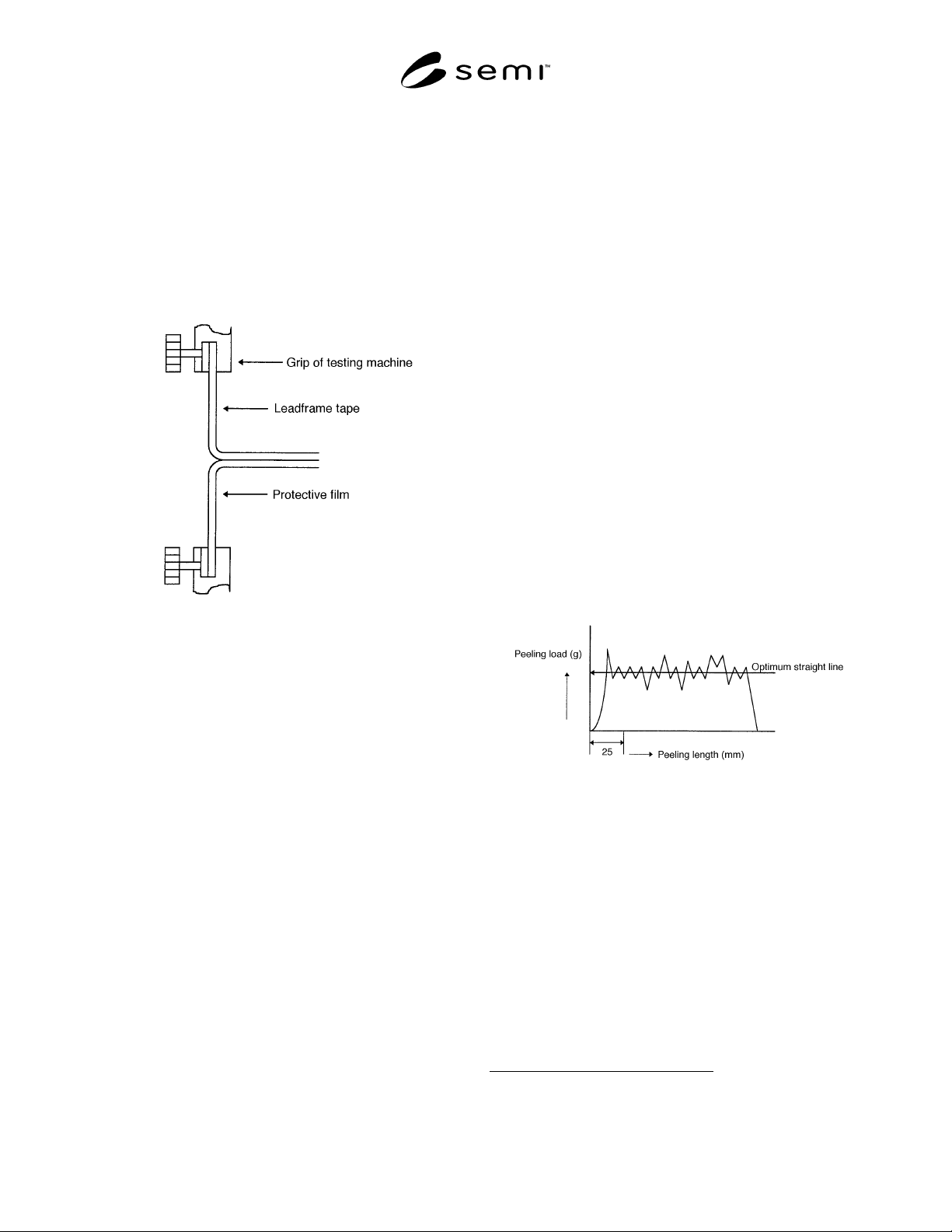
SEMI G75.3-069 8 © SEMI 1998 1 SEMI G75.3-0698 TEST METHOD FOR MEA SUREM ENT OF THE PEEL STRENGTH OF PROTECTIVE FILM ON LEA DFRA ME TAPE 1 Summary of Method 1.1 A tensile tester is used to peel t h e fi lm away from the …

SEMI G75.2-0698 © SEMI 1998 6
7 Related Documents
7.1 JIS Specification
1
JIS K 6854 — Testing Methods for Peel Strength of
Adhesives
NOTICE: These standards do not purport to address
safety issues, if any, associated with their use. It is the
responsibility of the user of these standards to establish
appropriate safety and health practices and determine
the applicability of regulatory limitations prior to use.
SEMI makes no warranties or representations as to the
suitability of the standards set forth herein for any
particular application. The determination of the
suitability of the standard is solely the responsibility of
the user. Users are cautioned to refer to manufacturer’s
instructions, product labels, product data sheets, and
other relevant literature respecting any materials
mentioned herein. These standards are subject to
change without notice.
The user’s attention is called to the possibility that
compliance with this standard may require use of
copyrighted material or of an invention covered by
patent rights. By publication of this standard, SEMI
takes no position respecting the validity of any patent
rights or copyrights asserted in connection with any
item mentioned in this standard. Users of this standard
are expressly advised that determination of any such
patent rights or copyrights, and the risk of infringement
of such rights, are entirely their own responsibility.
1 Japanese Standards Association, 1-24, Akasaka 4 Chome, Minato-ku, Tokyo, Japan
Copyright by SEMI® (Semiconductor Equipment and Materials
International), 3081 Zanker Road, San Jose, CA 95134. Reproduction o
f
the contents in whole or in part is forbidden without express written
consent of SEMI.
SEMI G75.3-0698 © SEMI 19981
SEMI G75.3-0698
TEST METHOD FOR MEASUREMENT OF THE PEEL STRENGTH OF
PROTECTIVE FILM ON LEADFRAME TAPE
1 Summary of Method
1.1 A tensile tester is used to peel the film away from
the adhesive (see Figure 1) and directly measure the
peel strength with a calibrated load cell.
Figure 1
Attaching of Test Piece for T-Type Peel Test
2 Equipment
2.1 Tensile tester with appropriate load cell, clamping
chucks, and a chart recorder.
2.1.1 Tensile tester shall keep constant the traveling
speed of clamping chucks, of which the traveling
distance can be read to the nearest 1 mm, and shall
simultaneously record the load imposed on the sample.
It shall measure and record the imposed load with ± 1%
on a chart recorder.
3 Test Condition
3.1 Peel strength testing shall be carried out at the
following ambient conditions:
Temperature — 23 ± 5°C
Humidity — 50 ± 5% RH
4 Sampling
4.1 The sampling is one sample per one lot. The
vendor must report the definition of lot, if the customer
requires it.
4.2 The width of the tape tested shall be 15 ± 0.2 mm.
5 Equipment Calibration and Setup
5.1 Refer to the tensile tester manufacturer’s
equipment manual for setup and calibration.
5.2 The sample shall be attached and peeled for T-type
peel test shown in Figure 1.
5.3 Both ends of a test piece shall be attached to the
grips of the testing machine specified in Section 2.1.
5.4 The pulling rate shall be set to 300 mm/minute.
5.5 The pulling distance shall be 125 mm minimum
from the start of peeling.
5.6 The peel strength shall be recorded in grams.
6 Measurements
6.1 As shown in Figure 2, draw the optimum straight
line which is parallel to the abscissa for peeling length,
that passes through the peeling curve, and find the
peeling load after eliminating initial 25 mm of peeling
length.
Figure 2
Obtaining Peeling Load by the Optimum Straight
Line Method
7 Related Documents
7.1 JIS Specification
1
JIS K 6854 — Testing Methods for Peel Strength of
Adhesives
1 Japanese Standards Association, 1-24, Akasaka 4 Chome, Minato-
ku, Tokyo, Japan

SEMI G75.3-0698 © SEMI 1998 2
NOTICE: These standards do not purport to address
safety issues, if any, associated with their use. It is the
responsibility of the user of these standards to establish
appropriate safety and health practices and determine
the applicability of regulatory limitations prior to use.
SEMI makes no warranties or representations as to the
suitability of the standards set forth herein for any
particular application. The determination of the
suitability of the standard is solely the responsibility of
the user. Users are cautioned to refer to manufacturer’s
instructions, product labels, product data sheets, and
other relevant literature respecting any materials
mentioned herein. These standards are subject to
change without notice.
The user’s attention is called to the possibility that
compliance with this standard may require use of
copyrighted material or of an invention covered by
patent rights. By publication of this standard, SEMI
takes no position respecting the validity of any patent
rights or copyrights asserted in connection with any
item mentioned in this standard. Users of this standard
are expressly advised that determination of any such
patent rights or copyrights, and the risk of infringement
of such rights, are entirely their own responsibility.
Copyright by SEMI® (Semiconductor Equipment and Materials
International), 3081 Zanker Road, San Jose, CA 95134. Reproduction o
f
the contents in whole or in part is forbidden without express written
consent of SEMI.