semi合集-English.pdf - 第1917页
SEMI E54.1-1000 © SEMI 1996, 2000 23 Figure 6 DM Object Ins tance Behavior* *Tran sit ions 10 throu gh 21 are rec ursi ve (i. e., th e New Sta te is the same a s the Cu rrent Stat e (inc luding all n ested sub -stat es )…
SEMI E54.1-1000 © SEMI 1996, 2000 22
7.3.2.9 Lock (Optional) — This service is used to restrict network access to all READ only attributes of all objects
of this device. This service guarantees that the READ only attributes of this device are not modified over the
network. There are no parameters specified for this service.
7.3.2.10 Unlock (Optional) — This service is used to make READ only attributes of objects of this device
modifiable over the network. Not only is support of this object optional, but the degree to which it is supported is
also specified by the manufacturer (i.e., only some attributes may become “unlocked”). Table 25 describes the
parameters specified for this service.
Table 25 DM Object Unlock Parameter Definitions
Parameter Request/
Indication
Response/
Confirmation
Form Description
Password Key C C Manufacturer-
Specific
Password may be specified to restrict access or to
provide a manufacturer-specified security scheme.
7.3.2.11 GetExceptionQueue (Optional) — This service is used to read all or portions of the AlarmQueue and
WarningQueue elements. Table 26 describes the parameters specified for this service.
Table 26 DM Object GetExceptionQueue Parameter Definitions
Parameter Request/
Indication
Response/
Confirmation
Form Description
ExceptionType M C**, = Byte, enumerated0 = Alarm1 =
Warning
Used to indicate which exception queue is being
queried.
ElementNumb M M unsigned integer < 65,536 Used to indicate the number of Exception queue
events to be returned with the service response. A
zero value implies that all elements in the queue
should be returned.
ExceptionList — M List of elements; element data
type.
Dependent on the Reporting
Mode (Basic or Expanded —
See Sections 7.3.1.12, 7.3.1.19,
7.3.1.20, and 7.3.3).
An array of exception queue events of size
ElemNumb returned with the response.
Clear M C Boolean Used to indicate whether or not the exceptions are
to be removed from the exception queue upon
reporting.
7.3.2.12 ClearExceptionQueue (Optional) — This service is used to clear all elements out of either the
AlarmQueue or WarningQueue. Table 27 describes the parameters specified for this service. If the ExceptionType
attribute is set to 0, 1, or 2 with the service request, the Alarm, Warning, or both queues respectively are cleared
completely of their members.
Table 27 DM Object Clear ExceptionQueue Parameter Definitions
Parameter Request/
Indication
Response/
Confirmation
Form Description
ExceptionType M C**, = Byte,
enumerated
0 = Alarm
1 = Warning
2 = Both
Used to indicate which exception queue(s) is/are to be
cleared.
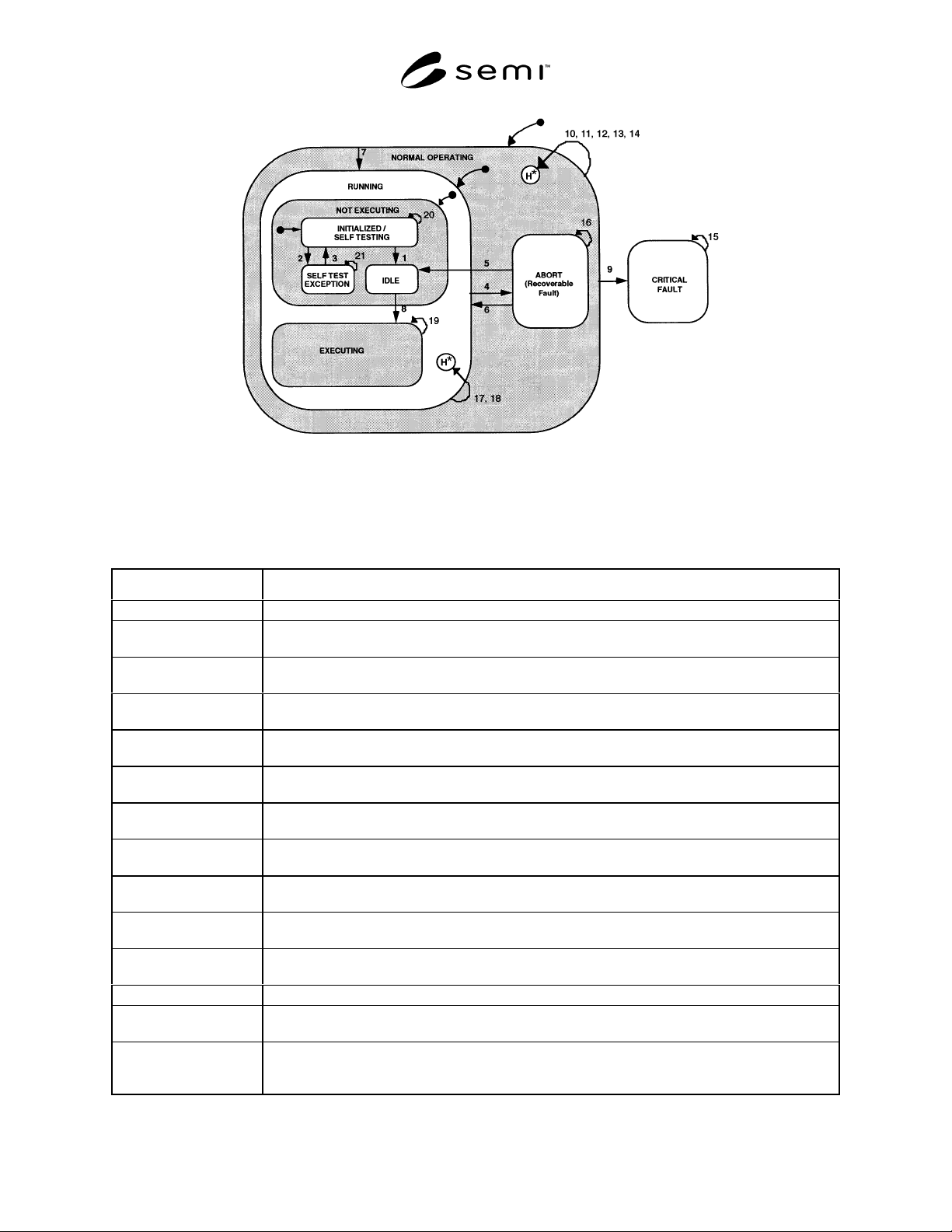
7.3.3 DM Object Behavior — The DM object behavior is illustrated in Figure 6 and in Tables 28 and 29.
SEMI E54.1-1000 © SEMI 1996, 200023
Figure 6
DM Object Instance Behavior*
*Transitions 10 through 21 are recursive (i.e., the New State is the same as the Current State (including all nested sub-states)).
Table 28 DM Instance Behavior State Description
State Description
NORMAL OPERATING Object instance exists. Object services can be processed.
RUNNING This is the entry sub-state to NORMAL OPERATING. Object instance is not in an aborted state.
Object is capable of reporting attribute values, including exceptions.
NOT EXECUTING Device is not executing (e.g., it is not performing its device-specific function). A detailed description
of this state is outside the scope of this document.
This state may be further specified in an appropriate sensor/actuator network specific device model
specification.
EXECUTING Device is executing (e.g., it is performing its device-specific function). A detailed description of this
state is outside the scope of this document.
This state may be further specified in an appropriate sensor/actuator network specific device model
specification.
INITIALIZED/SELF
TESTING
This is the entry sub-state to NORMAL OPERATING and RUNNING.
Object instance exists and has been initialized; all attributes have appropriate initial values(as
indicated herein and in an appropriate sensor/actuator network specific device model specification).
Device is performing device-specific and device type-specific tests to determine if it is qualified to be
running.
Note that as this is a sub-state of RUNNING, object is not initialized unless it is capable of reporting
attribute values, including exceptions.
SELF TEST
EXCEPTION
Object has detected an exception condition during self testing. The details of the exception are stored
in the appropriate attribute values of the DM object.
IDLE Object and device have been initialized and have successfully completed self testing.
ABORT Object instance is in an aborted state; a detailed description of this state is outside the scope of this
document. The object will not initiate communication over the network while in this state.
CRITICAL FAULT The object (and device) are in a fault state from which there is no recovery. Object services cannot be
processed. The conditions required for exit from a critical fault are outside the scope of this
document.

SEMI E54.1-1000 © SEMI 1996, 2000 24
Table 29 DM Instance Behavior State Transition Matrix*
# Current State Trigger New State Action Comment
1 INITIALIZED/
SELF TESTING
DM Object determines
internally that the
device is initialized and
self test passed.
IDLE Set Device Status attribute to
appropriate value.
Device is in an idle state.
2 INITIALIZED/
SELF TESTING
One or more exceptions
reported as a result of
device testing.
SELF TEST
EXCEPTION
Report exceptions through
appropriate attribute settings in
DM object. Set Device Status
attribute to appropriate value.
Conditions resulting in the
reporting of a self test
exception are
device-specific.
3 SELF TEST
EXCEPTION
Exception condition
cleared.
INITIALIZED/
SELF TESTING
Set Device Status attribute to
appropriate value. Initiate self
testing procedure from
beginning.
Enter RUNNING/NOT
EXECUTING/INITIALIZ
ED/SELF TESTING.
4 RUNNING Abort request. ABORT Abort response. Set Device
Status attribute to appropriate
value.
Abort request may be
generated internally (e.g.,
as a result of Self Test
catastrophic failure).
5 ABORT Recover request;
Device Status attribute
value == ABORT
FROM IDLE
OREXECUTING.
IDLE Recover response. Set Device
Status attribute to appropriate
value.
Enter IDLE state.
6 ABORT Recover request;
Device Status attribute
value == ABORT
FROM INITIALIZED/
SELF TESTING OR
SELF TEST
EXCEPTION.
INITIALIZED/S
ELF TESTING
Recover response. Initiate self
testing procedure from
beginning. Set Device Status
attribute to appropriate value.
Enter RUNNING/NOT
EXECUTING/
INITIALIZED/SELF
TESTING.
7 NORMAL
OPERATING
Reset request. RUNNING Reset response. DM Object is
initialized. Set Device Status
attribute to appropriate value.
Valid for all sub-states of
NORMAL OPERATING.
Move to RUNNING/NOT
EXECUTING/
INITIALIZED/SELF
TESTING.
8 IDLE Execute service request
(this service request
may be
internally generated).
EXECUTING Execute response. Set Device
Status attribute to appropriate
value.
Device is now executing.
9 NORMAL
OPERATING
Critical Fault detected. CRITICAL
FAULT
The object (and device) is in a
fault state from which there is
no recovery. Object services
generally cannot be processed.
The mechanism for exit
from a critical fault is
device-specific.
10 NORMAL
OPERATING
GetAttribute or Set
Attribute request.
NORMAL
OPERATING
Get or Set Attribute appropriate
response.
Valid for all sub-states of
NORMAL OPERATING.
11 NORMAL
OPERATING
PerformDiagnostics
request.
NORMAL
OPERATING
PerformDiagnostics response.
Diagnostic is performed if
possible. Exceptions are set
within DM object as necessary.
Conditions which are
deemed exceptions are
device-specific.
12 NORMAL
OPERATING
Lock or Unlock request. NORMAL
OPERATING
Adjust write access to READ
only attributes of all device
objects as appropriate. Lock or
Unlock service response.
The mechanism for exit
from a critical fault is
device-specific.
13 NORMAL
OPERATING
GetExceptionQueue or
Clear Exception Queue
request.
NORMAL
OPERATING
GetExceptionQueue response
with appropriate exception
queue data. Clear appropriate
Valid for all substates of
NORMAL OPERATING.