semi合集-English.pdf - 第5461页
SEMI PR9-0705 © SEMI 2005 5 7.5.6 Overall Dim ensions 7.6 Possible root causes for chemical/materials incompatibility are partially listed below. 7.6.1 Cleanliness of fluid system 7.6.2 Outgassing of materials from so li…

SEMI PR9-0705 © SEMI 2005 4
7.2.3 The reader is specifically requested to consult the Materials Safety Data Sheet (MSDS) and the
manufacturer’s recommended practices for any fluid or component prior to use and to follow the suggestions
prescribed. In addition, the acceptable degree of chemical and material incompatibilities are relative to conditions of
use. For instance, microscopic corrosion may be intolerable in one application yet may be quite tolerable in another.
A list of such considerations is well documented in materials selection handbooks
2
, 3 , 4
.
7.3 In Service Considerations are partially listed below.
7.3.1 Operating pressure
7.3.2 Operating temperature
7.3.3 Chemical environment: dry, moist, corrosive
7.3.4 Loads-magnitude, nature-tension, bending, torsion
7.3.5 Loads-nature-static, dynamic, impact
7.3.6 Mating part materials
7.3.7 Attachment points/ mechanisms
7.3.8 Presence of potential crevices
7.3.9 Allowable deflections /rotation
7.3.10 Allowable failure modes
7.3.11 Dimensional stability needed-short and long term
7.3.12 Frequency of assembly and disassembly
7.3.13 Insulation-thermal/electrical
7.3.14 Isolation-RF, thermal, electrical
7.3.15 Chemical Potential
7.4 Manufacturing Considerations are partially listed below.
7.4.1 Cost
7.4.2 Availability of material
7.4.3 Stock shapes-availability
7.4.4 Weldability
7.4.5 Formability
7.4.6 Expected consumption rate
7.4.7 Machinability
7.4.8 Achievable surface finishes
7.5 Assembly/Transport/Shipping consideration partially listed below.
7.5.1 G Forces-allowable shock and vibration
7.5.2 Allowable Moisture
7.5.3 Allowable Temperature
7.5.4 Allowable Pressure
7.5.5 Total Weight
2 Cheremisinoff, Nicholas, P., Materials Selection Deskbook, William Andrew Publishing/Noyes, 1996, p.p. 18-36.
3 Kutz, M, Handbook of Materials Selection, 2002
4 Ashby, MF, Materials Selection in Mechanical Design, 2000

SEMI PR9-0705 © SEMI 2005 5
7.5.6 Overall Dimensions
7.6 Possible root causes for chemical/materials incompatibility are partially listed below.
7.6.1 Cleanliness of fluid system
7.6.2 Outgassing of materials from solid surfaces into process fluid
7.6.3 Process fluid purity (trace chemical impurities)
7.6.4 Process fluid cleanliness (particulate)
7.6.5 Permeability of chemicals in solid materials
7.6.6 Infectious biomaterial
7.6.7 Corrosion-Erosion
7.7 Classification of materials and fluids
7.7.1 Fluids
7.7.1.1 Classification of Gases
5
(with examples)
7.7.1.1.1 Inerts — argon, helium, krypton, neon, radon, xenon
7.7.1.1.2 Hydrogen — deuterium, hydrogen, tritium
7.7.1.1.3 Hydrocarbons — acetone, acetylene, hexane, propane
7.7.1.1.4 Halogenated Hydrocarbons — carbon tetraflouride, octafluorocyclobutane
7.7.1.1.5 Hydrides — silane, germane, phosphine, arsine
7.7.1.1.6 Halogens, other than Fluorine — chlorine, iodine
7.7.1.1.7 Halides, other than Fluorides — hydrogen chloride, hydrogen bromide, hydrogen iodine
7.7.1.1.8 Fluorine and Fluorides — F
2
, XeF
2
, NF
3
, BF
3
,WF
6
7.7.1.1.9 Organo — Metallic and Siloxanes
7.7.1.1.10 Oxygen, Oxides and Sulfides
7.7.1.1.11 Nitrogen and Nitrogen Compounds
7.7.1.1.12 Acids — hydroflouric acid, nitric acid, sulfuric acid
7.7.1.1.13 Nano structures and compounds
7.7.1.2 Liquids
6
7.7.1.2.1 Water — de-ionized, distilled
7.7.1.2.2 Inorganic Acids — hydrochloric acid, hydrofluoric acid, nitric acid
7.7.1.2.3 Bases — sodium hydroxide, potassium hydroxide, ammonium hydroxide
7.7.1.2.4 Organic acids — glacial acetic, trichloroacetic
7.7.1.2.5 Hydrocarbon solutions — toluene, iso-octane
7.7.1.2.6 Alcohols — ethyl, isopropanol, methyl
7.7.1.2.7 Amines — aniline, ethylenediamine
7.7.1.2.8 Ethers — tetrahydrofuran
7.7.1.2.9 Ketones/Aldehydes — acetone, benzaldehyde, methyl ethyl ketone
5 SEMI F79-0703 Guideline for Gas Compatibility with Silicon used in Gas Distribution Components
6 http://www.entegrisfluidhandling.com
SEMI PR9-0705 © SEMI 2005 6
7.7.1.2.10 Esters — dimethylphthalate
7.7.1.2.11 Chlorinated Solvents — methylene chloride, perchloroethylene, carbon tetrachloride
7.7.1.2.12 Freon
®
— Freon — TF, Freon — TMC, Freon TMS
7.7.1.3 Classification of Materials; Common materials are considered
7
as follows (including in the nanometer size
regime):
7.7.1.3.1 Silicon — Element 14 (and all isotopes), single crystal, doped, polycrystalline, amorphous
7.7.1.3.2 Polymers — PCTFE, PTFE, Polyimide, Chemraz
®
, Kalrez, Viton
®
7.7.1.3.3 Glassy Materials — Silicon dioxide, Pyrex
®
, silicon nitride
7.7.1.3.4 Metals — Aluminum, stainless steel 316L, Hastelloy
®
c-22, Elgiloy
®
, Nickel 200
7.7.1.3.5 Ceramics — Alumina, Macor
®
7.7.1.3.6 Plastics — Polyethylene, PVC
7.7.1.3.7 Graphitic — nanotubes, C60, graphite, pyrolytic graphite, diamond-like carbon
7.7.1.3.8 Suspended Nano structures and compounds
7.7.1.4 Biological Materials
7.7.1.4.1 tissue
7.7.1.4.2 Viruses
7.7.1.4.3 DNA
7.7.1.4.4 Proteins
7.7.1.4.5 Polypeptides
7.7.1.4.6 Cellular materials
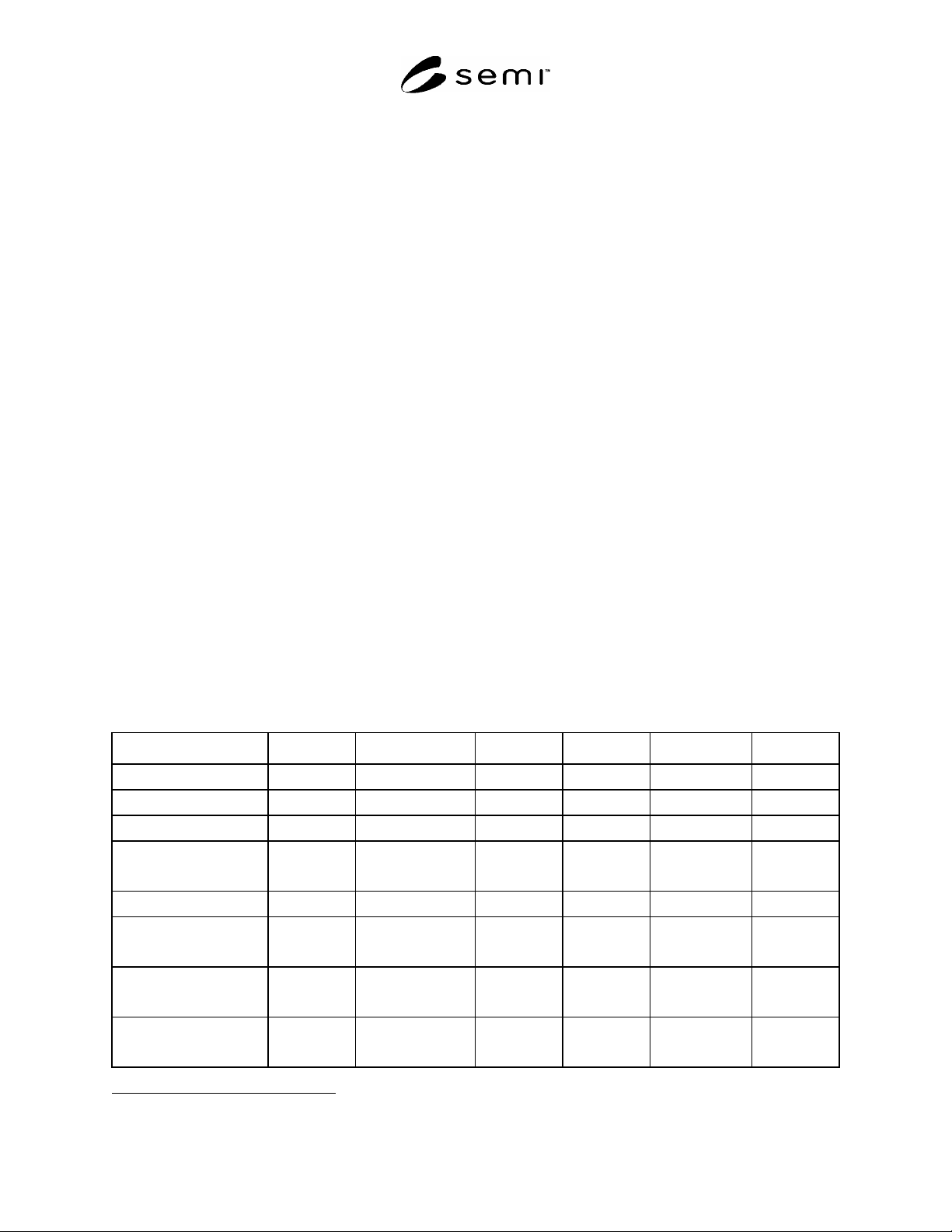
7.8 Materials/Chemical Compatibility
7.8.1 The compatibility chart below, is presented as a broad cross-section of materials and fluids that may be used
as a springboard for further development of fluidic devices and/or interfaces.
Silicon Polymers Glass Metals Ceramics Plastics
Inerts
A A A A A A
Hydrogen
5 7 7 7
Hydrocarbons
5 5,7 7 7
Halogenated
Hydrocarbons
5
Hydrides
5 7 7 7
Halogens, other than
Fluorine
5 7 7 7
Halides, other than
Fluorides
5 7 7 7
Fluorine and Fluorides
U/5 7 7 7
7 http://www.airproducts.com/specgases/safety/70008.htm