semi合集-English.pdf - 第1622页
SEMI E38-1296 © SEMI 1995 , 1996 11 7.1.4 Material Movement Models — M a terial movement in a clus ter tool incl udes all services requ ired within the clust er tool to mov e materi al from the f actory to a se quence of…
SEMI E38-1296 © SEMI 1995, 1996 10
Carriers may be cassettes used to transport single material in the factory and to input single material to the cluster
tool, or they may be material boats in batch process modules.
The attributes of the material slot object are standardized to enable mapping of single material in carriers. Other
objects in the diagram are not standardized. However, the identifier of the material, MaterialID, is an attribute of the
material slot object.
Other materials (consumable gases and fluids, etc.) are present in the cluster tool, but outside the scope of these
standards.
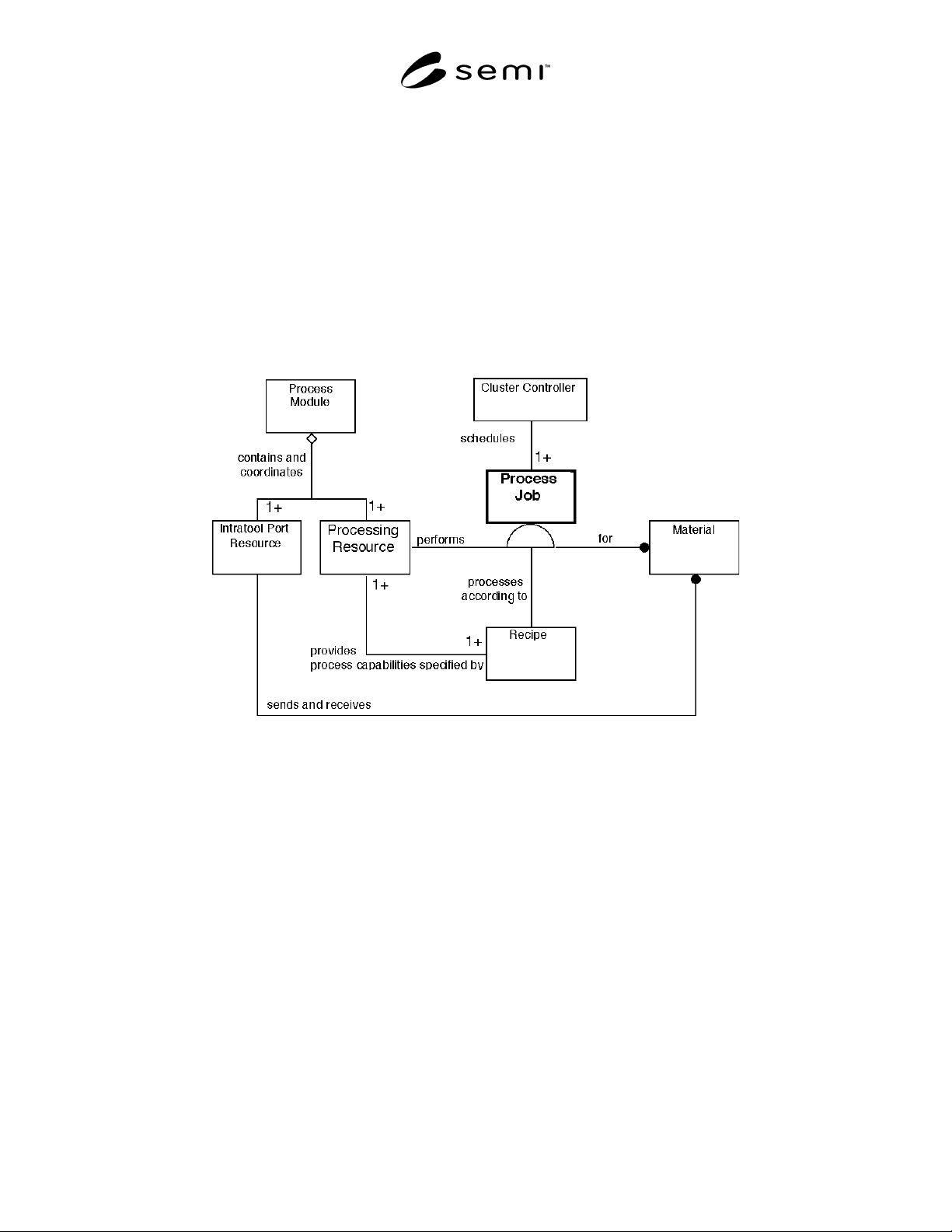
7.1.3 Material Processing Model — The material processing model in Figure 7 shows the use of the process job to
direct the processing resource to apply the appropriate process, as specified by the recipe, to one or more materials
in a process module. A processing resource in a process module has processing capabilities which are specified by
corresponding recipes.
Figure 7
Material Processing Information Model
A process job can control multiple material only if identical processing is applied to all. Processing should begin and
end simultaneously, synchronized with the arrival of the whole group of material.
The process job lifecycle extends beyond the active processing of the material. It exists from just before material
arrival at the intratool port resource, through setup and processing, and until just after the material departure at the
same, or another, intratool port resource. This allows for material-related pre-conditioning and post-conditioning of
the processing resource before the material is received and after it is sent. As material input and output is controlled
by the intratool port resource, it is the responsibility of the process module to ensure coordination of the intratool
port and processing resources.
This is the model used to establish the Processing Management definition. There is no standardization beyond
creation and control (starting, canceling, stopping, aborting, and pausing) of the high-level process job since the
low-level control of process modules is application-dependent.
There is a component of scheduling embodied in this model. The material, recipes, and processing resources are
scheduled by the cluster controller according to the process specification to a particular process module through the
use of the process job. In order to perform the required processing, material is transferred to the processing resource,
as directed by the cluster controller.
SEMI E38-1296 © SEMI 1995, 199611
7.1.4 Material Movement Models — Material movement in a cluster tool includes all services required within the
cluster tool to move material from the factory to a sequence of process modules in order to be processed and then
back to the factory. Material is moved individually within a cluster tool and may be received from the factory in
cassettes or individually.
The material movement model is divided into three parts as follows:
• intratool material movement defines the transfer of material between attached modules, with the transfer agent
being a transport module.
• intertool material movement defines the exchange of carriers and single material with the factory at the cluster
tool cassette module.
• carrier mapping defines presence and identifiers of single material contained in carriers.
These three models are used to establish the Material Movement Management definition within a cluster tool.
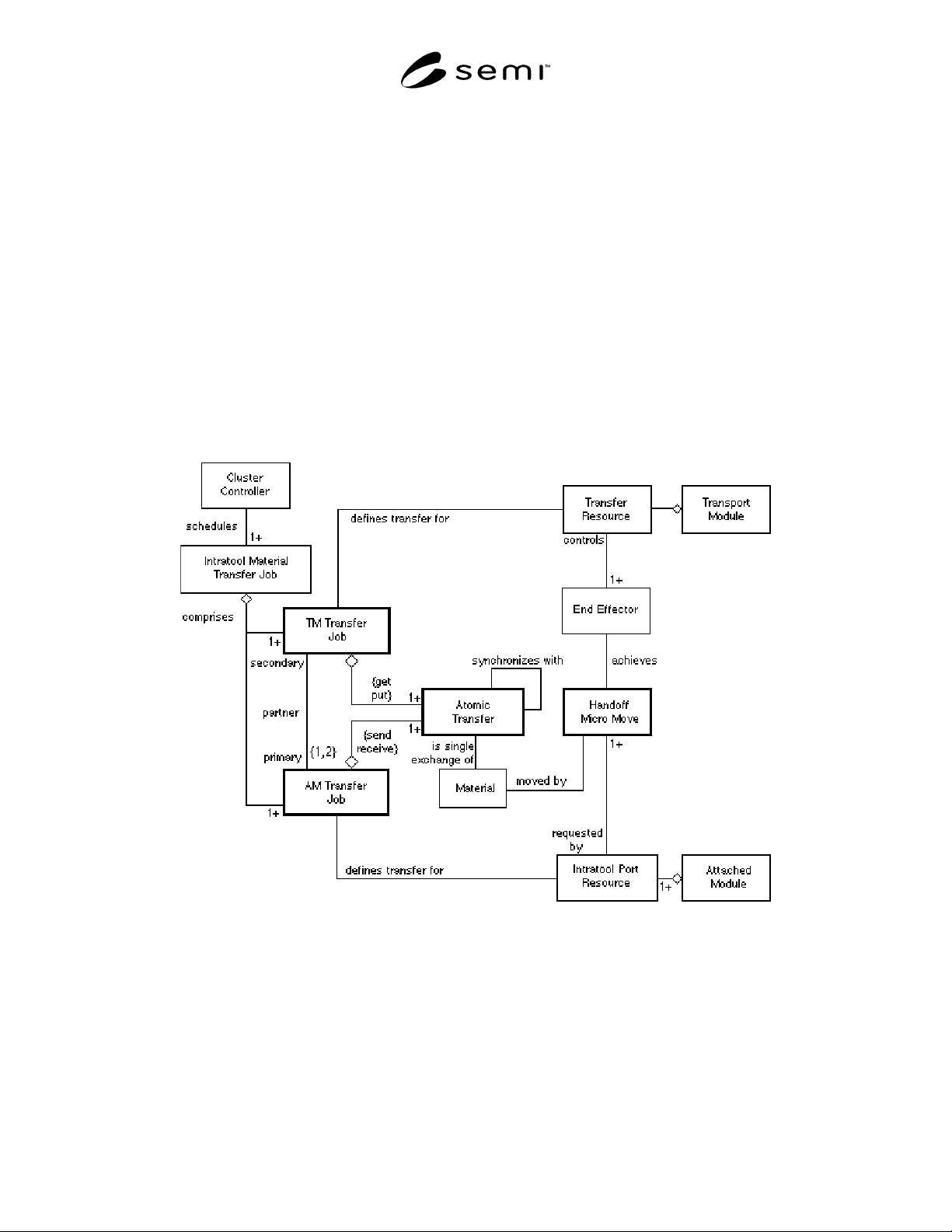
7.1.4.1 Intratool Material Transfer — The intratool material movement model is shown in Figure 8. An intratool
material transfer is the movement of material from one attached module to another attached module through the
linking transport module.
Figure 8
Intratool Material Movement Information Model
The cluster controller schedules an intratool material transfer job when intratool material transfer is required. This is
achieved by TM and AM transfer jobs assigned to the appropriate module resource in each of the participating
modules:
• to the transfer resource in the transport module to get the material from the source attached module and put it
into the destination attached module.
• to the intratool port resource in the source attached module to send the material to the transport module.
SEMI E38-1296 © SEMI 1995, 1996 12
• to the intratool port resource in the destination attached module to receive the material from the transport
module.
Transfer jobs are made up of atomic transfers. An atomic transfer in one transfer partner synchronizes with the
corresponding atomic transfer in the other partner to achieve the material transfer through handoff micro moves. In a
cluster tool, the attached module is the primary partner, requesting the handoff micro moves, and the transport
module is the secondary partner achieving those micro moves by controlling the end effector on which the material
is transported.
The transport module is responsible for managing constraints on the simultaneous opening of isolation valves as it
relates to contamination of the transport module's environment by that of an attached module, as well as cross
contamination between modules. The attached module ensures that its environment will not contaminate the
transport module before synchronizing for handoff. The rules for re-establishing isolation at verification are
determined by the transport module.
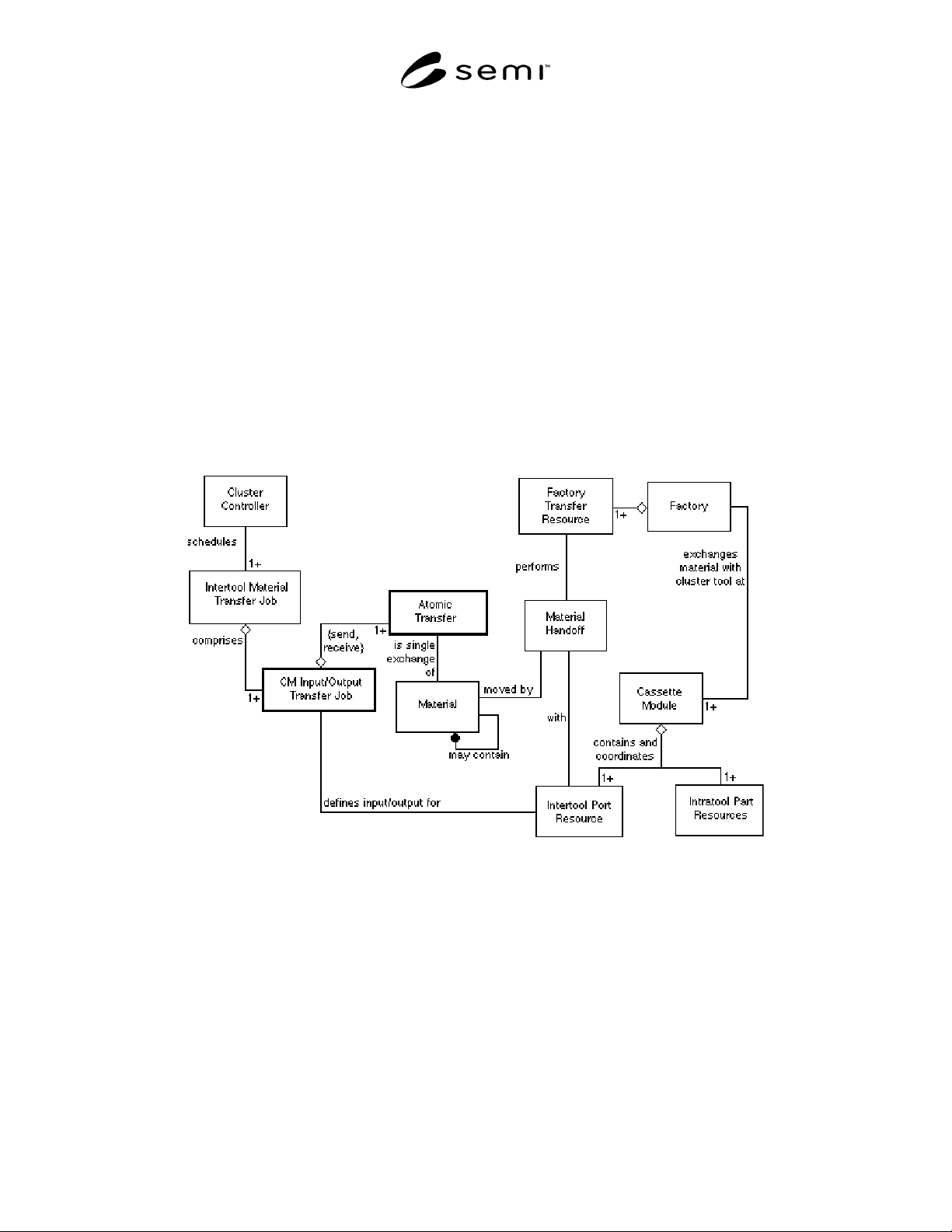
7.1.4.2 Intertool Material Transfer — The cassette module performs material exchange with the factory. The
material generally consists of cassettes with single material or empty cassettes, but may be individual single
material. The intertool material movement model, shown in Figure 9, is similar to the intratool material movement
model. An intertool material transfer is a transfer in the factory which includes the cluster tool as one of the transfer
partners.
Figure 9
Intertool Material Movement Information Model
In the cluster tool, the cluster controller schedules an intertool material transfer job when material exchange with the
factory is required. This job may be an element of a factory material transfer job in which the cluster tool is a
partner.
The intertool material transfer job is achieved by a CM input/output transfer job assigned to the intertool port
resource in the participating cassette module. It defines the material exchange with the factory for the cassette
module. The CM input/output transfer job comprises an atomic transfer, which defines the roles in the material
handoff.
In the cassette module, material transfer with the transport module is controlled by the intratool port resource. It is
the responsibility of the cassette module to coordinate its intertool and intratool port resources.