semi合集-English.pdf - 第4637页
SEMI C3.2-030 1 © SEMI 1981, 2001 1 SEMI C3.2-0301 SPECIFICA TION FOR A RSINE ( A sH 3 ) IN CYL INDERS , 99.94% QUALIT Y This specif ication was technic ally approved by the Global Ga ses Committee and is the direct resp…
SEMI C3.12-1102 © SEMI 1983, 2002 4
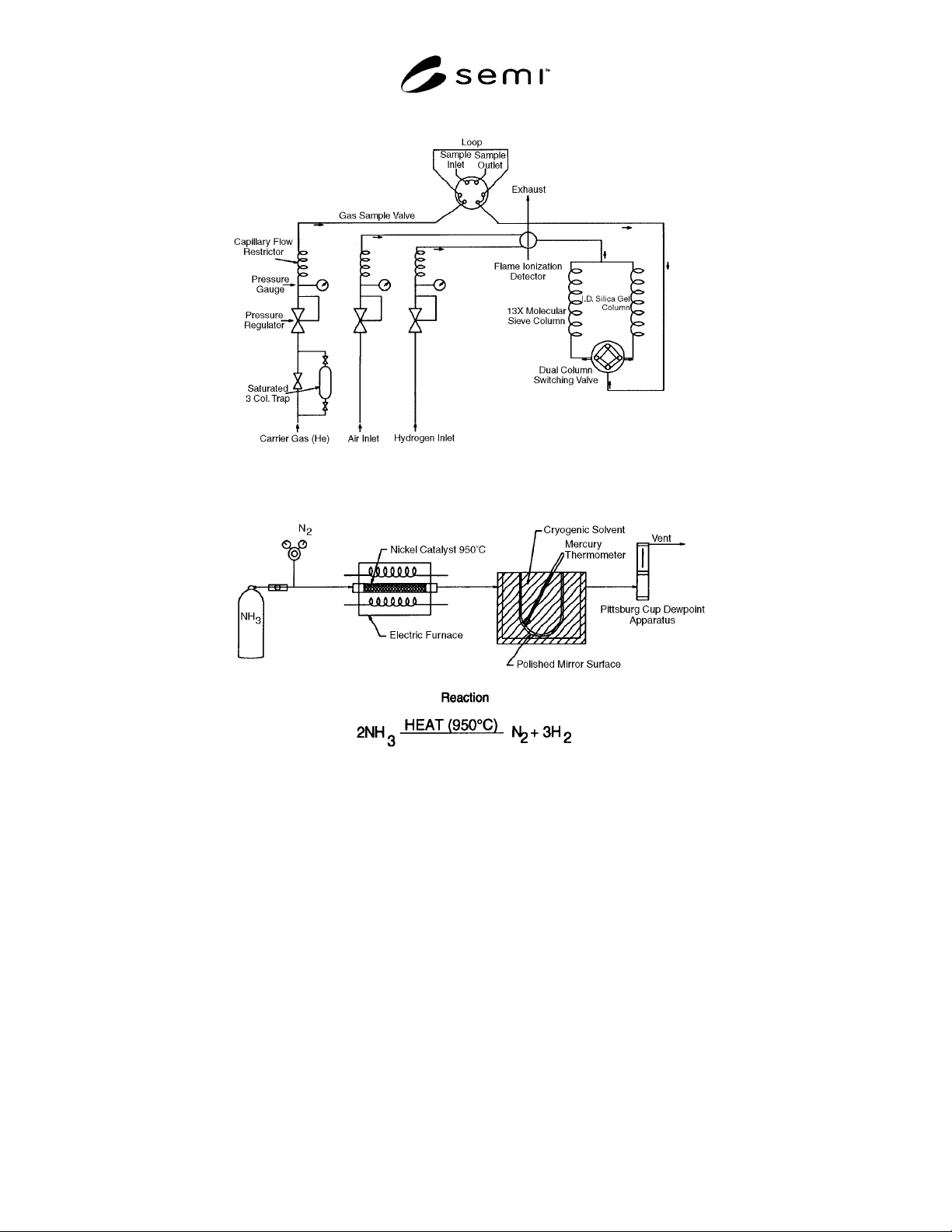
Figure 1
Figure 2
Electronic Ammonia Water Measurement
NOTICE: These standards do not purport to address safety issues, if any, associated with their use. It is the
responsibility of the user of these standards to establish appropriate safety and health practices and determine the
applicability of regulatory limitations prior to use. SEMI makes no warranties or representations as to the suitability
of the standards set forth herein for any particular application. The determination of the suitability of the standard is
solely the responsibility of the user. Users are cautioned to refer to manufacturer’s instructions, product labels,
product data sheets, and other relevant literature respecting any materials mentioned herein. These standards are
subject to change without notice.
The user’s attention is called to the possibility that compliance with this standard may require use of copyrighted
material or of an invention covered by patent rights. By publication of this standard, SEMI takes no position
respecting the validity of any patent rights or copyrights asserted in connection with any item mentioned in this
standard. Users of this standard are expressly advised that determination of any such patent rights or copyrights, and
the risk of infringement of such rights, are entirely their own responsibility.
Copyright by SEMI® (Semiconductor Equipment and Materials
International), 3081 Zanker Road, San Jose, CA 95134. Reproduction o
f
the contents in whole or in part is forbidden without express written
consent of SEMI.
SEMI C3.2-0301 © SEMI 1981, 20011
SEMI C3.2-0301
SPECIFICATION FOR ARSINE (AsH
3
) IN CYLINDERS, 99.94% QUALITY
This specification was technically approved by the Global Gases Committee and is the direct responsibility of
the North American Gases Committee. Current edition approved by the North American Regional Standards
Committee on October 17, 2000. Initially available at www.semi.org January 2001; to be published March
2001. Originally published in 1981; previously published in 1992.
1 Description
1.1 Arsine is a highly toxic, flammable, colorless gas
with a disagreeable garlic-like odor. It is a hemolytic
poison.
2 Specifications
QUALITY: 99.94%
Impurities
Maximum Acceptable
Level (ppm)
(See NOTE 1.)
Carbon monoxide and carbon dioxide
(CO + CO
2
)
2
Hydrocarbons (methane (CH
4
),
ethane (C
2
H
6
), ethylene (C
2
H
4
), and
acetylene (C
2
H
2
))
1
Hydrogen (H
2
) 500
Hydrogen Sulfide (H
2
S) 1
Nitrogen (N
2
)10
Oxygen (O
2
) + Argon (Ar) 5
Phosphine (PH
3
)10
Water (H
2
O) 4
TOTAL LISTED IMPURITIES 533
Metals — See NOTE 2.
Particles — See NOTE 2.
NOTE 1: An analysis of significant figures has not been considered.
The number of significant figures will be based on analytical
accuracy and the precision of the provided procedure.
NOTE 2: To be determined between supplier and user.
3 Physical Constants (for in formation only)
Metric Units US Units
Molecular weight 77.946 77.946
Boiling point at 1 atm -62.48°C -80.46°F
Density of gas at 20°C
(68°F) and 1 atm
3.243 kg/m
3
0.202 lb/ft
3
Specific gravity of gas at
21.1°C (70°F) and 1 atm
(air = 1)
2.695 2.695
Density of liquid at B.P. 1653 kg/m
3
103.96 lb/ft
3
4 Analytical Procedures
4.1 Carbon Monoxide, Carbon Dioxide, and
Hydrocarbons (methane, ethane, ethylene, acetylene)
— This procedure is for the determination of carbon
monoxide, carbon dioxide, and hydrocarbons in arsine
using a gas chromatograph with a methanizer and a
flame ionization detector. (See Note 1 and Figure 1.)
4.1.1 Detection Limit — 0.1 ppm each impurity.
4.1.2 Instrument Parameters
4.1.2.1 Column: Porapak QS, 3.5 m (12 ft) by 2 mm
ID (1/8 in OD) ss or equivalent.
4.1.2.2 Carrier Flow: 35 mL/min helium.
4.1.2.3 Support Gases: Set the flow rates as specified
by the instrument manufacturer.
Hydrogen: 30 mL/min added to the carrier gas
between the column outlet and the
methanizer inlet.
Air: 500 mL/min.
4.1.2.4 Temperatures:
Detector 110°C
Injector 40°C
Oven 40°C
Methanizer 370–400°C
4.1.2.5 Sample Volume: 3 mL.
4.1.3 Calibration Standards — 1–10 ppm each:
carbon monoxide, carbon dioxide, methane, ethane,
ethylene, and acetylene; balance helium.
4.1.4 Operating Procedure
4.1.4.1 Inject the calibration standard into the column
using a gas sampling valve. Record retention times and
peak areas. Order of elution is carbon monoxide,
methane, carbon dioxide, acetylene, ethylene, ethane.
4.1.4.2 Inject the sample to be tested in same manner
as the calibration standard. Vent the arsine after the
ethane peak. Record the retention times and peak areas.
4.1.4.3 Repeat 4.1.4.1.
SEMI C3.2-0301 © SEMI 1981, 2001 2
4.1.4.4 Compare the average peak areas of the
calibration standard to those of the arsine sample being
tested. Calculate the concentration of each impurity,
using the formula below. The results may not exceed
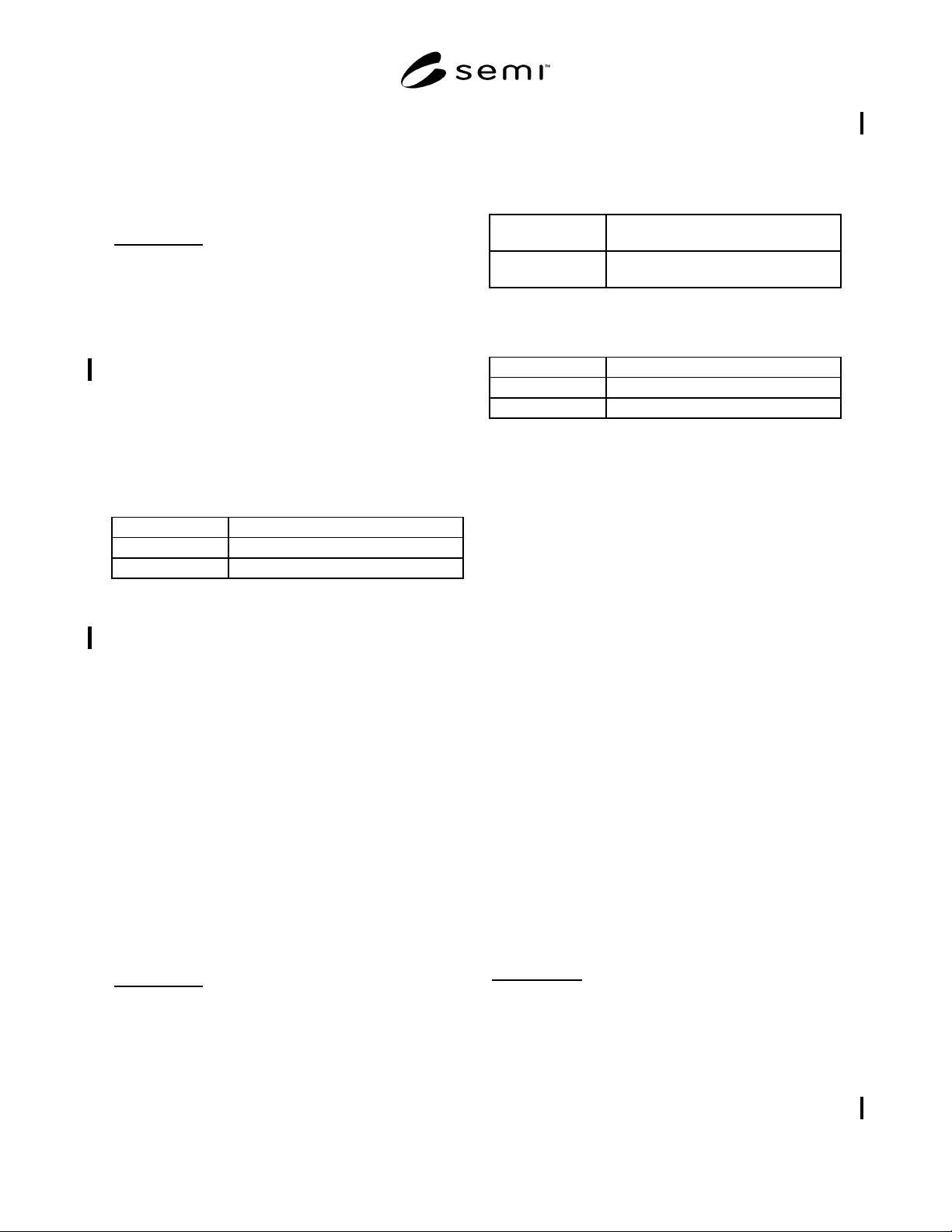
specifications in Section 2 of this Standard.
Sample Pea
k
Area
Standard Peak
Area
×
Concentration
of Standard
=
Concentration
of Sample
4.2 Phosphine — This procedure is for the
determination of phosphine in arsine using a gas
chromatograph with a thermal conductivity detector.
4.2.1 Detection Limit — 5 ppm (mol/mol).
4.2.2 Instrument Parameters
4.2.2.1 Column: Porapak QS, 3.5 m (12 ft) by 2 mm
ID (1/8 in OD) ss or equivalent.
4.2.2.2 Carrier Flow: 35 mL/min helium.
4.2.2.3 Temperatures:
Detector 80°C
Injector 40°C
Oven 40°C
4.2.2.4 Sample Volume: 3 mL.
4.2.3 Calibration Standard — 10–50 ppm (mol/mol)
phosphine, balance helium.
4.2.4 Operating Procedure
4.2.4.1 Inject the calibration standard into the column
using a gas sampling valve. Record the retention time
and peak area.
4.2.4.2 Inject the sample being tested in same manner
as the calibration standard. Record the retention time
and peak area.
4.2.4.3 Repeat 4.2.4.1.
4.2.4.4 Compare the average peak area of the
calibration standard to that of the arsine sample being
tested. Calculate the concentration of phosphine, using
the formula below. The result may not exceed the
specification in Section 2 of this Standard.
Sample Pea
k
Area
Standard Peak
Area
×
Concentration
of Standard
=
Concentration
of Sample
4.3 Hydrogen, Nitrogen and Oxygen + Argon — This
procedure is for the determination of hydrogen,
nitrogen, oxygen + argon in arsine using a gas
chromatograph with a helium ionization detector.
4.3.1 Detection Limits — 100 ppb (mol/mol)
hydrogen, 100 ppb oxygen + argon, 500 ppb nitrogen.
4.3.2 Instrument Parameters
4.3.2.1 Columns:
Column 1: Porapak QS, 2.5 m (8 ft) by 3.2 mm
(1/8 in) ID ss or equivalent
Column 2: Molecular Sieve 5A, 3 m (10 ft) by
3.2 mm ID ss or equivalent.
4.3.2.2 Carrier Flow: 25 mL/min helium.
4.3.2.3 Temperatures:
Detector 10°C
Injector 30°C
Oven 30°C
4.3.2.4 Sample Volume: 3 mL.
4.3.3 Calibration Standard — 1–10 ppm nitrogen, 1–
10 ppm oxygen, 1–10 ppm argon, 10–100 ppm
hydrogen, balance helium.
4.3.4 Operating Procedure
4.3.4.1 Determination of the backflush time: Inject a
methane sample (1–1000 ppm, balance helium) using a
10 port gas valve and backflush at different times.
Select the backflush time so that the methane peak is
split by the backflush.
4.3.4.2 Inject the calibration standard into the column
using the same gas valve. Backflush at the time
determined in 4.3.4.1 and record retention times and
peak areas. Order of elution is hydrogen, oxygen +
argon and nitrogen.
4.3.4.3 Inject the sample being tested in same manner
as the calibration standard. Record the retention times
and peak areas.
4.3.4.4 Repeat 4.3.4.2.
4.3.4.5 Compare the average peak areas of the
calibration standard to those of the arsine sample being
tested. Calculate the concentration of each impurity,
using the formula below. The results may not exceed
the specifications in Section 2 of this Standard.
Sample Pea
k
Area
Standard Peak
Area
×
Concentration
of Standard
=
Concentration
of Sample
4.4 Hydrogen Sulfide — This procedure is for the
determination of hydrogen sulfide in arsine using gas a
chromatograph with a flame photometric detector.
4.4.1 Detection Limit — 0.1 ppm (mol/mol).