semi合集-English.pdf - 第6596页
SEMI C1-0705 © SEMI 1978, 2005 22 7.13 Determination of Trace Elements by Inducti vely Coupled Plasma Mass Spectrome try (ICP-MS) — The determination of trace elements in liquid chemicals which are comm only used in adva…

SEMI C1-0705 © SEMI 1978, 2005 21
Element Symbol Line (nm)
Boron (B) 249.77
Cadmium (Cd) 214.44
Calcium (Ca) 393.27
Chromium (Cr) 205.55
Copper (Cu) 324.75
Iron (Fe) 238.20
Lead (Pb) 220.35
Lithium (Li) 670.78
Magnesium (Mg) 279.55
Manganese (Mn) 257.60
Nickel (Ni) 231.6
Potassium (K) 766.49
Sodium (Na) 589.59
Tin (Sn) 189.99
Titanium (Ti) 334.94
Vanadium (V) 292.40
Zinc (Zn) 213.86
7.12.2 Operating Conditions — Sensitivity, instrumental detection limit, precision, linear dynamic range, and
interference effects must be investigated and established for each individual analyte line on that particular
instrument. Types of interferences other than the simple overlap of a concomitant line on an analyte line must be
considered.
7.12.3 Solution Conditions — The solutions are prepared as given in the procedures for the individual liquid
chemical.
7.12.4 Working Standard Solutions — Working standard solutions should be prepared on the day of use by dilution
of a stock standard solution. For best results, standards should be matrix matched.
7.12.5 Multi-element standards may be prepared. The components should be selected to provide stable standards
within the required concentration range.
7.12.6 Quantitation — Commonly, the samples are measured against matrix-matched calibration standards;
however, whenever a new or unusual matrix is encountered, the method of standard addition is employed. The
standard addition does not detect coincident spectral overlap; an alternate wavelength or an alternate method is
recommended for verification. A calibration obtained with aqueous standards may be used if its slope and the
standard addition method slope are identical.
7.12.7 Evaporation of Sample — The detection limits achievable can be improved by preconcentration of a large
sample by evaporation. Through volatilization there may be a loss of trace elements, and recovery study data must
be obtained. The loss of trace elements in this enrichment process can be reduced, often by the presence of
additives. The evaporation must be conducted under “clean air” conditions, and reliability should be assured by use
of a “blank” or control sample determination. The sample size will depend on the detection limits required and the
capability of the instrument used.
7.12.8 Background Correction — A background correction technique is required for variable background
contribution to the determination of trace elements. The correction interval should be selected such that the intensity
of the background at that wavelength is equal to the background intensity under the analyte peak.
7.12.9 Additives — The procedures for the individual liquid chemical will provide detailed instructions for required
additives in the sample solution.
7.12.10 Remarks — The manufacturer’s manual should be consulted for proper use of the instrument. The user
should check the performance of the instrument from time to time to assure that adequate sensitivity is being
attained for the needs of the particular determination.

SEMI C1-0705 © SEMI 1978, 2005 22
7.13 Determination of Trace Elements by Inductively Coupled Plasma Mass Spectrometry (ICP-MS) — The
determination of trace elements in liquid chemicals which are commonly used in advanced semi-conductor
manufacturing requires a sensitive technique with the ability to perform simultaneous analysis for multiple elements.
Achievable detection limits are adequate for sample analysis with little sample preparation prior to analysis. Liquid
chemical matrix reduction needed to perform routine analysis is often achieved by dilution of the sample. Water
used for dilution should be the appropriate grade of 18.2 Mohm-cm water that meets ASTM Standard Guide D5127.
Matrix removal methods which require sample evaporation should be performed under HEPA filtered air such that
reproducible blank samples are obtained at or less than one half the specified limit of trace elements for the sample.
No specific procedure for inductively coupled plasma mass spectrometry is included since instrumentation and
practices vary among laboratories. Some practical considerations relevant to the method are outlined below.
7.13.1 Equipment — A mass spectrometer with better than 1 amu resolution from 5–250 amu is required to separate
the isotopes of the elements stated in the specification for an individual liquid chemical. The use of hot or cool
plasmas as well as a collision/reaction cell may be required to meet the SEMI detection limit requirements for
certain analytes. The signal from the detector is digitized by a computer system for quantitative calculation.
Interference correction may be required for some isotopes. Typical analytically useful masses are listed in Table 11.
Table 11 Suggested Analytical Masses
Element Masses
Aluminum (Al) 27
Antimony (Sb) 121, 123
Arsenic (As) 75
Barium (Ba) 137, 138
Boron (B) 11
Cadmium (Cd) 111, 114
Calcium (Ca) 40
Chromium (Cr) 52
Copper (Cu) 63, 65
Iron (Fe) 56
Lead (Pb) 206, 207, 208
Lithium (Li) 7
Magnesium (Mg) 24
Manganese (Mn) 55
Nickel (Ni) 58, 60
Potassium (K) 39
Sodium (Na) 23
Tin (Sn) 118, 120
Titanium (Ti) 48
Vanadium (V) 51
Zinc (Zn) 64, 66
7.13.2 Sample Introduction — Conventional glassware used for sample introduction is in most cases appropriate for
liquid chemical analysis, however for Grade 5 liquid chemicals an ultra clean sample introduction system is
recommended. Liquid chemicals containing hydrofluoric acid (HF) require a HF resistant introduction system
unless the hydrofluoric acid matrix is removed prior to the analysis.
7.13.3 Ionization Source — An inductively coupled plasma using argon as the support gas has proven to be
satisfactory as an ionization source for the method. Ionization conditions present in the argon plasma are highly
dependent on the various argon gas flow rates used to support the plasma. Sample introduction techniques used to
introduce the sample into the plasma are important to the analysis of the samples and must be optimized to allow
successful analysis. In particular, sample uptake and nebulizer gas flow require special attention and should be
treated carefully in order to optimize instrument performance for each of the various liquid chemicals.
SEMI C1-0705 © SEMI 1978, 2005 23
7.13.4 Evaporation of Samples — Liquid chemical matrix elements may be the source of spectral interferences on
certain target elements e.g. 48SO interferes with 48Ti in a sulfuric acid matrix when using quadrupole-based ICP-
MS. Such spectral interferences may be significantly reduced or eliminated by controlled evaporation of the sample
followed by dissolution and analysis in ultrapure nitric acid or other suitable solvent.
7.13.5 Solution Conditions — The solutions are prepared as given in the procedures for the individual liquid
chemicals or elements.
7.13.6 Working Standard Solutions — Working standard solutions are prepared daily by dilution of stock standard
solutions. Internal standard solutions, if used, are prepared similarly.
7.13.7 Quantification — Quantification may be performed by the method of standard additions or by external
calibration. External standards may also be matrix matched in ultra pure liquid chemicals to assure that plasma
conditions during the analysis are similar for both standards and samples. For those liquid chemicals, which require
matrix removal, the preferred matrix after preparation is dilute nitric acid (typically 1–3%.) The working standard
solutions are prepared to cover the expected range of trace element concentration. Background subtraction by use of
a reagent blank solution is may be used for sample analysis by this technique.
7.13.8 One or more internal standards (such as indium or rhodium) may be used for drift correction during the
analysis.
7.13.9 Remarks — The manufacturer’s manual should be consulted for details specific to the operation of the
instrument. Performance checks on the instrument should be made from time to time to assure adequate mass
resolution, performance, and sensitivity.
7.14 Calibration and Measurement Method for Particles in Liquids — This standard describes the apparatus and
methods used to calibrate optical particle counters (OPCs) and to count hard particles in liquid reagents. The
procedures in this standard provide a means of comparison of particle levels in various reagents using pressurized
sampling and counted using the various available instruments. While the procedures in this standard are primarily
directed at off-line sampling or sampling from containers, OPCs can also be used for continuous on-line particle
measurement. While some substantial technical difficulty may accompany the implementation of the pressurized
sampling technique for containers of more than 10 L, the method should be followed as closely as possible to
maximize the integrity of the data. The following procedures are partially based on the publications in the attached
bibliography, which should be consulted for further details.
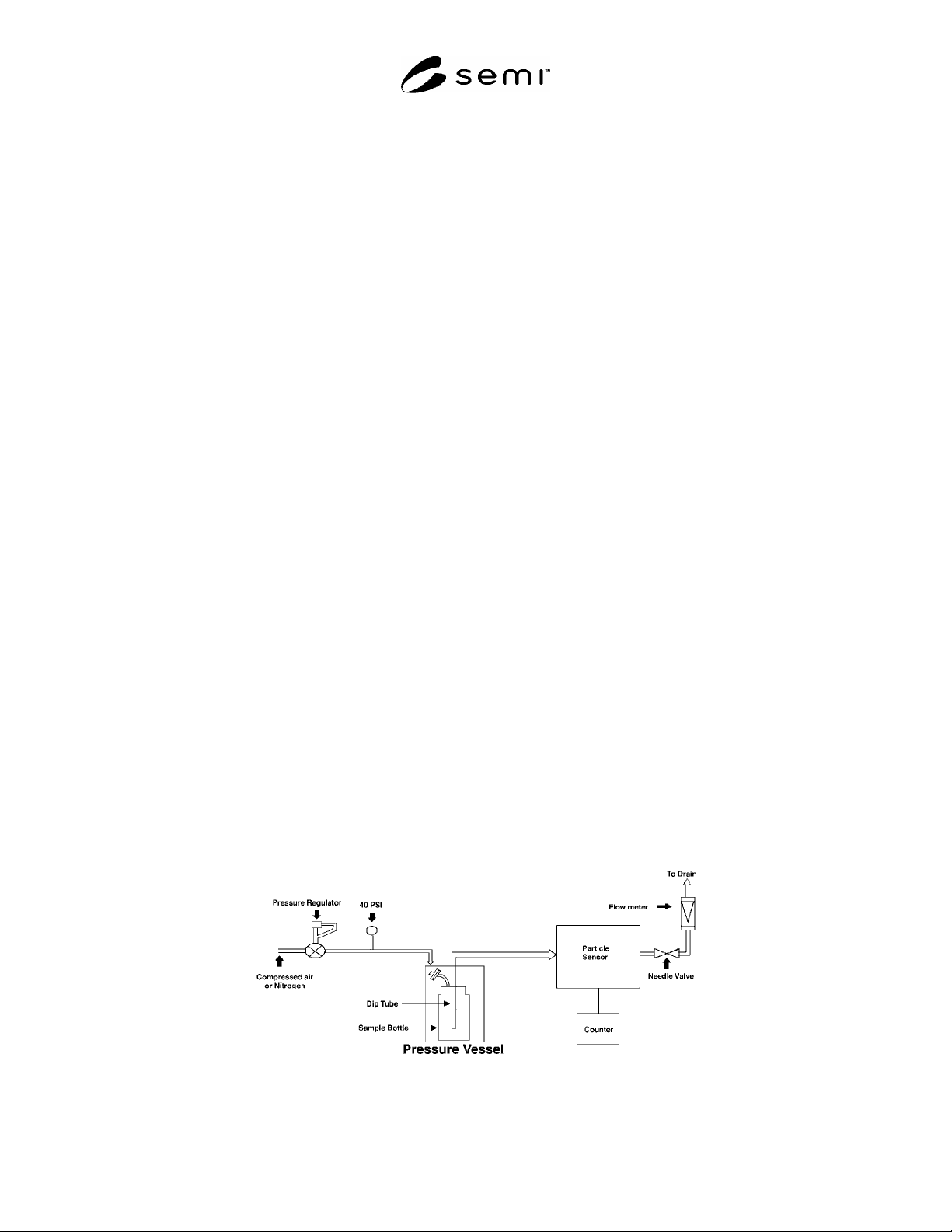
7.14.1 Apparatus — The apparatus used to measure the concentration of particles in reagents is comprised of a
sample supply system, a particle counter, and a flow measurement and control system. Two manual flow
measurement and control systems are presented in Figures 4 and 5. Several manufacturers have developed
automated pressurized sampling systems.
7.14.2 Discrete Sample Supply System — In the method specified in this standard, the pressure in the reagent
container is raised sufficiently above atmospheric pressure to produce the required flow and to reduce microbubble
formation, which causes falsely high counts. Pressurizing containers of reagents presents a substantial safety
hazard. Several systems have been developed for pressurizing the contents of a reagent container without placing a
pressure differential across the reagent container wall. A pressurized sampling system is required for all reagents.
Figure 5
Pressurized Test System