semi合集-English.pdf - 第7187页
SEMI S24-0705 © SEMI 2005 7 9.3.2 Have everyone know an d follow the in struction of the incident/accident preve n tion measures after confirm ing the work proce dures based o n the work sc hedule and t h e work procedur…
SEMI S24-0705 © SEMI 2005 6
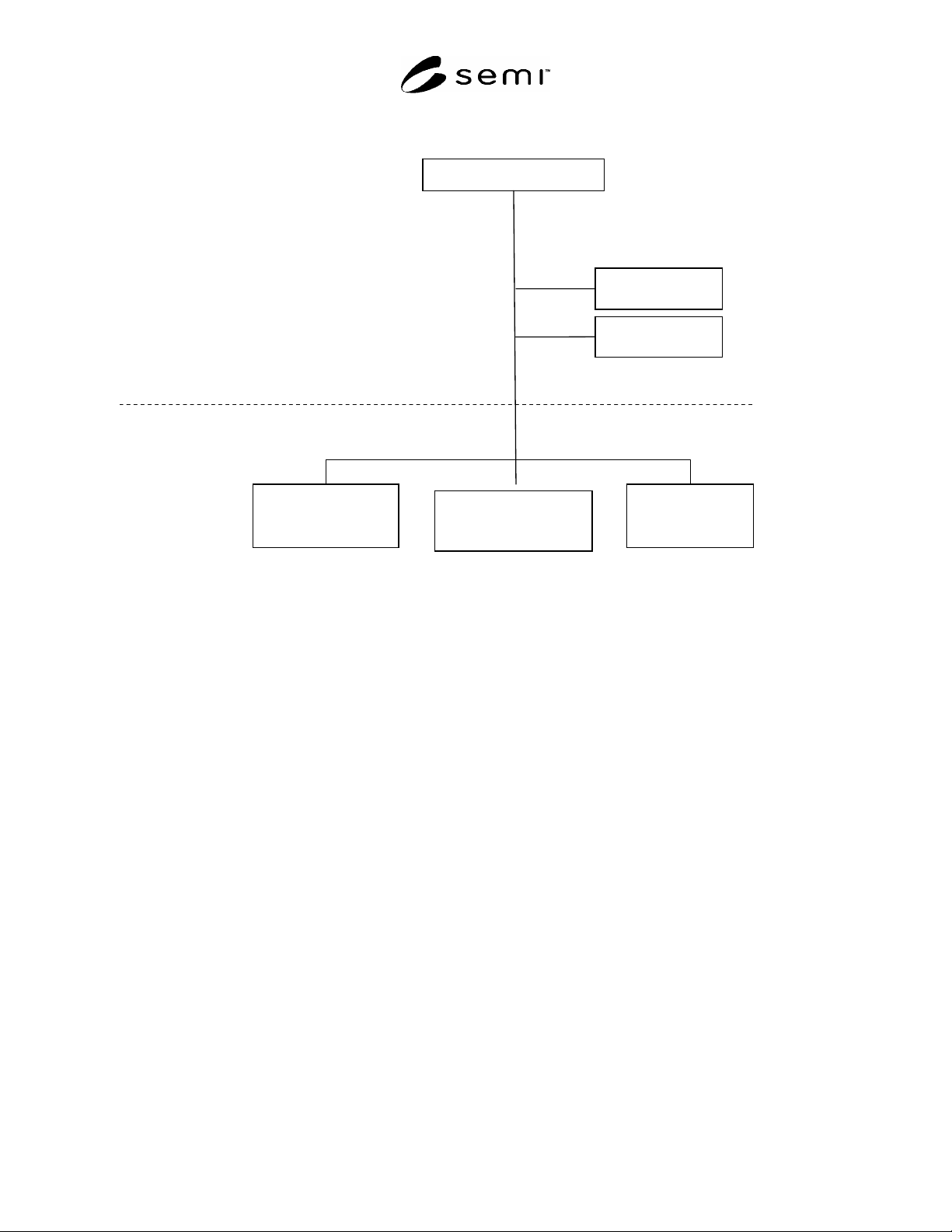
9.1.2.4 Example of Organization Chart of the SSCC
EHS Manager
Facility
Administrator(s)
Independent
Contractors
Equipment
Suppliers
and their contractors
Facility
Suppliers
and their contractors
Equipment
Administrator(s)
User Side
Supplier Side
Table 1
Example of Organization Chart of the SSCC
9.2 Role of the SSCC
9.2.1 Review and discuss all the safety issues (including concerns escalated by employees) about perceived or
obvious unsafe conditions, even though not listed below.
9.2.2 Review the safety of installation/overhaul/startup work based on the work procedure and work schedule.
9.2.2.1 Identify each hazardous task and review the appropriate work procedures.
9.2.2.2 Share the incident/accident information and recurrence preventive actions.
9.2.2.3 Follow the user safety rules. Verify all workers are trained
to perform tasks assigned to them.
9.2.2.4 Specify communication channel on hazardous work among affected suppliers and contractors.
9.2.2.5 Share the update of work status.
9.2.2.6 Discuss how to eliminate or mitigate each difficulty reported by safety patrol team.
9.2.2.7 Conduct safety patrol, report the results, such as unsafe action or violation, and take corrective action.
NOTE 5: The SSCC should discuss how to avoid intellectual property issues that might be generated when observing adjacent
work areas at a safety patrol.
9.2.2.8 Inform the affected employees how to respond including evacuation route and method in an emergency.
9.3 Specific activities of the SSCC
9.3.1 Establish a communication route from the user to the supplier/contractor workers so that results of the SSCC
meeting or the safety patrol can be conveyed to everyone smoothly each time. The workers should communicate
with each other and coordinate their work by informing each other of their work progress under the leadership of the
user.

SEMI S24-0705 © SEMI 2005 7
9.3.2 Have everyone know and follow the instruction of the incident/accident prevention measures after confirming
the work procedures based on the work schedule and the work procedures of the adjacent work area.
9.3.3 Cooperate with the user in their safety training so that the user safety rules will be known to everyone and
fully carried out.
9.3.4 Have each SSCC member report his/her respective work schedules and contents at respective work sites to the
council.
9.3.5 When conflict occurs among the schedules, adjust each work schedule among the user and affected
suppliers/contractors, and identify hazardous areas and restricted areas in multi-employer work areas. Notify each
company's workers of the adjustments.
9.3.6 Conduct safety patrol in the workplace and, if any unsafe condition, place or behavior is found, give proper
advice or instruction to the relevant worker on the spot and report it to the council.
9.3.7 Instruct everyone of the evacuation procedures.
9.3.8 Identify common warning signs.
9.3.9 Share all kinds of safety topics of the previous day.
9.4 Specific things to be reported to the SSCC
9.4.1 Floor opening or closing
9.4.2 Work performed on elevated surface
9.4.3 Using a scaffold, stepladder or ladder
9.4.4 Upper floor work or lower floor work
9.4.5 Starting gas or liquid chemical supply in a pipe
9.4.6 Turning on the facility electrical supply to the equipment
9.4.7 There is a possibility of affecting to an adjacent work area.
9.4.8 Having witnessed or caused an incident/accident
9.5 Inauguration of the SSCC
9.5.1 When two or more suppliers/contractors are conducting or planning installation, startup, or servicing of
equipment in the user fab simultaneously, the user should inaugurate Safety Supervisors’ Communication Council.
9.5.2 The user should confirm:
a supplier/contractor name,
number of workers,
a work supervisor’s name and how to contact him/her,
equipment name,
each tool name for the work,
qualification required for the work,
work contents, and
a training record of each worker.
9.5.2.1 After confirming above, the user should start the council activities, and each council members should carry
out their roles. (Refer to ¶9.2.)

SEMI S24-0705 © SEMI 2005 8
9.6 Enrollment in the SSCC
9.6.1 Suppliers planning to conduct installation, startup or service work and facility work should report their work
schedule to the user. Submission of the work schedule to the user automatically enrolls such suppliers to the SSCC if
the SSCC is already set up.
9.6.2 After receiving a work schedule report from a newly enrolling supplier/contractor, the user should report the
name and contact of the new supplier/contractor to the other suppliers and contractors working in the same area.
NOTE 6: EXCEPTION — In case of a resource constraint on site for a supplier/contractor, its attendance in the daily SSCC
meeting should be determined in accordance with the user’s instruction.
9.7 Withdrawal from the SSCC
9.7.1 A supplier or contractor who has completed installation, startup or service work, or facility work should be
automatically withdrawn from the SSCC by reporting the completion of its work to the user.
9.7.2 The user should report the company name and contact of the withdrawn supplier/contractor to the other
suppliers/contractors working in the same area through the SSCC.
9.8 Dissolution of the SSCC
9.8.1 The user should announce the dissolution of the SSCC when the number of suppliers/contractors who are
conducting installation, startup or service work in an area becomes only one.
10 Safety Patrol
10.1 The SSCC should conduct a safety patrol at least once a week. The SSCC should ask the user to participate in
the patrol whenever possible.
10.1.1 Purpose of Safety Patrol — The purpose of the safety patrol is to verify that the workers are complying with
the rules specified by the user or the SSCC, and to eliminate any unsafe condition or behavior through the
interactive job hazard analysis conducted by the suppliers and contractors working at the same area.
10.2 Execution of Safety Patrol
10.2.1 The SSCC should organize the Safety Patrol Team(s), which consist(s) of the members of the SSCC, as the
execution body.
10.2.2 The SSCC should decide the members of the team, the area to be covered, and the frequency of the patrol.
10.2.3 Points to observe during Safety Patrol
10.2.3.1 Warning indications and signs
10.2.3.2 Housekeeping practices around work area
10.2.3.3 Sound execution of the items specified in ¶9.3 and ¶9.4
10.2.3.4 Other points specified by the SSCC
10.2.3.5 Other safety concerns that may affect to multiple suppliers or contractors
10.2.4 If a Safety Patrol Team noticed any unsafe condition or behavior during the patrol, the Team should give an
instruction to the worker(s) concerned on the spot and also report the fact to the SSCC.
10.2.5 The SSCC should take a necessary action or ask the supplier or contractor concerned to take a necessary
action to improve or eliminate the unsafe condition or behavior observed by the Safety Patrol.