semi合集-English.pdf - 第7846页
SEMI T13-1104 © SEMI 2004 6 metrology data, inspection results, test results, and s orting inf ormation. If dice on such substrate as waf er and PCB are processed, all dice share data for the substrate. This case a part …
SEMI T13-1104 © SEMI 2004 5
8 Overview
8.1 Die Trace Capability — Economic growth around the world makes it possible to get entered into semiconductor
manufacturing business and advanced electronics business which uses semiconductor devices. The number of
semiconductor manufacturing countries and/or companies including subsidiaries and branch divisions is growing.
Procurement by e-commerce makes it easy to purchase semiconductor devices and electronics parts as application of
the devices from emerging companies in wide and distant areas. Suppliers of such devices and parts are required to
have device tracking facilities or die tracing capabilities to reduce security risks, perform quality assurance, improve
quality engineering and some other purpose depending on products.
8.2 Wide Area Communication — Such electronics as cell phones and television sets consist of many
semiconductor devices. They are decomposed into circuit boards, display module, operation panel unit and so on.
Most of such subcomponents also consist of semiconductor devices. They are supplied by semiconductor
manufacturers, set makers or third party suppliers. Tracking semiconductor devices or die tracing does not just
happen in semiconductor manufacturing fab. Close communication with assembly works including print circuit
board (PCB) suppliers and set makers is expected.
8.3 Range of Die Tracing — If traceability expectation were only for confirmation of producer and producing
country, this standard would address backend processes and PCB assembly line. Industries around semiconductor
manufacturing, e.g. automobile and car electronics industries, anticipate more than secure components. To address
that, this document extends the range of specification not only for assembly but also for wafer processes. Some
specific process data including metrology and inspection may be included in target data for die tracing.
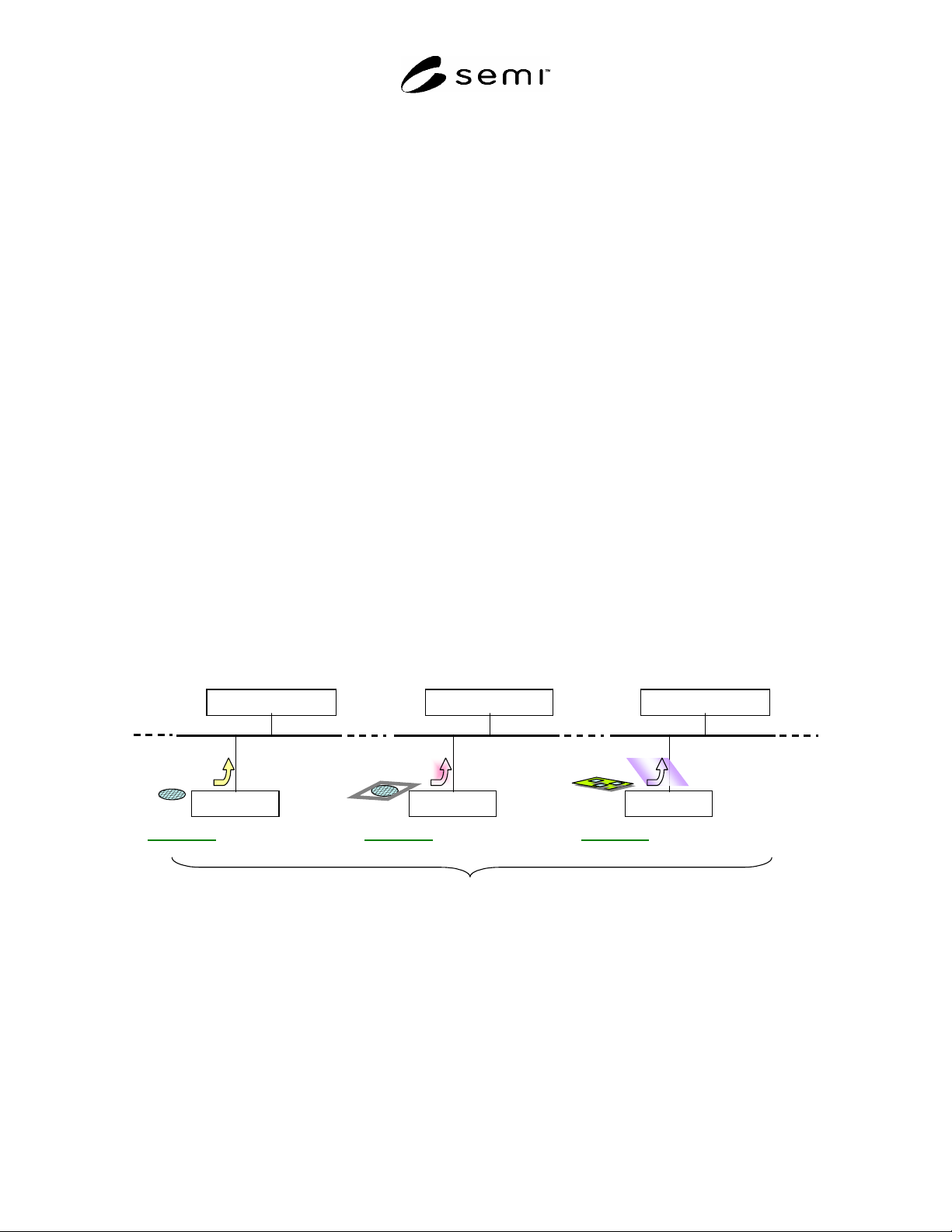
8.4 Die Trace Data — As described above, data traced for a die doesn’t come from just one specific process or a
piece of equipment. Die information is required to be traced on each key equipment. Otherwise it doesn’t make
sense, in other words, tracing system doesn’t work as a whole. Storage for Die Trace Data may or may not be
distributed.
8.5 Variety of Die Trace Data — Tracers collect various kinds of data for die tracing. They may be collation
information of pick & place history from dicing film to lead frame, electric test information for sorting dice or
metrology data on the wafer to which a die belongs. They are just examples of variety of Die Trace Data. Their
generic format can not be specified and unified central tracing system may not be realistic.
dice
Die Trace Data
Trace Data Storage
Equipment-P
Process-A
Material-X
dice
Die Trace Data
Trace Data Storage
Equipment-Q
Process-B
Material-X
dice
Die Trace Data
Trace Data Storage
Equipment-R
Process-C
Material-X
Same Material on Different Equipment types for Different Processes
Figure 1
Example of Die Trace Data on Key Equipment
8.6 Data Source of Die Trace Data — Most Die Trace Data are reported by equipment because die tracing tracks
what happens on a die for process. The things that happen are not for equipment control, process control nor
performance tracking done with execution. But they are for logging to certify the pedigree of a product or to track
back when some serious problem is detected on a product or prevent further damage to application of the product. In
this sense, Die Trace Data may be a part of or summary of MES data, or some calculated data. Equipment may not
be the data source in these cases.
8.7 Data Taxonomy — Die Trace Data can be categorized in various ways: by data source, data type, data form,
semantics and so on. The other classification criteria may be geometric information, deviation of process settings,
SEMI T13-1104 © SEMI 2004 6
metrology data, inspection results, test results, and sorting information. If dice on such substrate as wafer and PCB
are processed, all dice share data for the substrate. This case a part of data for a die links to the substrate data. If a
group of dice or substrates which is referred to as a lot is processed at a time or in the same environment, die trace
data for one of the dice links to the lot.
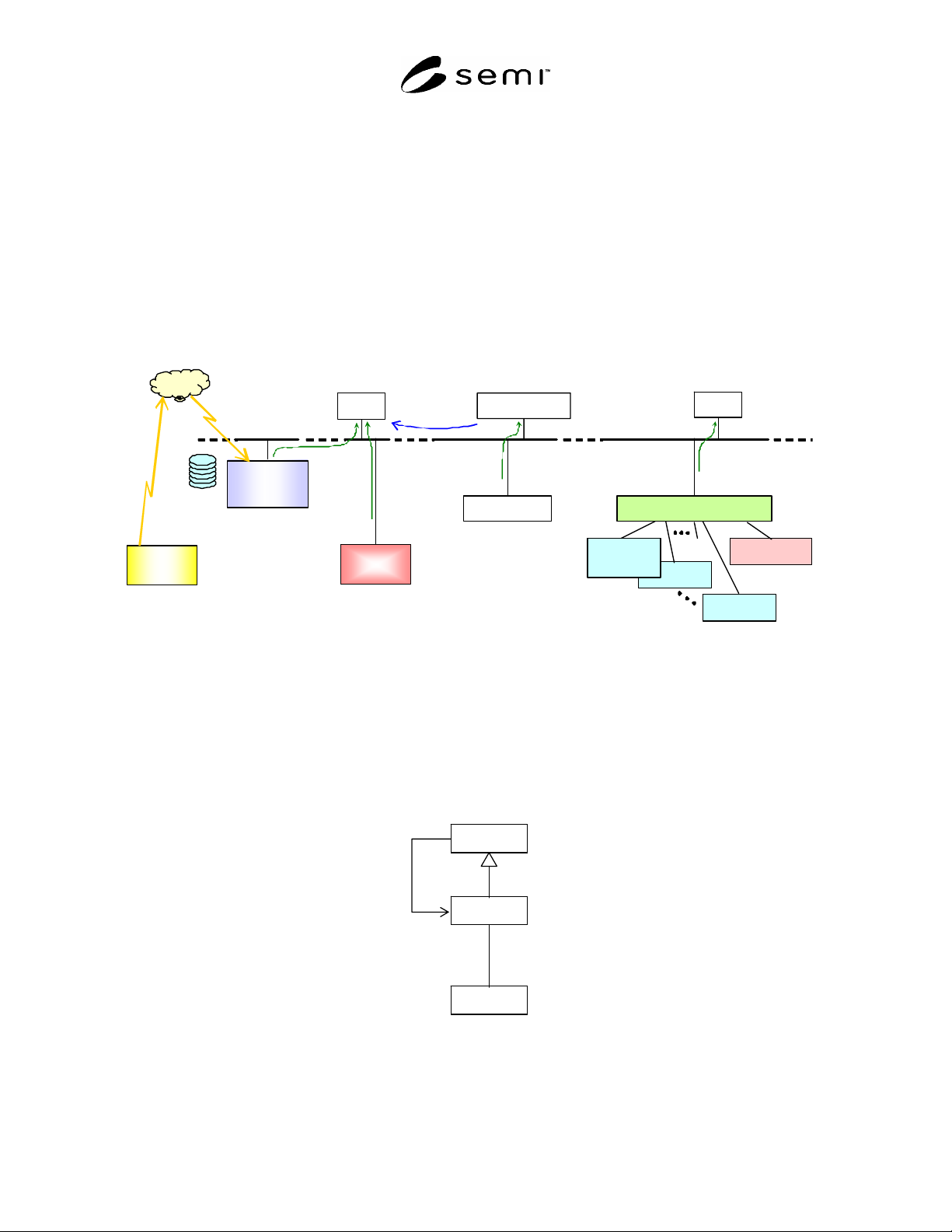
8.8 Die Trace System and its Clients — Die Trace System keeps collecting expected Die Trace Data on Equipment
or some other entities in a fab. A Client asks the system to make specific information for die tracing about one or
more dice. Client may give some fault information to the system to find out the cause of the fault. When the system
discovers a potential problem, it may notify an alert. Die Tracer is a closest entrance to Die Trace System.
8.9 Tracer and Machine — To reduce ambiguity or burdensome discussion and to make a process conspicuous, this
document highlights die trace data of a process or on a piece of equipment from the ensemble of data. In this aspect
data tracking entity, or a snapshot of the system, is referred to as ‘Tracer’ and entity to execute the process is called
as ‘Machine’ to discriminate from physical equipment.
VIT
VIT
ask
Material /
Acceptance
Database
Die Trace
Data (DTD)
WIP
Computer
Machine
Die Trace Data
Tracer
Defect Analysis System
Inspection
Tool (VIT)
Review Tool
Tracer / Client
Supplier
Database
Tracer
Die Trace
Data (DTD)
Die Tr ace
Data (DTD)
Figure 2
Example of Tracers with/without Machine
9 Basic Concepts
9.1 Domain Analysis and Object Based Modeling — To model and design complicated system or to have shared
specification of a part of system which is used widely in deferent applications, some sophisticated methodologies are
required. Analyzing problem domain by object oriented paradigm is one of the best practices to be taken. Because
this technology is frequently used in many SEMI standards, there is no confusion if this document follows the way.
Client
collects
1..*
1
..*
asks
Tracer
Machine
0..*
Figure 3
Die Trace Cell Model

SEMI T13-1104 © SEMI 2004 7
9.2 UML representation — The diagram above is
modeling of Tracing Capability for Dice in UML
diagram. It is not required to make systems with object
oriented programming language compliant to this
specification. Even if UML is typical object oriented
representation, object oriented implementation may be
expected but may not be mandatory.
9.3 Ensemble Modeling — Die tracing can be done at
any stage of process. Collected data on such different
processes for a specific die are linked together and
accumulated as a serialized one Die Trace Data.
Because the serialized data is an ensemble of snapshot
data of each key process stage. This document models
such snapshot of the ensemble as depicted above Figure
1.
9.3.1 Die Trace Machine Object (Machine) — This is
an instance of Die Trace Machine class (Machine). The
Machine acquires Die Trace Data and reports the data
to associated Tracer.
9.3.1.1 Special Machines — However Die Trace
Machines are often physical equipment, they may be
sometimes such non-automated entities as human
assisted semi-automated manufacturing tools and
handcraft processes. Die Trace Machine is any entity to
process products or make metrology assistance and
have capability to report Due Trace Data on the shop
flower of semiconductor device manufacturing. They
need to manufacture exactly and input at the terminal
by the process or record on work schedule pad for later
input in the office.
9.3.2 Die Tracer Object (Tracer) — This is an instance
of Die Trace class (Tracer). The Tracer collects Die
Trace Data reported by Die Trace Machine below. The
Tracer searches Die Trace Data as requested by Die
Trace Client. Figure 3 is a class model of a cell which
consists of a Tracer and its reporting Machines.
9.3.2.1 Data Searching Chain — Because the Tracer
inherits Client class, the Tracer can ask the other Tracer
when it doesn’t have enough data to respond a request.
Because the Tracer knows very specific type of Tracer,
the inquiring chain is usually restarted at the specific
Tracer.
9.3.2.2 Data Source of Tracer — There are different
kinds of data source from the Machine. Sometimes such
entities as controlling computers, database systems and
their software processes or application programs could
be data source of Die Tracer. The controlling computers
may be called as Manufacturing Execution System
(MES), Work In Process (WIP) computer, Host
computer, Cell Controller and so on.
9.3.3 Die Trace Client Object (Client) — This is an
instance of Die Trace Client class (Client). Basically
the Client asks some Die Trace Data set, asks searching
Die Trace Data or sets expecting data items to be
collected next. At the same time some specific Client
may be asked to register concerning phenomena happen
on specific product or specific production group, or
notify serious problem potentially happens on specific
product or production group to possible customers or
quality assurance database computer of semiconductor
device manufacturer.
9.4 Die Trace Data Hierarchy and Linkage — As
described very briefly in Section 8.7 Data Taxonomy,
whole substrate trace data may complement die trace
data on the substrate. They should be linked by some
means to keep the relation. Possible data hierarchy is as
below.
9.4.1 Die Trace Data (DTD)— This is a generic class
of any kind of Die Trace Data. This class represents
basic concept and primitive nature of data acquired for
Die Tracing. Any objects instanced for this class or its
derived class have following responsibility.
9.4.1.1 Die Trace Data Class Definition — Die Trace
Data must have such attribute as ID, Type and etc. as
depicted on Figure 4. These attributes cannot be
changed because they are proper for a specific object.
Because this document doesn’t intend these attributes to
be accessed directly but just for reference to specify
services to access or make use of these attributes. This
class is used to discuss and handle generic issues of any
subclasses.
9.4.1.1.1 Target Material — Die Trace Data need to
specify intended material. Die Trace Data must have an
attribute for the purpose and it shall provide a service to
identify the target material.
9.4.1.1.2 Data Representation — Actual Data may be
contained in its object as an attribute if amount of data
is relatively small. However it may be stored in such
independent entity as files or database and referenced
with an attribute of this class if the data is relatively
large and the attribute for data value must be null. This
case it is suggested to take care of the separated data
value not to be removed. Storage system often may not
notify or ask when related data is removed. It may be
better to have another copy of the important data
somewhere in Die Tracing System. It is recommended
to use any Universal Resource Identifier (URI) for data
value reference to access without confusion.
9.4.1.2 Responsibility of Die Trace Data — Because
Die Trace Data class is to be data container or data
label, responsibility of this class is to play the role.
9.4.1.3 Services of Die Trace Data — To complete the
responsibility, this class provides following services.