semi合集-English.pdf - 第2505页
SEMI E88-1104 E © SEMI 1999, 2004 2 SEMI E37 — High-Spee d SECS Message Services (HSMS) Generic Services SEMI E37.1 — High-Speed SECS Message Se rvices Single Selected-Session Mode (HSMS-SS) SEMI E84 — Specification for …

SEMI E88-1104
E
© SEMI 1999, 2004 1
SEMI E88-1104
E
SPECIFICATION FOR AMHS STORAGE SEM (STOCKER SEM)
This specification was technically approved by the Global Information & Control Committee and is the direct
responsibility of the North American Information & Control Committee. Current edition approved by the
North American Regional Standards Committee on July 11, 2004. Initially available at www.semi.org
September 2004; to be published November 2004. Originally published September 1999; last published July
2004.
E
This standard was editorially modified in September 2004 to correct a formatting error. Changes were made
to Table 6.
1 Purpose
1.1 This standard establishes a Specific Equipment
Model (SEM) for AMHS storage equipment (Stocker
SEM). The model consists of equipment characteristics
and behaviors that are to be implemented in addition to
the SEMI E30 fundamental requirements and selected
additional capabilities. The intent of this standard is to
facilitate the integration of Stocker SEM equipment
into an automated (e.g., semiconductor fabrication and
flat panel display) factory. This document accomplishes
this by defining an operational model for Stocker SEM
equipment as viewed by a factory automation controller
(Host). This definition provides a standard host
interface and equipment operational behavior (e.g.,
control, state models, and data reports). Several topics
require additional activity that are within the scope of
this standard: queuing, parallel interface for carrier
transfer (SEMI E23), stocker controller architecture,
and scheduling and transport of the transfer unit.
2 Scope
2.1 The scope of this standard is limited to the usage
and description of AMHS storage equipment (Stockers)
as perceived by a SEMI Equipment Communications
Standard 2 (SECS-II) host that complies with the GEM
model (as specified in Section 13). It defines the view
of the equipment through the SECS communication
link. It does not define the internal operation of the
equipment. It includes a specific transfer command
state model and stocker controller state model as the
basis for all equipment of this class.
2.2 This document assumes that the GEM fundamental
requirements and selected additional capabilities (as
specified in Section 13) have been implemented on the
Stocker SEM equipment. It expands the GEM standard
requirements and capabilities in the areas of state
models (stocker controller, transfer command, carrier
and stocker crane state models), collection events,
alarm documentation, remote commands, data item
variables, and material movement.
NOTICE: This standard does not purport to address
safety issues, if any, associated with its use. It is the
responsibility of the users of this standard to establish
appropriate safety and health practices and determine
the applicability of regulatory or other limitations prior
to use.
3 Limitations
3.1 SEMI Standards Alignment
3.1.1 The GEM (SEMI E30) model was used as the
basis for Stocker SEM requirements definition in
alignment with existing AMHS SEM Specifications.
3.2 AMHS Storage Equipment Description
3.2.1 This standard is targeted at the different
types/configurations of 300 mm AMHS storage
equipment. The term Stocker SEM equipment refers to
all the types of AMHS storage equipment. The
equipment types may have fundamental mechanical
differences.
3.2.2 Stocker (configuration)
3.2.2.1 A Stocker is generally an AMHS automated
storage and retrieval device used to provide temporary
storage of carriers. The device is not required to
provide temporary storage of carriers (for example,
when used as a device to connect multiple IBSEM
devices or as a floor to floor lifter). Additionally, any
number of physical interfaces may exist to connect the
stocker with external devices such as: Interbay and/or
Intrabay Transport Systems, Process Equipment, other
StockerSEM devices, Operator ports, etc.
4 Referenced Standards
4.1 SEMI Standards
SEMI E4 — SEMI Equipment Communications
Standard 1 Message Transfer (SECS-I)
SEMI E5 — SEMI Equipment Communications
Standard 2 Message Content (SECS-II)
SEMI E23 — Specification for Cassette Transfer
Parallel I/O Interface
SEMI E30 — Generic Model for Communications and
Control of Manufacturing Equipment (GEM)

SEMI E88-1104
E
© SEMI 1999, 2004 2
SEMI E37 — High-Speed SECS Message Services
(HSMS) Generic Services
SEMI E37.1 — High-Speed SECS Message Services
Single Selected-Session Mode (HSMS-SS)
SEMI E84 — Specification for Enhanced Carrier
Handoff Parallel I/O Interface
4.2 Other References
Harel, D., “Statecharts: A Visual Formalism for
Complex Systems,” Science of Computer Programming
8 (1987) 231-274.
1
NOTICE: Unless otherwise indicated, all documents
cited shall be the latest published versions.
5 Terminology
5.1 Abbreviations and Acronyms
5.1.1 AMHS — Automated Material Handling System
5.1.2 BP — Buffer Port
5.1.3 FOUP — Front Opening Unified Pod
5.1.4 GEM — Generic Equipment Model
5.1.5 IBSEM — InterBay/IntraBay Specific Equipment
Model
5.1.6 ITS — Interbay or Intrabay Transport System
5.1.7 LP — Loading Port
5.1.8 OP — Output Port
5.1.9 PGV — Person Guided Vehicle
5.1.10 SC — Stocker Controller
5.1.11 TCP/IP — Transmission Control
Protocol/Internet Protocol
5.1.12 TSC — Transport System Controller
5.2 Definitions
5.2.1 Automated Material Handling System — an
automated system to store and transport materials
within the factory.
5.2.2 automation — the capability of managing
material and data within the factory.
5.2.3 bidirectional load port — a load port used for
loading and unloading carriers.
5.2.4 buffer — a set of one or more locations for
holding carriers at the production equipment.
5.2.5 buffer port — special buffer port location on a
stocker output shuttle. Contains carrier presence
1 Elsevier Science, P.O. Box 945, New York, NY 10159-0945,
http://www.elsevier.nl/homepage/browse.htt
sensors so that the host can be notified when a carrier is
situated at this position.
5.2.6 carrier — a container with one or more fixed
positions for holding substrates. Examples of carriers
include FOUPs and open cassettes.
5.2.7 carrier ID — a readable and unique identifier for
the carrier.
5.2.8 FOUP—a closed carrier for holding wafers.
5.2.9 host — the factory computer system, or an
intermediate system, that represents the factory and the
user to the equipment. Refers system that controls or
supervises the Stocker Controller (SC) throughout this
document.
5.2.10 independent port — a load port on the stocker
that is dedicated to input or output. It is considered that
the carriers can only be transferred in one direction.
5.2.11 interbay transport system — a transport system
used to move work-in-process between stockers in
different parts of the factory.
5.2.12 Intrabay Transport System — a transport
system dedicated to one or more bays in the factory and
responsible for transferring carriers to and from
production equipment. ITS consists of the physical
units of the system (e.g., vehicles, nodes, docking
stations), the low-level unit controllers, and a system-
level controller. ITS excludes factory floor storage
systems (stockers), but includes any short-term storage
integral to the system, such as storage locations within
an overhead track system that are accessible only to
units of the particular ITS.
5.2.13 load port — the interface location on the
equipment where carriers are transferred.
5.2.14 loading port — user or vehicle accessible port
location on a stocker output shuttle. Contains carrier
presence sensors so that the host can be notified when a
carrier is situated at this position.
5.2.15 output port —port location on a stocker output
shuttle, typically accessible by the stocker crane.
Contains carrier presence sensors so that the host can be
notified when a carrier is situated at this position.
5.2.16 process equipment — equipment used to make
semiconductor devices. This excludes metrology and
material handling equipment.
5.2.17 production equipment — equipment used to
produce semiconductor devices, including wafer
sorting, process, and metrology equipment and
excluding material handling equipment.
SEMI E88-1104
E
© SEMI 1999, 2004 3
5.2.18 Stocker Controller — stocker Equipment
Controller that communicates with the host and
represents the system as the equipment.
5.2.19 stocker crane — stocker transfer agent
specialized for the movement of carriers between
shelves and input and output port locations.
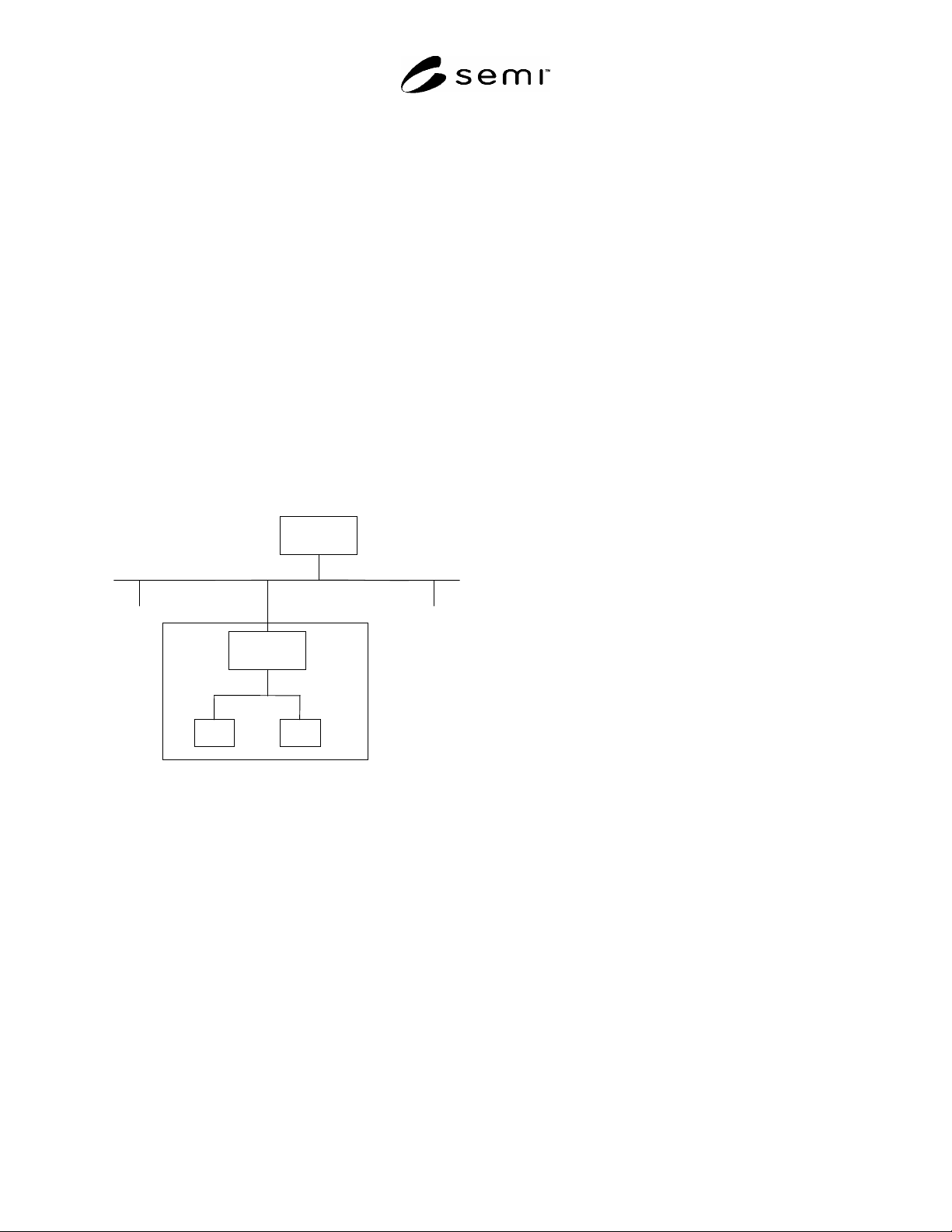
5.2.20 stocker equipment — an individual stocker
viewed as a single piece of equipment, with distributed
components and distributed control, as illustrated in
Figure 1. The stocker controller communicates with the
host using HSMS and GEM and represents the system
as an equipment. The factory may require more than
one type of stocker.
5.2.20.1 Communications with transport system
equipment may require a low-level handshake with a
transport unit directly involved in the transfer of
material (such as a vehicle or a docking station on an
overhead track).
5.2.20.2 Communications between the various stocker
units and controllers are proprietary to the supplier.
Stocker
Controller
internal proprietary
communications
Factory Host
Stocker
Equipment
host/equipment
communications
factory network
Stocker
Unit
Stocker
Unit
Figure 1
Example of Stocker Equipment
5.2.21 stocker shelf — locations within the stocker
equipment to store carriers. These locations exclude
load ports.
5.2.22 stocker unit — a physical component of the
stocker system, such as a stocker crane, ID reader,
wafer sensor, shuttle port, etc.
5.2.23 swapping port — a load port on the stocker
capable of handling single load and unload of carriers
or simultaneous replace of carriers.
5.2.24 transfer agent — a component of equipment
specialized to the movement of transfer objects from
place to place within a factory. May be of different
types with widely-differing characteristics. Examples
are fixed-arm robots, robot arms on fixed tracks,
overhead gantries or even systems containing a
heterogeneous collection of other transfer agents.
Humans may also act as transfer agents.
5.2.25 transfer completed port — the destination port
specified in a transfer command.
5.2.26 transfer port — point on the transport system at
which a change of equipment ownership of the carrier
occurs.
5.2.27 transfer unit — the element of movement
(assemblage of carriers) of the ITS that consists of a
maximum number of carriers allowed in a specific
transfer command:
AA is the maximum number of carriers allowed for
acquire at the transfer source.
BB is the maximum number of carriers allowed for
deposit at the transfer destination.
CC is the maximum number of carriers allowed for
transfer in one transport vehicle.
5.2.27.1 The maximum size of the transfer unit is the
minimum of AA, BB, and CC.
5.2.27.2 For purposes of the Stocker SEM, the transfer
unit is limited to one carrier.
5.2.28 transport system — the component of AMHS
that moves material from one part of the factory to
another.
5.2.29 transport unit — a physical component of a
transport system, such as a vehicle, node, or docking
unit.
5.2.30 zone — a logical assignment referencing a set of
one or more locations. A stocker can have several
logical zone assignments. For example, a specific
stocker may have 2 zones defined as LEFT_ZONE and
RIGHT_ZONE. The assignment of zones is specific to
the Stocker SEM equipment supplier and it may be
desirable for the supplier to remain flexible in the
assignment of zones so that it could be configured to
meet the specific requirements of different users. A
specific zone may only contain shelf locations or ports,
but not both. A location may be in at most one zone.
6 Overview and Assumptions
NOTE 1: This section has been included as background
information to help clarify requirements.
6.1 Destination Control (to Shelf or to Output Port)
6.1.1 The destination is controlled by Host when the
carrier is input to the stocker (i.e., the carrier enters the
stocker domain). The destination of the transfer
command is required. It would be invalid for the Host
to issue a transfer command to the SC without
including a valid destination.