semi合集-English.pdf - 第719页
SEMI E99-1104 E © SEMI 2000, 2004 9 9.3.4 Figure 2 shows the diagram fo r the Read (Write) Hea d State Model. CIDRW HEAD C 12 OPERAT ING 16 BUSY IDLE 13 14 15 NOT OPER ATING Figure 2 Read (Write) Head State Model 9.3.5 T…
SEMI E99-1104
E
© SEMI 2000, 2004 8
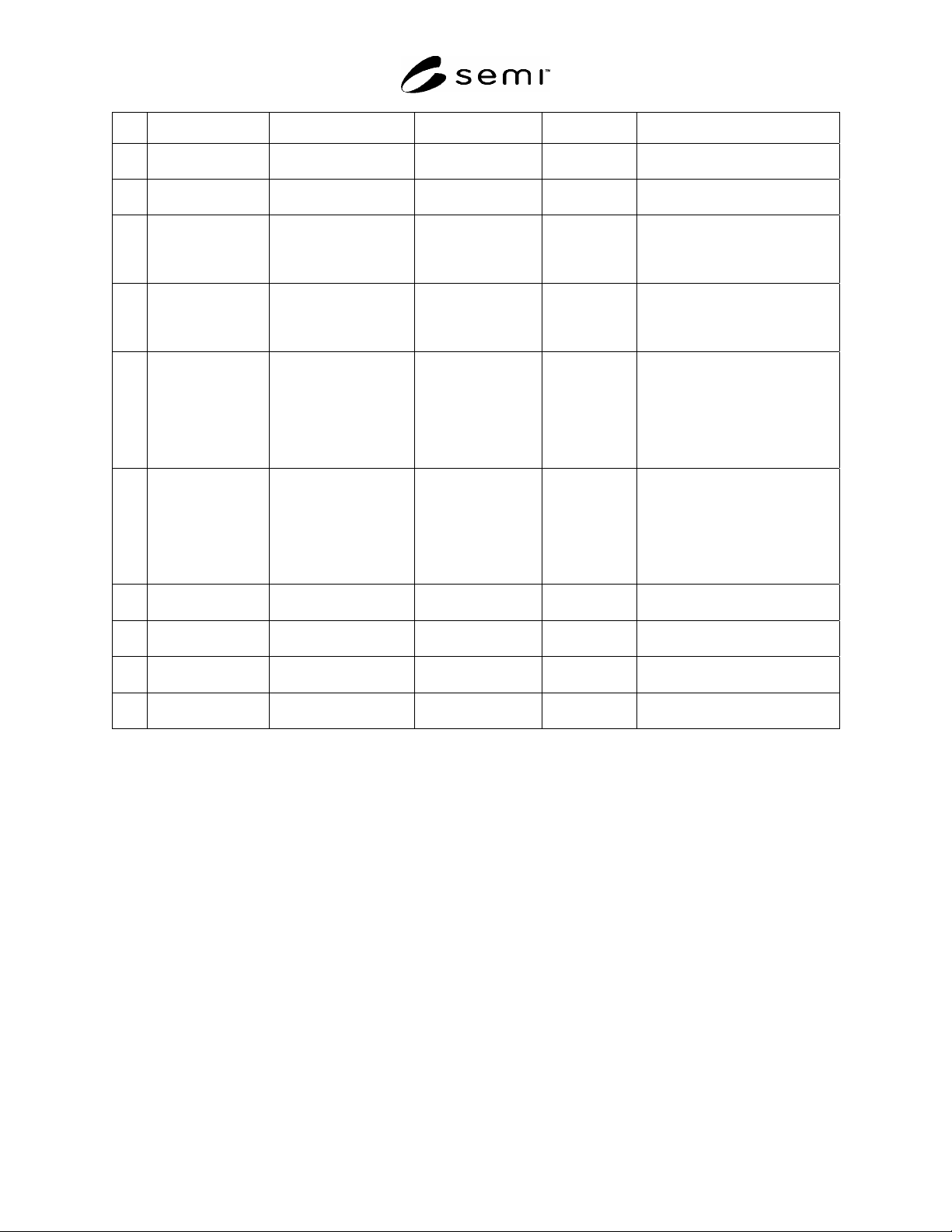
# Previous State Trigger New State Actions Comments
2 INITIALIZING Initialization is
complete.
RUNNING None The CIDRW is now able to
communicate.
3 INITIALIZING Default entry into
OPERATING.
IDLE None Internal
4 IDLE A service request to
read or write or
perform diagnostics is
received.
BUSY None
5 BUSY All service requests
that affect the state of
the hardware are
completed.
IDLE None
6 IDLE A user selects the
MAINTENANCE
state and all heads are
idle.
MAINTENANCE None The upstream controller may
send a request or the operator
may set a switch to select the
OPERATING or the
MAINTENANCE state.
Maintenance and setup activities
may now be performed.
7 MAINTENANCE A user selects the
OPERATING state
and all heads are idle.
IDLE None The upstream controller may
send a request or the operator
may set a switch to select the
OPERATING or the
MAINTENANCE state. Normal
operating activities may now be
performed.
8 INITIALIZING Default entry into
ALARM STATUS.
ALARMS or NO
ALARMS
None
9 NO ALARMS An alarm condition is
detected.
ALARMS None
10 ALARMS All alarm conditions
have cleared.
NO ALARMS None
11 Any A reset service
request is received.
CIDRW None
9.3 Read (Write) Head State Model
9.3.1 For a CIDRW with multiple heads, this state model shall be provided for each Read/Write Head.
9.3.2 For the single head case, these states are covered in the CIDRW state model and no additional state model for
the head is required. IDLE and BUSY correspond to substates of the same names in the CIDRW state model. If any
head is NOT OPERATING, then the active substate of ALARM STATUS in the CIDRW state model is ALARMS.
9.3.3 The NOT OPERATING state is not required, if it is not possible to detect alarms related to the head. Note
also that some alarm conditions are fatal (so that the head cannot operate with full functionality) while others may
not be fatal.
SEMI E99-1104
E
© SEMI 2000, 2004 9
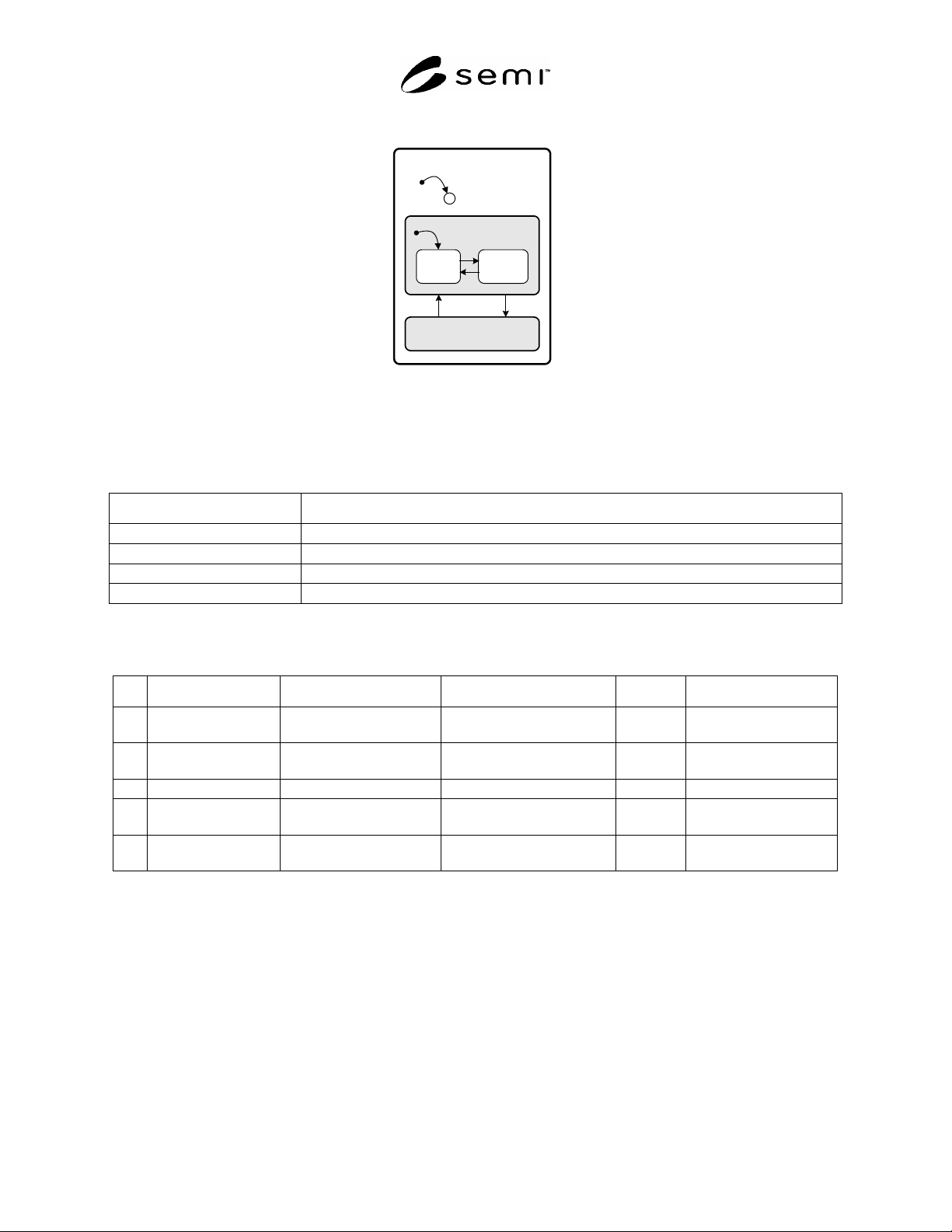
9.3.4 Figure 2 shows the diagram for the Read (Write) Head State Model.
CIDRW HEAD
C
12
OPERATING
16
BUSYIDLE
13
14
15
NOT OPERATING
Figure 2
Read (Write) Head State Model
9.3.5 Table 5 defines the states for the Read (Write) Head.
Table 5 Read (Write) Head State Definitions
State Definition
NOT OPERATING Head is in a non-operational state or has reduced functionality. Maintenance is required.
OPERATING Head is active and fully functional.
IDLE Head is not performing a service.
BUSY Head is performing a service.
9.3.6 Table 6 defines the transitions of the Read (Write) Head State Model.
Table 6 Read (Write) Head State Transitions
# Previous State Trigger New State Actions Comments
12 (unknown) Initialization on powerup
or reset.
Either NOT OPERATING
or OPERATING
None Default entry on
power-up.
13 IDLE Request to perform a
service.
BUSY None
14 BUSY Completion of service. IDLE None
15 OPERATING An alarm condition is
detected.
NOT OPERATING None
16 NOT OPERATING Self-Diagnostic Service OPERATING None All alarm conditions
are clear.
10 Alarm Conditions
10.1 An alarm condition exists whenever one or more faults or exceptions that interfere with normal read/write
operations is detected. A maintenance condition exists when the CIDRW determines the need for either
maintenance (repair) or preventive maintenance activities.
10.2 The CIDRW is able to detect and report alarm conditions through its status attributes (when queried by the
upstream controller). It may additionally report changes in alarm conditions asynchronously through alarm or event
reports.
SEMI E99-1104
E
© SEMI 2000, 2004 10
11 Services
11.1 To be compliant with this standard, the CIDRW shall support all services that are indicated as required. In
addition, if the CIDRW provides other services that have the same or similar functionality as services defined in this
document, then compliance to this standard requires they shall satisfy the requirements of the service as defined.
11.2 List of Services
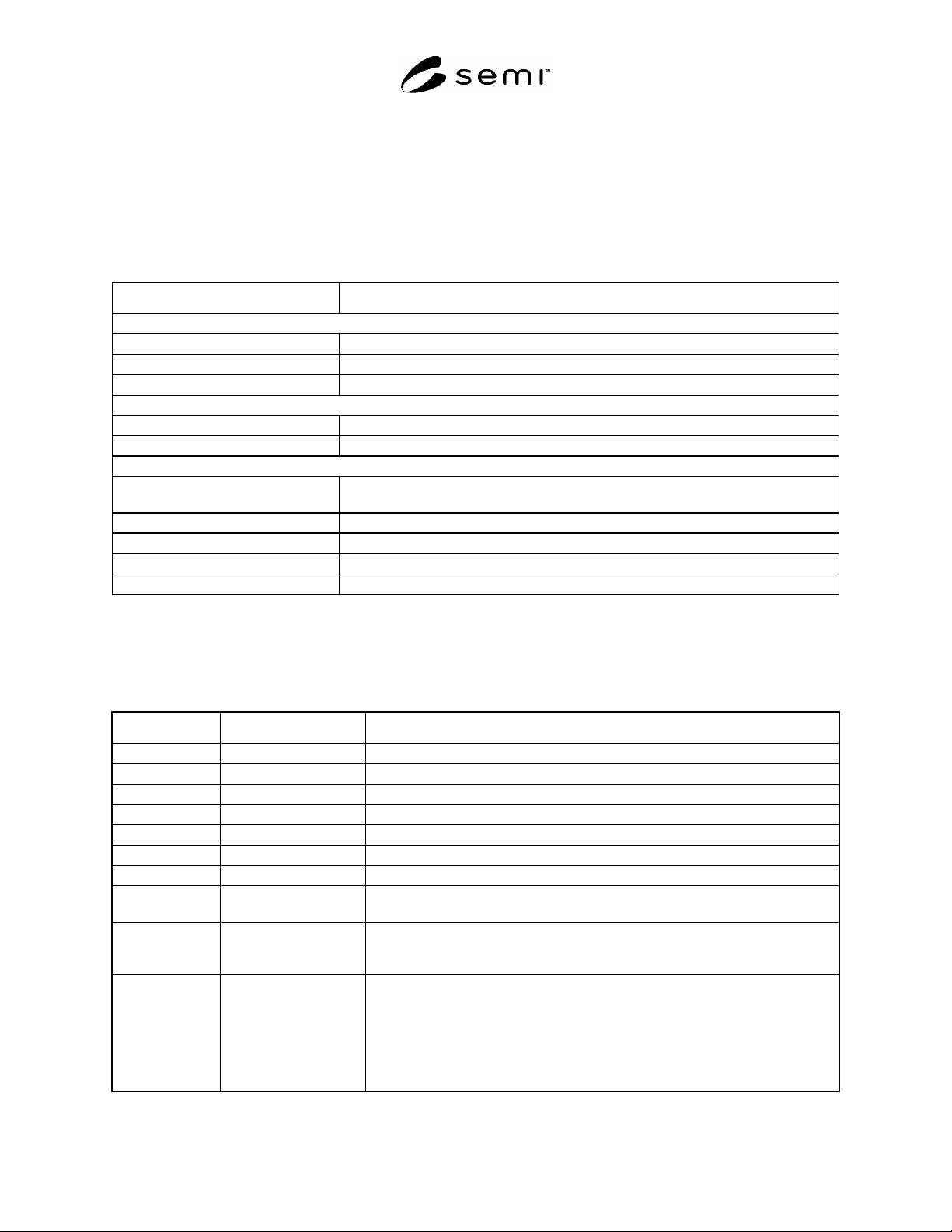
11.2.1 Table 7 lists the services defined by this standard and indicates which are optional and which are required.
Table 7 List of Services
Service Name Description
Fundamental Requirements
Get Attributes Get specified information about the CIDRW.
Get Status Get the current status of the CIDRW.
Read ID Read ID.
Requirement for Reader/Writer
Read Data Read back data written previously (not applicable to read-only devices).
Write Data Write data (not applicable to read-only devices).
Optional Capabilities
ChangeState Change to MAINTENANCE state or to OPERATING state. This is required if the
device supports the optional WriteID service.
Perform Diagnostics Perform diagnostic tests.
Reset Reset CIDRW hardware and software.
Set Attributes Write specified information.
Write ID Write ID field (device must also support ChangeState service).
11.3 Parameter Definitions
11.3.1 Table 8 defines the parameters that are used in one or more services, including individual items within
parameter structures. Parameters are listed in alphabetical order.
Table 8 Parameter Definitions
Parameter Form Description
Action Protocol-specific. Specifies diagnostic action to perform.
Attribute ID Text Attribute identifier. Name of attribute.
Attribute Value Varies with attribute. Attribute value.
Carrier ID Text User data.
Data Text User data.
DataSeg Protocol-specific. Indicates specific section of data to read or write.
DataSize Unsigned integer Indicates the number of bytes of data to read or write.
Head ID Number 0–31 Identifies either an individual head (non-zero) or the CIDRW subsystem itself
(zero).
PM Information Enumerated:
-Normal execution
-Maintenance required
Preventive Maintenance Information
Result Status Enumerated:
-Normal operation
-Execution Error
-Communication Error
-Hardware Error
-Tag Fault
Result information on the status of the request concerning the service request.
Execution Error: cannot read Tag data. Cannot Read ID sequence. But
equipment is normal.
Communication Error: syntax error of Message or Message format or Value.
Hardware Error: ID reader/writer head fault, ID reader/writer head is powered
off.
Tag Fault: power fault, exceeded retry limit