semi合集-English.pdf - 第906页
SEMI E117-1104 © SEMI 2002, 2004 8 RELATED INFORMATION 1 APPLICATION NOTES NOTICE : This rel ated information is not an official part of SEMI E117 and was de rived from current indu stry knowledge. This related informati…
SEMI E117-1104 © SEMI 2002, 2004 7
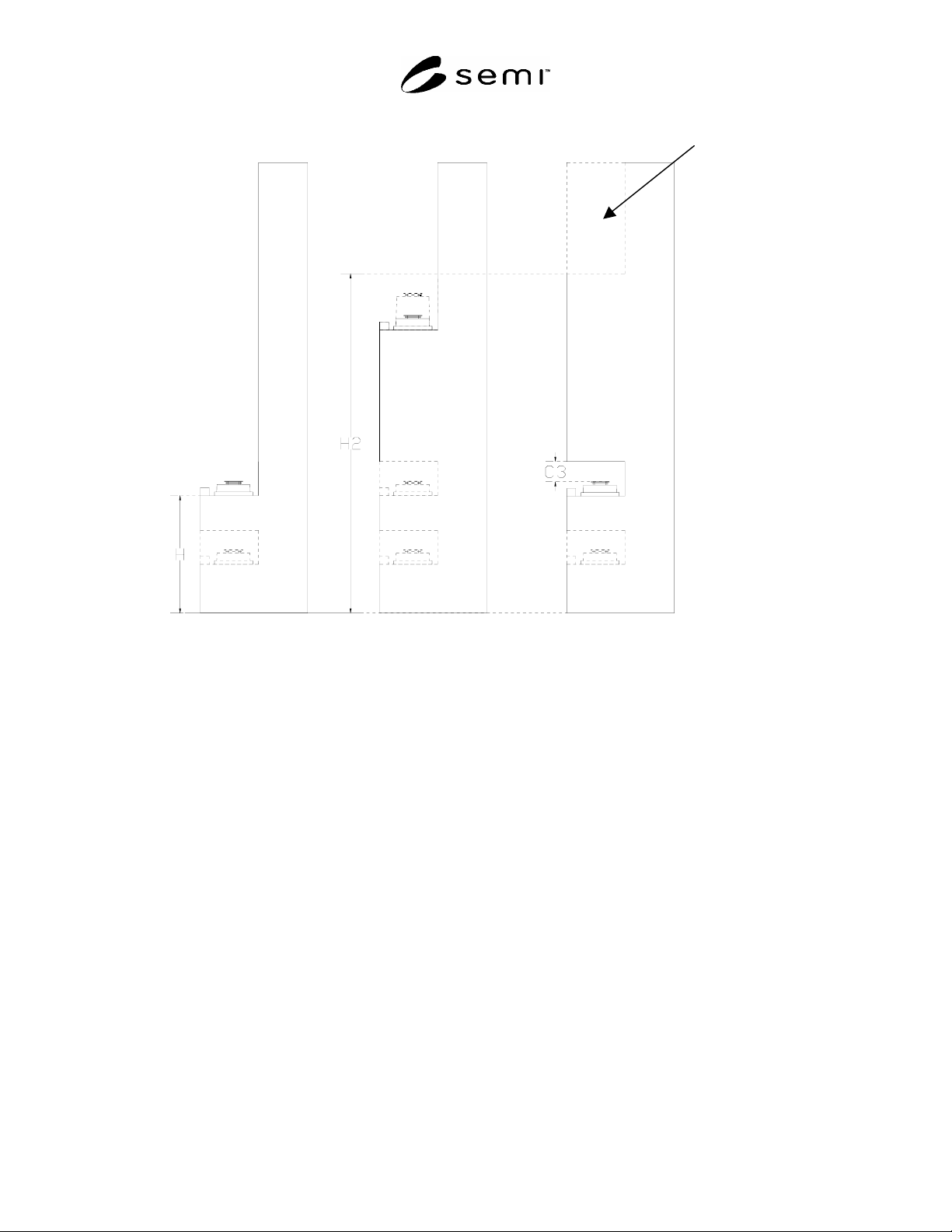
Option 1
Option 2
Option 3
Reserved
space for
overhead
transport of
boxes
Figure 4
Reticle Load Port Options

SEMI E117-1104 © SEMI 2002, 2004 8
RELATED INFORMATION 1
APPLICATION NOTES
NOTICE: This related information is not an official part of SEMI E117 and was derived from current industry
knowledge. This related information is to be approved for publication by full letter ballot procedure.
NOTICE: This related information is not meant to modify or supersede SEMI E117 in any way. Rather, these notes
are provided primarily as a source of information to aid in the application of the standard. As such, they are to be
considered as reference material only. The standard should be referred to in all cases.
R1-1 Application Notes
R1-1.1 Compliance with This Standard — It is the device makers’ expectation that suppliers of production
equipment are ultimately responsible for ensuring that their equipment (as installed in the device makers’ facility)
complies with this standard. This expectation is the same whether the reticle load port is developed internally by the
equipment supplier or is purchased from a third party source. In either case, the production equipment supplier is
responsible for understanding all of the requirements contained in this standard. Full compliance with this standard
can only be determined after the reticle load port is integrated with the equipment and can be directly affected by
production equipment design features (such as user interfaces and light towers).
R1-1.2 To prevent interference between transport systems on the same or adjacent load ports, it is recommended
that floor-based transport vehicles and over-head hoist vehicles not exceed clearances C1 and C2 when picking up or
placing a RSP on the load port.
NOTICE: SEMI makes no warranties or representations as to the suitability of the standards set forth herein for any
particular application. The determination of the suitability of the standard is solely the responsibility of the user.
Users are cautioned to refer to manufacturer's instructions, product labels, product data sheets, and other relevant
literature, respecting any materials or equipment mentioned herein. These standards are subject to change without
notice.
By publication of this standard, Semiconductor Equipment and Materials International (SEMI) takes no position
respecting the validity of any patent rights or copyrights asserted in connection with any items mentioned in this
standard. Users of this standard are expressly advised that determination of any such patent rights or copyrights, and
the risk of infringement of such rights are entirely their own responsibility.
Copyright by SEMI® (Semiconductor Equipment and Materials
International), 3081 Zanker Road, San Jose, CA 95134. Reproduction of
the contents in whole or in part is forbidden without express written
consent of SEMI.

SEMI E118-1104
E
© SEMI 2002, 2004 1
SEMI E118-1104
E
SPECIFICATION FOR WAFER ID READER COMMUNICATION
INTERFACE — THE WAFER ID READER FUNCTIONAL STANDARD:
CONCEPTS, BEHAVIOR AND SERVICE
This specification was technically approved by the Global Information and Control Committee and is the
direct responsibility of the Japan Information and Control Committee. Current edition approved by the Japan
Regional Standards Committee on July 19, 2002. Initially available at www.semi.org October 2002; to be
published November 2002.
E
This standard was editorially modified in February 2005 to correct errors in Figure R2-1.
NOTICE: The designation of SEMI E118 was updated during the 1104 publishing cycle to reflect revisions to
SEMI E118.1.
1 Purpose
1.1 The purpose of the Wafer ID Reader Functional
Standard is to provide a common specification for
concepts, behavior, and services (functions) provided
by a Wafer ID Reader to an upstream controller.
1.2 A standard interface will increase interchange-
ability of Wafer ID Readers so that users and
equipment suppliers have a wider range of choices.
2 Scope
2.1 The Wafer ID Reader Functional Standard
addresses the functional requirements for a generic
Wafer ID Reader interface with an upstream controller.
2.2 The specification includes required behavior and
required communications for a Wafer ID Reader.
2.3 This specification does not require, define, or
prohibit asynchronous messages sent by the Wafer ID
Reader.
2.4 This specification intents to read the Wafer ID
specified by SEMI Standard and accessed in the
equipment where the wafers transfer in / out is executed
with a carrier unit.
NOTICE: This standard does not purport to address
safety issues, if any, associated with its use. It is the
responsibility of the users of this standard to establish
appropriate safety and health practices and determine
the applicability of regulatory or other limitations prior
to use.
3 Limitations
3.1 This standard does not define the specific protocol
to be used for the Wafer ID Reader. Supplements to this
standard are required to describe how the functions of
the Wafer ID Reader are implemented for specific
protocols.
4 Referenced Standards
4.1 SEMI Standards
SEMI E15 Specification for Tool Load Port
SEMI E30 Generic Model for Communications and
Control of Manufacturing Equipment (GEM)
SEMI E39 Object Services Standard: Concepts,
Behavior, and Services
SEMI E47.1 Provisional Mechanical Specification
for Boxes and Pods Used to Transport and Store 300
mm Wafers
SEMI E62 Provisional Specification for 300 mm
Front-Opening Interface Mechanical Standard (FIMS)
SEMI E87 ― Specification for Carrier Management
(CMS)
SEMI E90 ― Specification for Substrate Tracking
SEMI E99 — The Carrier ID Reader/Writer Functional
Standard: Specification of Concepts, Behaviors, and
Services
SEMI E101 — Provisional Guide for EFEM Functional
Structure Model
SEMI T7 ― Specification for Back Surface Marking of
Double-Side Polished Wafers With a Two-Dimensional
Matrix Code Symbol
4.2 ISO/IEC Standard
1
ISO/IEC 16022 — International Symbology
Specification – Data Matrix
NOTICE: Unless otherwise indicated, all documents
cited shall be the latest published versions.
1 International Organization for Standardization, ISO Central
Secretariat, 1, rue de Varembé, Case postale 56, CH-1211 Geneva 20,
Switzerland. Telephone: 41.22.749.01.11; Fax: 41.22.733.34.30
Website: www.iso.ch