semi合集-English.pdf - 第2326页
SEMI E82-0705 © SEMI 1999, 2005 22 Variable Name Type Description Class Format Comment UnitStatus Clearable CV When a UnitStatusOccured event is generated this f lag indicates if the equipment is going to generate a Unit…

SEMI E82-0705 © SEMI 1999, 2005 21
Variable Name Type Description Class Format Comment
TransferComplete-
Info
CV Carrier information associated
with a transfer.
DVVAL L,n
1.<L,2
1. <TransferInfo
1
>
2. <CarrierLoc
1
#1
>
:
:
n.<L,2>
1. <TransferInfo
n
>
2. <CarrierLoc
n
#1
>
N : size of Transfer Unit
TransferInfo CV Carrier information associated
with a particular transfer
command.
DVVAL L,3
1. <CarrierID>
2. <SourcePort>
3. <DestPort>
TransferInfo
i
CV Carrier information associated
with the i
th
transfer command.
SV L,3
1. <CarrierID
i
>
2. <SourcePort
i
>
3. <DestPort
i
>
TransferPort CV Transfer Port unique
identifier.
DVVAL A[1–64] Must be the name of the port
where the transfer is taking
place, not the corresponding
transport system node name
or number. May be the
unique name of an internal
transfer port, and therefore
may not correspond to a
valid SourcePort or DestPort
value.
TransferPortList CV Transfer Port information
associated with a particular
vehicle arrival or departure
event.
DVVAL L,n
1. <TransferPort
1
>
2. <TransferPort
2
>
.
.
.
n. <TransferPort
n
>
n > 1 for simultaneous
transfers
TransferState
i
CV State of Transfer Command. SV U2 1. Queued
2. Transferring
3. Paused
4. Canceling
5. Aborting
6. Waiting
TSCState CV TSC State (SYSTEM). SV U2 1 = TSC Init
2 = Paused
3 = Auto
4 = Pausing
UnitID CV The Id of the ‘transport unit’. DVVAL A[1–64] This is the id of a port,
vehicle, etc.
UnitLocation CV The location of the ‘transport
unit’.
DVVAL A[0-64] This is the id of the location
of the ‘transport unit’. It
could be the id of a port, a
section of track, etc.

SEMI E82-0705 © SEMI 1999, 2005 22
Variable Name Type Description Class Format Comment
UnitStatus
Clearable
CV When a UnitStatusOccured
event is generated this flag
indicates if the equipment is
going to generate a
UnitStatusCleared event
when the status is corrected.
DVVAL A[1] ‘Y’ – A UnitStatusCleared
event will be generated.
‘N’ – A UnitStatusCleared
event will be NOT be
generated.
UnitStatusID CV The identification of the
status.
DVVAL A[1–64] This is generally a vendor
determined id which
identifies the status. For
example it could be
“LostCommunication” or
“SensorMalfunction” or
“1234”.
UnitStatusText CV Vendor specific information
relating to the UnitStatusID
DVVAL A[0-80] Information that may be
helpful to an operator. This
could include more precise
location information or other
related information.
VehicleID CV Unique identification of a
vehicle associated with an
event.
DVVAL A[1–32]
VehicleID
i
CV Unique identification of the
ith vehicle.
SV A[1–32]
VehicleInfo CV Information associated with a
particular vehicle.
DVVAL L,2
1. <VehicleID>
2. <VehicleState>
VehicleInfo
i
CV Information associated with
the ith vehicle.
SV L,2
1. <VehicleID
i
>
2. <VehicleState
i
>
VehicleLocation CV Location of the vehicle. DVVAL A[0–64] The vehicle’s port location.
The data is only valid if the
vehicle is Parked, Acquiring,
or Depositing.
VehicleLocation
i
CV Location of the vehicle. SV A[0–64] The vehicle’s port location.
The data is only valid of the
vehicle is Parked, Acquiring,
or Depositiong.
VehicleState CV The state of the vehicle. DVVAL U2 1 = Removed
2 = Not Assigned
3 = Enroute
4 = Parked
5 = Acquiring
6 = Depositing
VehicleState
i
CV The state of the ith vehicle. SV U2 See VehicleState above.
#1
Current location (port or vehicle id) of the carrier is reported in ‘CarrierLoc’. This may be used as a source port in a following transfer
command.
10 Alarm List
10.1 Since each model of IBSEM equipment differs in configuration, it is not practical to provide an exhaustive list
of all possible alarms. Instead, the IBSEM is requiring the two tables provided as described in SEMI E30
(Document Section). Alarm List Table which is intended to provide for equipment configuration specific alarms
and Alarm ID, Alarm Set/Cleared Event Table. Any alarm that is displayed locally at the equipment, if enabled, is
required to be sent to the host. To be compliant, Tables 9 and 10 must be completed by the supplier, documenting
all alarms.
SEMI E82-0705 © SEMI 1999, 2005 23
10.2 Alarm List Table
10.2.1 The alarm list table contains examples of alarms that pertain to various configuration aspects of equipment.
These examples are intended to illustrate that alarms pertain to situations in which there exists a potential for
exceeding physical safety limits associated with people, equipment, and material being transported as per the SEMI
E30 definition of an alarm. See SEMI E30 for further reference. The supplier is responsible for supplying
documentation associated with these alarm definitions. Each alarm will have an associated alarm text (ALTX) and
alarm identifier (ALID). Table 9 contains example alarm list information that is intended to be augmented when the
IBSEM equipment supplier documents its interface. Examples highlighted by (*) are required by IBSEM.
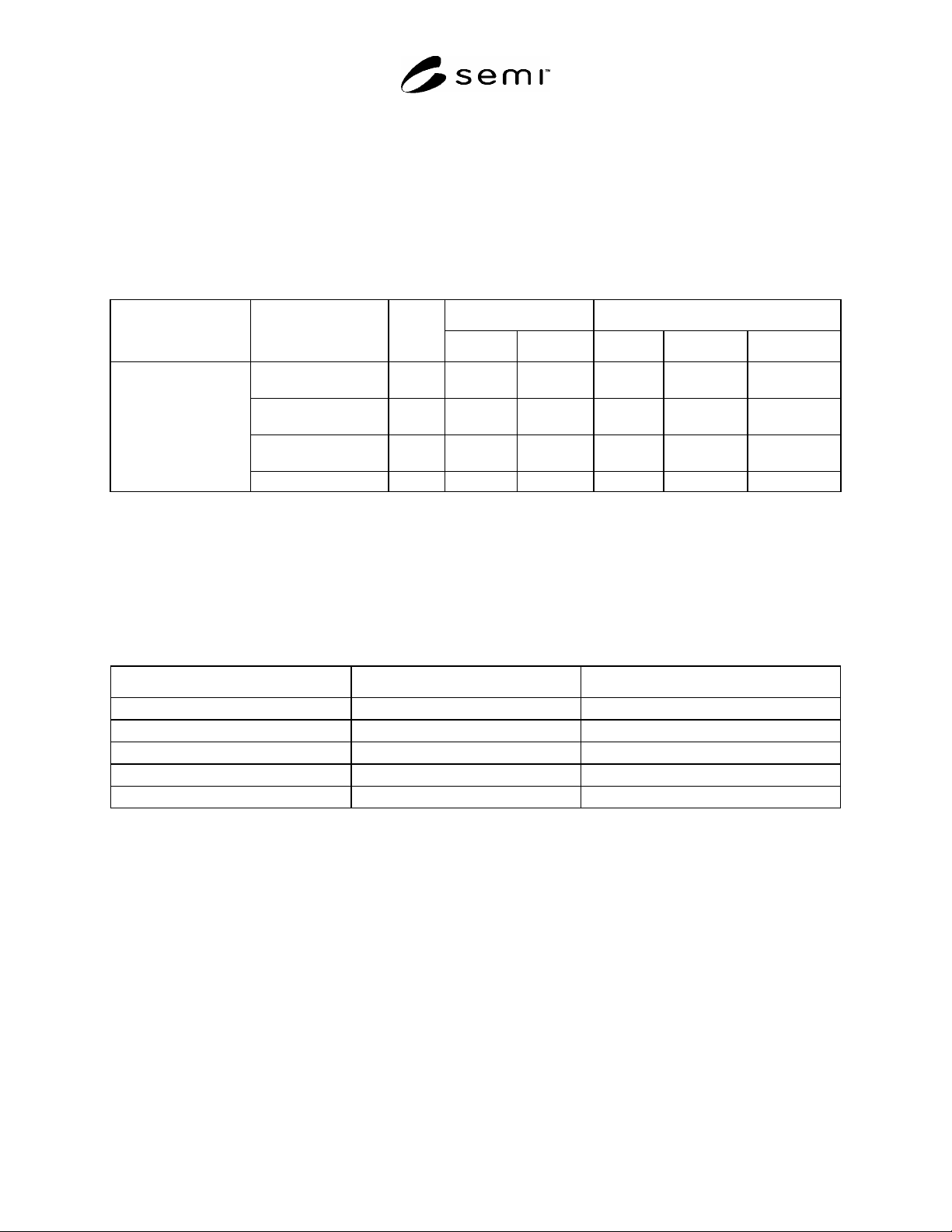
Table 9 Alarm List Table
Danger Affected
Equipment Cfg. Alarm Text ALID
Potential Imminant Operator Equipment Material
vehicle obstruction*
(exceeded timeout)
X X
transport system
equipment failure*
X X X
Carrier Handoff
Parallel I/O failure*
X X X X
OHT, OHS, RGT,
AGT, and DWC
database error* X X
10.3 Alarm ID, Alarm Set/Cleared Event Table
10.3.1 The Alarm ID, Alarm Set/Cleared Event table documents the association of each ALID to a set and cleared
event as required by SEMI E30. See SEMI E30 for further reference. The supplier is responsible for supplying
documentation associated with these alarm definitions. Each alarm will have associated alarm set and cleared
collection event identifiers (CEID
set
and CEID
clear
). Table 10 contains example alarm event information that is
intended to be replaced when the IBSEM equipment supplier documents its interface.
Table 10 Alarm ID, Alarm Set/Cleared Event Table
Alarm ID (ALID) Alarm SET Event (CEID
set
) Alarm CLEARED Event (CEID
cleared
)
11 Remote Commands
11.1 The purpose of this section is to identify remote commands, command parameters, and valid commands versus
states pertinent to the SEM. All remote commands identified in this section follow the format of the S2,F41 Host
Command Send SECS-II message except for the TRANSFER and STAGE commands, which follow the S2,F49
Enhanced Remote Command Send SECS-II message.
11.2 Requirements
The equipment shall support the SEMI E30 (according to the GEM capabilities required per §13) required
remote commands.
All the remote commands defined by IBSEM are required to be implemented as specified.
The alphanumeric strings defined by IBSEM for RCMD and CPNAME are required.
A completed table must be generated where an “X” is placed in the table for each state that a given command is
valid.