semi合集-English.pdf - 第7763页
SEMI T12-0305 © SEMI 2004, 2005 42 RELATED INFORMATION 2 AN EXAMPLE ON EQUIPMEN T WITH SECS-II AND GEM NOTICE: This related information is not an official part of SEMI T12 and was derived fro m the work of the originatin…
SEMI T12-0305 © SEMI 2004, 2005 41
RELATED INFORMATION 1
USE CASE OF TRACKING JIGS AND IMPLEMENTS
NOTICE: This related information is not an official part of SEMI T12 and was derived from the work of the
originating task force. This related information was approved for publication by full letter ballot procedures on
January 9, 2004.
R1-1 Use Case Diagram
R1-1.1 Use Case diagram is one of good start point to understand and analyze problem domain. It is often used
before modeling a system.
R1-1.2 Use Case diagram consists of Actors and Use Cases. A use case defines something expected to a system
related to an actor or between actors. All use cases build up whole system.
R1-2 Use Case Diagram of Attachment Tracking
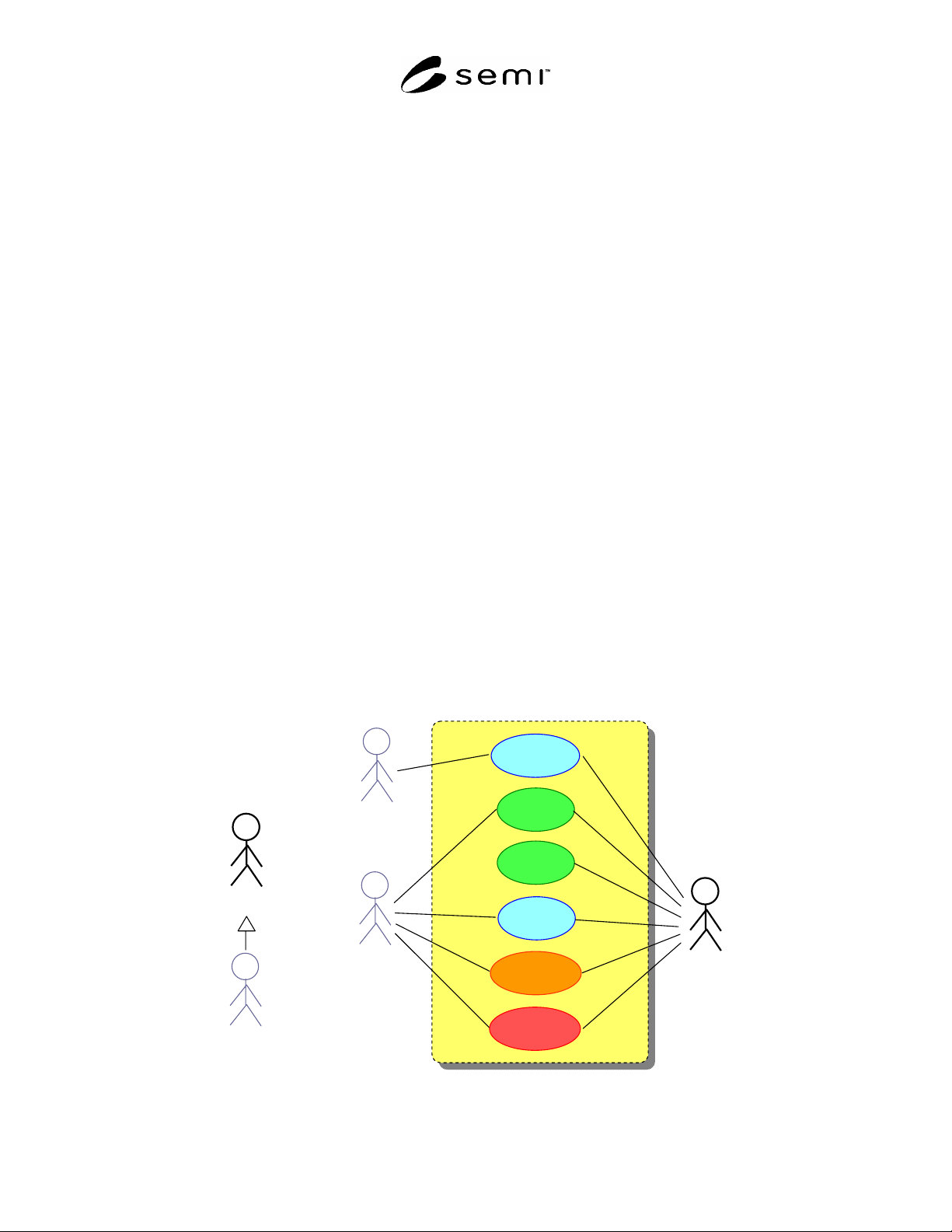
R1-2.1 Figure R1-1 is for use cases of Jigs and Implements.
R1-2.2 Update Inventory — Jig Handler updates when it takes jig to or brings from equipment. Tool updates when
jig has arrived (and verified) and removed.
R1-2.3 Update or Check History — Tool reports when it uses some amount of cycle or such things as maintenance,
inspection or problem happens. Superintendent checks history of a jig. Provided information is based on data in
database with inquiry about current delta on equipment.
R1-2.4 Manage Exception — Tool reports when some exception happens. Superintendent instructs something.
Tool replies.
R1-2.5 Invoice — Superintendent send invoice to let tool know which jig is delivered. Tool asks whether received
jig is right one or not. If something is wrong, an exception process is required.
R1-2.6 Manage Expiration — When Jig is used repeatedly and it use-time or cycles reaches preset value, tool has to
make some expected action to avoid unexpected processing.
R1-2.7 Manage Exception — Superintendent configures effective period or cycle of a Jig. Tool stop using the Jig
or notify the event when it is expired.
Update
History
Superinten
dent
Too l
(
Ji
g
User
)
Check
History
Invoice
Manage
Expiration
Update
Inventory
Jig
Handler
Superinten
dent
Too l
(
Ji
g
User
)
Manage
Exception
Figure R1-1
SEMI T12-0305 © SEMI 2004, 2005 42
RELATED INFORMATION 2
AN EXAMPLE ON EQUIPMENT WITH SECS-II AND GEM
NOTICE: This related information is not an official part of SEMI T12 and was derived from the work of the
originating task force. This related information was approved for publication by full letter ballot procedures on
January 9, 2004.
R2-1 GEM Level Example
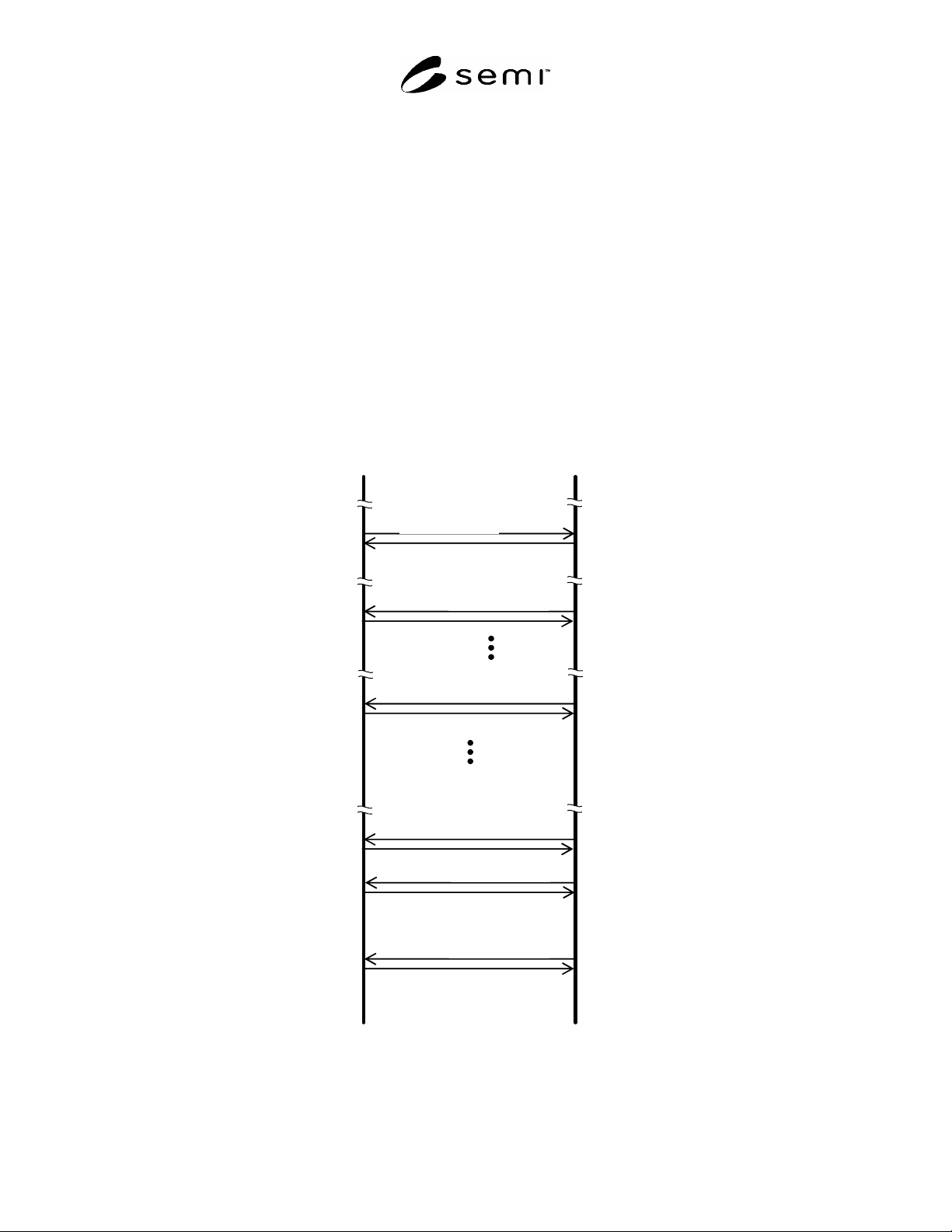
R2-1.1 This example is a possible implementation of attachment tracking capabilities “Acquisition of Minimum
Tracking Information” and “Action on Expiration” with SEMI E5 (SECS-II) and SEMI E30 (GEM).
R2-1.2 Great many equipment and production lines adopt GEM level implementation around the world because it
was standardized more than ten years ago and was the only unified communication standard between equipment and
factory host computer for long period.
R2-2 Example Scenario
R2-2.1 An example scenario consists of setting up expiry, tracing data of an attachment and hitting expiration.
Host
Equipment
S2F15 (ECS)
or S2F41 (HCS)
S2F16 (ECA)
or S2F42
(
HCA
)
Settin
g
Ex
p
iration
A
cknowled
g
e
S6F11
(
ERS
)
S6F12
(
ERA
)
Acknowled
g
e
C
y
cle Increment
S6F11
(
ERS
)
S6F12
(
ERA
)
Acknowled
g
e
Use-Time Increment
S6F11
(
ERS
)
S6F12
(
ERA
)
Acknowled
g
e
Expired and
Equipment Stops
S5F1
(
ARS
)
S5F2
(
ARA
)
Acknowled
g
e
A
larm Raised
S5F1
(
ARS
)
S5F2
(
ARA
)
Acknowled
g
e
A
larm Cleared
Figure R2-1
SEMI T12-0305 © SEMI 2004, 2005 43
RELATED INFORMATION 3
AN EXAMPLE ON EQUIPMENT WITH SECS-II, GEM AND OSS
NOTICE: This related information is not an official part of SEMI T12 and was derived from the work of the
originating task force. This related information was approved for publication by full letter ballot procedures on
January 9, 2004.
R3-1 Example with GEM plus OSS
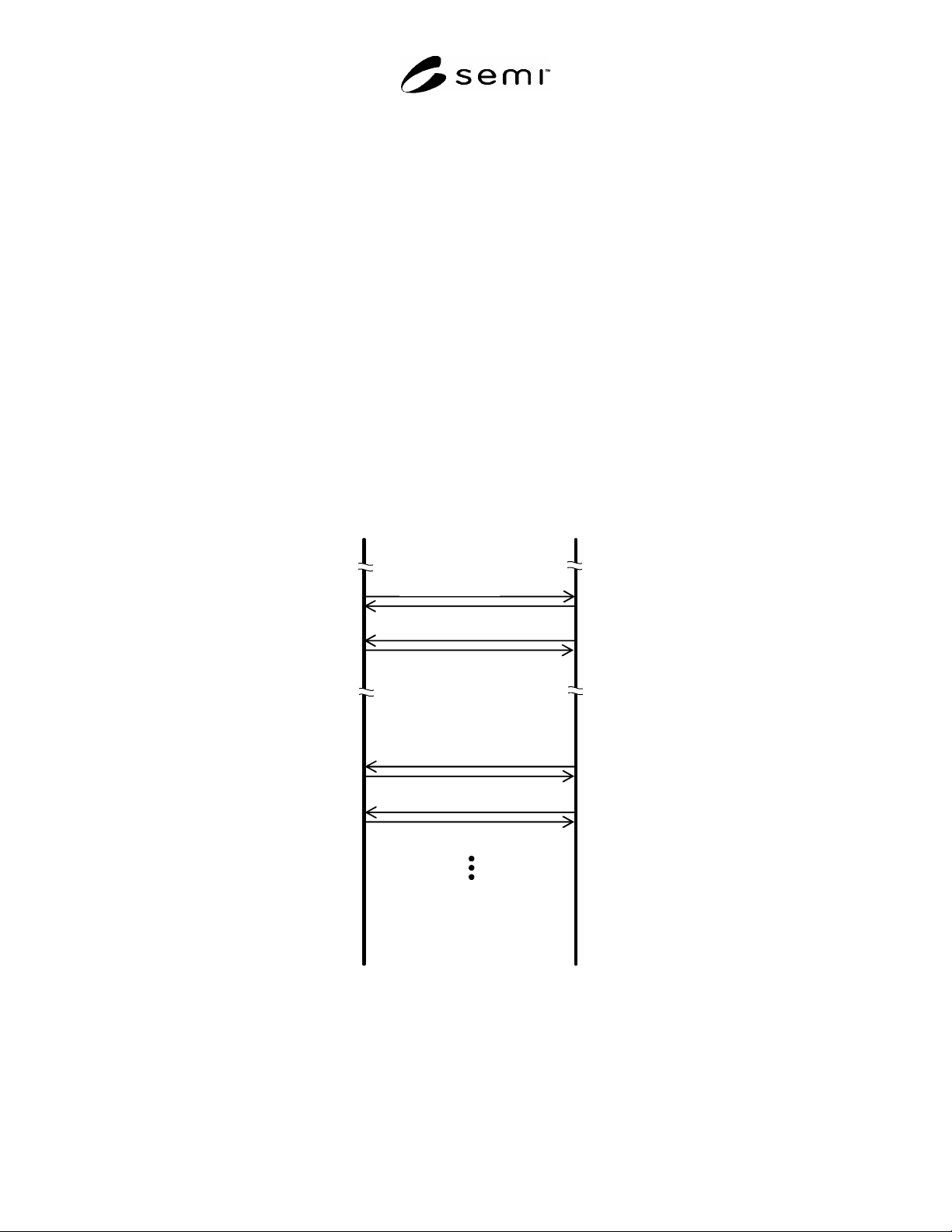
R3-1.1 This example is a possible implementation of attachment tracking capabilities “Acquisition of Minimum
Tracking Information”, “Action on Expiration” and “Identification and Verification of Attachments” with SEMI E5
(SECS-II), SEMI E30 (GEM) and SEMI E39 (OSS).
R3-1.2 Object base system modeling and OSS has been recognized recently by equipment users especially in 300
mm fabs as handy tools to access data on equipment because the allows accessing unit by object rather than all
values or just one data.
R3-2 Example Scenario
R3-2.1 An example scenario consists of verification of attachment/setting up expiry, tracing data of an attachment
and hitting expiration.
R3-2.2 Verification of Attachment/Setting up Expiry
Host
Equipment
S14F9 (COR)
S14F10 (COA)
Sendin
g
Invoice
A
cknowled
g
e
S6F11
(
ERS
)
S6F12
(
ERA
)
Acknowled
g
e
Invoice object has
been created
S6F11
(
ERS
)
S6F12
(
ERA
)
Acknowled
g
e
Secondment object
has been created
A
n attachment
has arrived
Equipment verifies
and it is ri
g
ht one.
Expiry objects has
been created, using
Invoice information
S14F19
(
GSR
)
S14F20
(
GSA
)
Acknowled
g
e
update:
(
De
p
loied
)
HistoryBuffer object
has been created
Figure R3-1