semi合集-English.pdf - 第6817页
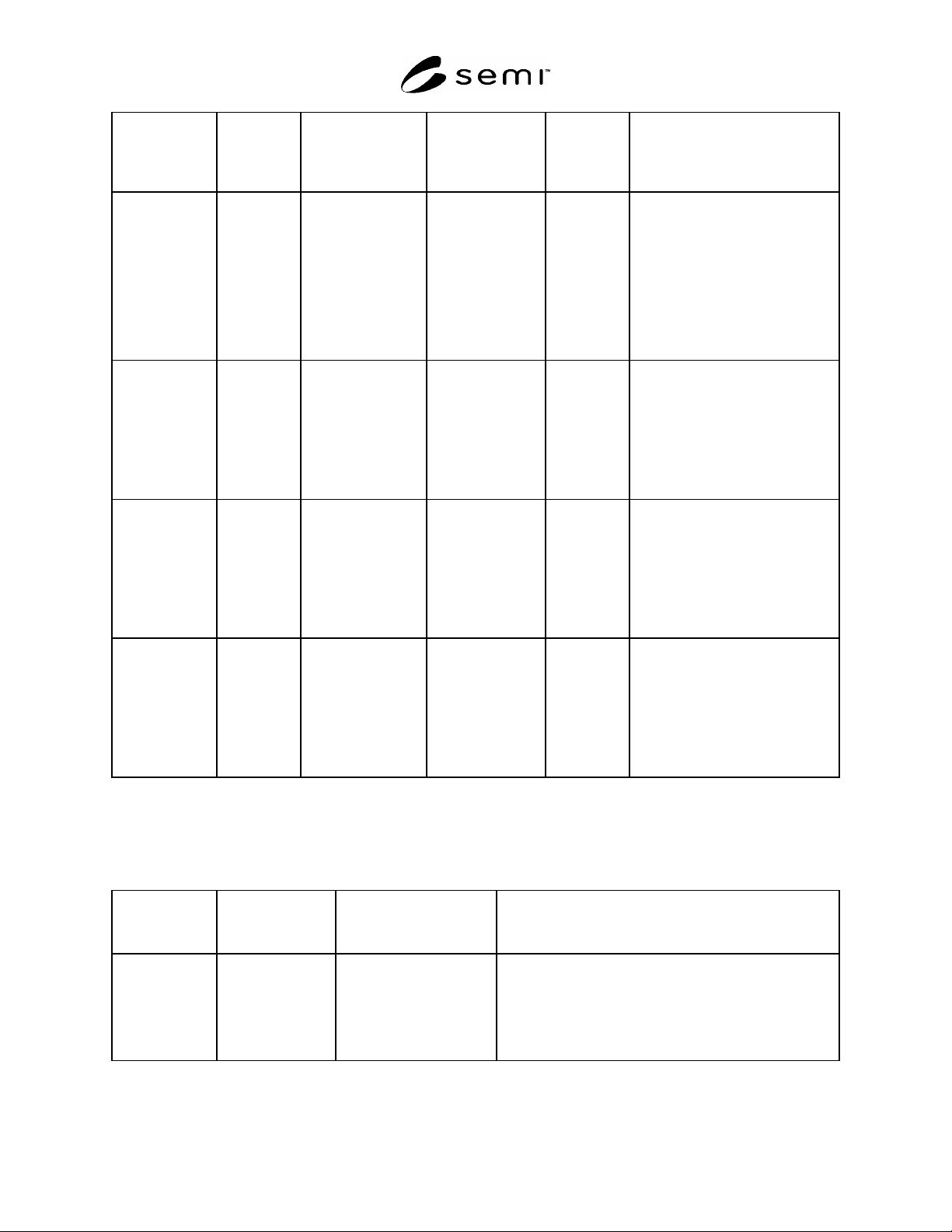
SEMI S2-0703a E © SEMI 1991, 2004 46 Optical Energy Physical Quantity Measured (units) Access Limit Testing Methods Visible Light 1 400 nm to 700 nm (e.g., heating lamps) Irradiance µ W/cm 2 (See NOTES 1, 2, and 3.) Radi…
SEMI S2-0703a
E
© SEMI 1991, 2004 45
Energy
Category
Physical
Quantity
Measured
(units)
Operator-
Accessible Limit
Maintenance-
and Service-
Accessible Limit
Pacemaker
Labeling
Level
Testing Methods
Radio-
frequency
Field
2
100 kHz to
100 MHz
(e.g., RF used
to generate
plasma)
Induced
current and
contact
current
(mA)
18 mA through
both feet
9 mA through each
foot
9 mA contact
40 mA through
both feet
20 mA through
each foot
20 mA contact
NA Contact instrument vendor for
suitable instrument based on
frequency and emission
characteristics.
Measurement of induced and
contact currents for freq. < 100
MHz should be made when
approaching 20% of the
applicable electric field emission
limit.
Radio-
frequency
Field
2
3 kHz to
300 MHz
(e.g., RF used
to generate
plasma)
Electric
Field
Strength
(V/m) (See
NOTE 1.)
Frequency
dependent (see
ANSI/IEEE
C95.1).
20% of
Uncontrolled limit
in Table 2 of
C95.1
Frequency
dependent (see
ANSI/IEEE
C95.1).
20% of
Controlled limit
in Table 1 of
C95.1
NA Use a diode rectifier or
displacement sensor at each
location (use three axis probe or
make three mutually orthogonal
measurements at each location).
Measurements should be made at
20 cm from the surface.
Radio-
frequency
Field
2
3 kHz to
300 MHz
(e.g., RF used
to generate
plasma)
Magnetic
Field
Strength
(A/m) (See
NOTES 1
and 2.)
Frequency
dependent (see
ANSI/IEEE
C95.1).
20% of
Uncontrolled limit
in Table 2 of
C95.1
Frequency
dependent (see
ANSI/IEEE
C95.1).
20% of
Controlled limit
in Table 1 of
C95.1
NA Use a coil sensor at each location
(use three axis probe or make
three mutually orthogonal
measurements at each location)
Measurements should be made at
20 cm of the surface.
Radio-
frequency
Fields
2
300 MHz to
300 GHz
(e.g., RF used
to generate
plasma)
Power
Density
(mW/cm
2
)
(See NOTE
1.)
Frequency
dependent (see
ANSI/IEEE
C95.1).
20% of
Uncontrolled limit
in Table 2 of
C95.1
Frequency
dependent (see
ANSI/IEEE
C95.1).
20% of
Controlled limit
in Table 1 of
C95.1
NA Use a diode rectifier or
thermocouple at each location
(use three axis probe or make
three mutually orthogonal
measurements at each location).
Measurements should be made at
20 cm of the surface.
NOTE 1: It is assumed that electric and magnetic fields exist separately at frequencies below 300 MHz. It is assumed that electric and magnetic
fields exist as a combined entity (electromagnetic radiation) at higher frequencies. Two evaluations are needed at frequencies <300 MHz and only
one (usually made by measuring the electric field) at higher frequencies.
NOTE 2: 1 gauss (G) 79.55 amperes per meter (A/m). 1 tesla (T) = 10,000 G, 1 millitesla (mT) = 10 G.
Table A5-2 Optical Energy
Optical Energy Physical Quantity
Measured
(units)
Access Limit Testing Methods
Infrared
Energy
1
700 nm to
1 mm
(e.g., heating
lamps)
Irradiance
W/m
2
(See NOTES 1, 2,
and 3.)
Radiance
W/m
2
- sr
Wavelength dependent
20% of the applicable
exposure limits.
(See Reference 1.)
Thermocouple, thermopile, pyroelectric, photoelectric
Direct measurements locating the maximum irradiance
and orientation of the energy at the closest approach to
the view port(s) or accessible leakage point(s).
SEMI S2-0703a
E
© SEMI 1991, 2004 46
Optical Energy Physical Quantity
Measured
(units)
Access Limit Testing Methods
Visible Light
1
400 nm to
700 nm
(e.g., heating
lamps)
Irradiance
µW/cm
2
(See NOTES 1, 2,
and 3.)
Radiance
W/m
2
- sr
Wavelength dependent
20% of the applicable
exposure limits.
(See Reference 1.)
Thermocouple, thermopile, pyroelectric, photoelectric
Direct measurement locating the maximum irradiance and
orientation of the light energy at the closest approach to
view port(s) or accessible leakage point(s).
Ultraviolet
Energy
1
315 nm to
400 nm
(e.g., plasma,
stepper)
Irradiance
mW/cm
2
(See NOTES 1
and 2.)
0.2 mW/cm
2
Photoelectric detectors with filters and or controlled
phosphors
Direct measurements locating the maximum irradiance
and orientation of the energy at the closest approach to
the view port(s) or accessible leakage point(s).
Ultraviolet
Light
1
180 nm to
315 nm
(e.g., plasma,
stepper)
Effective
Irradiance
µW/cm
2
(See NOTE 4.)
0.02 W/ cm
2
Photoelectric detectors with filters and/or controlled
phosphors (See NOTE 5.)
Direct measurements locating the maximum irradiance
and orientation of the energy at the closest approach to
the view port(s) or accessible leakage point(s).
NOTE 1: “Irradiance” is essentially the same as “power density.”
NOTE 2: Lamp manufacturer data can sometimes be used to estimate and evaluate exposures using a spreadsheet.
NOTE 3: These guidelines cover visible, IR-A, and IR-B, and are frequency dependent. Separate evaluations may be needed for thermal or
photochemical retinal hazards and infrared eye hazards.
NOTE 4: “Effective irradiance” is irradiance adjusted to account for the wavelength-dependent biological hazard. Permissible exposure time =
0.003 J/cm2 divided by the effective irradiance.
NOTE 5: Instrumentation is commercially available that accounts for the wavelength dependence of the standard and gives results in effective
irradiance.
A5-5 References
1. 1996 TLVs and BEIs Threshold Limit Values for Chemical Substances and Physical Agents Biological
Exposure Indices, ACGIH, Cincinnati, OH
2. ANSI/IEEE Standard for Safety Levels with Respect to Human Exposure to Radio Frequency Electromagnetic
Fields, 3 kHz to 300 GHz, C95.1-1991, Piscataway, New Jersey
3. Guidelines on Limits of Exposure to Broad-Band Incoherent Optical Radiation (0.38 to 3 M), Health Physics
Vol. 73, No. 3 (September), pp.539-554, 1997
4. ICNIRP 1994 “Guidelines on Limits of Exposure to Static Magnetic Fields,” Health Physics Vol 66 (1)
(January), pp. 100-106, 1994
5. Interim Guidelines on the Limits of Exposure to 50/60 Hz Electric and Magnetic Fields, IRPA/ICNIRP
Guidelines, Health Physics Vol. 58, No. 1 (January), pp. 113-122, 1990
SEMI S2-0703a
E
© SEMI 1991, 2004 47
APPENDIX 6
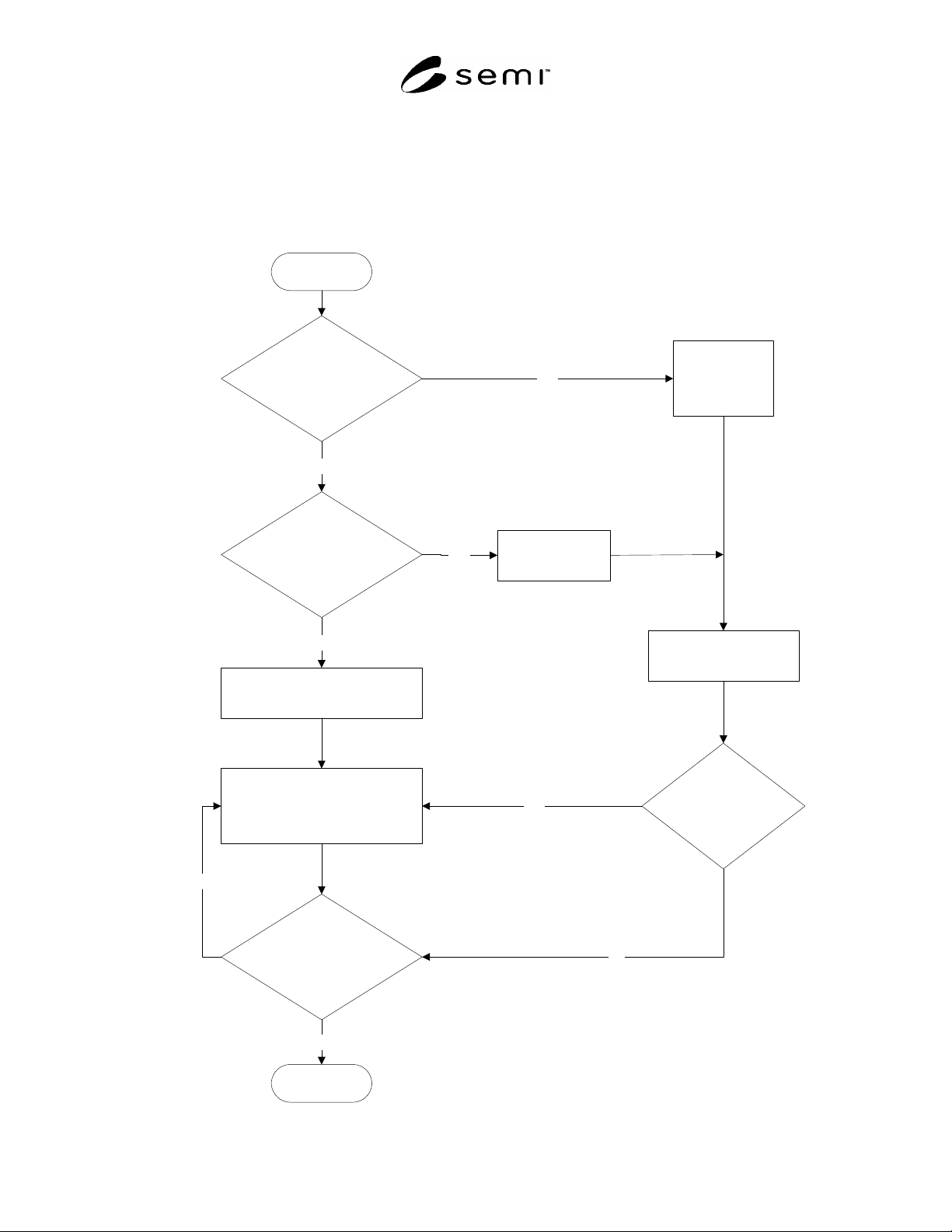
FIRE PROTECTION: FLOWCHART FOR SELECTING MATERIALS OF
CONSTRUCTION
NOTICE: The material in this appendix is an official part of SEMI S2 and was approved by full letter ballot
procedures on December 15, 1999 by the North American Regional Standards Committee.
Construct of
materials which do
not propagate flame
*
Can the system
reasonably be constructed
of materials which do not
propagate flame
*
?
Start
Construct from
non-combustible
materials
Can the system
reasonably be constructed
of non-combustible
materials?
Is there a significant fire
risk, based on process
chemicals?
End
No
No
Does a qualified
party (see Section 14.2.1)
accept the risk assessment and
engineering controls?
No
Yes
Yes
Yes
Design engineering controls to mitigate
the fire risks based on materials of
construction and process chemicals.
This may include fire detection and
suppression systems.
No
Yes
Assess the fire risks based on the
materials of construction and process
chemicals.
Assess the fire risks based
on the process chemicals.
*beyond the ignition zone with or
without the continued application of
the ignition source